Stress has ended, but avoidance comes later: a molecular clue in the amygdala
How can a brief hormonal surge connect with behavior a week later? A mouse study follows the amygdala’s ventral-hippocampal projection to a clue involving Sgk1.
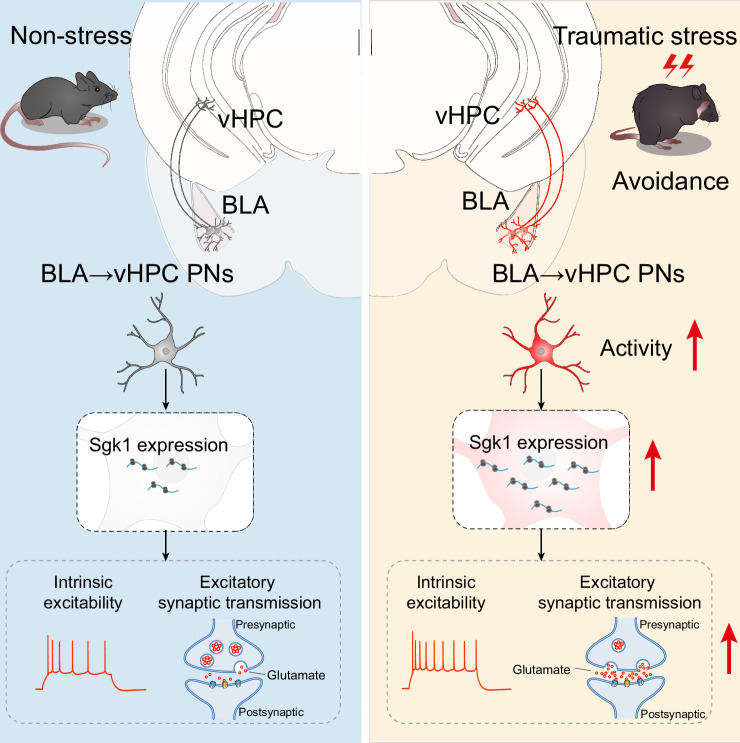
Intense stress has passed, yet some behavioral changes do not appear immediately. In observations a week later, mice explore the open-field center and elevated-maze open arms less. What happens in the intervening time? A 2026 Nature Communications study follows a transient corticosterone surge into the amygdala and its ventral-hippocampal projection, identifying Sgk1. The story concerns how this molecule interacts with stress experience to shape circuit and behavioral responses.
A week after stress, BLA neurons projecting to ventral hippocampus show increased activity and Sgk1 expression. Reducing Sgk1 function attenuates these changes; increasing it enhances responses to weaker stress without producing the same effects in unstressed mice.
Contents · 6 sections
Remembering danger and showing avoidance have different timelines
After stronger footshock over two days, mice already showed more contextual freezing on day one. Reduced open-field center and open-arm exploration appeared at one week, with overall distance preserved. Females showed a similar avoidance time course, separating the timelines of fear-related memory and avoidance.
Weaker or shorter stress produced different longer-term outcomes. Intensity, duration and observation time jointly shaped the behavioral pattern. The team focused on delayed approach–avoidance changes and sought neural clues that could span the interval.
Stronger activity appears in cells with a particular destination
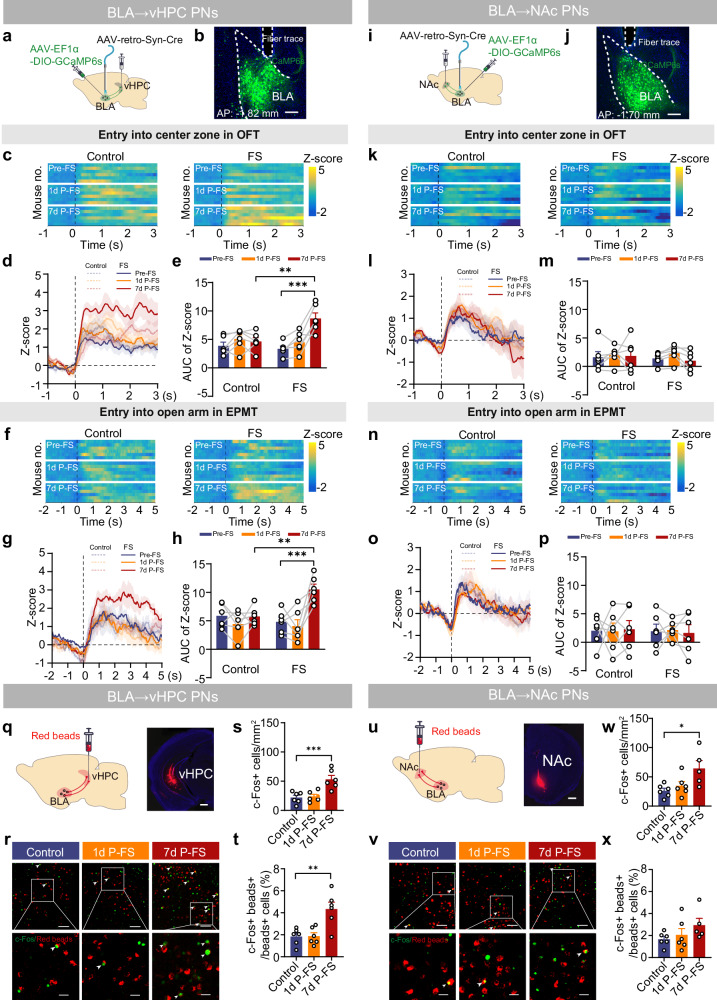
At one week, BLA population calcium signals increased during center or open-arm entry. Separating cells by their projection targets localized the difference to ventral-hippocampal (vHPC) cells, without the same change in nucleus-accumbens (NAc) cells. The destination of an amygdala output became a key clue.
Slice recordings showed more ready firing and more frequent miniature excitatory events in vHPC-projecting cells on day seven, without parallel amplitude or inhibitory changes. Inhibiting this projection-defined population reduced avoidance. In vivo activity, electrophysiology and behavior converged on cells for further molecular investigation.
Source: Zou JX et al. · Nature communications · CC BY
Original figure and English caption ↗
Following the circuit after the hormonal peak subsides
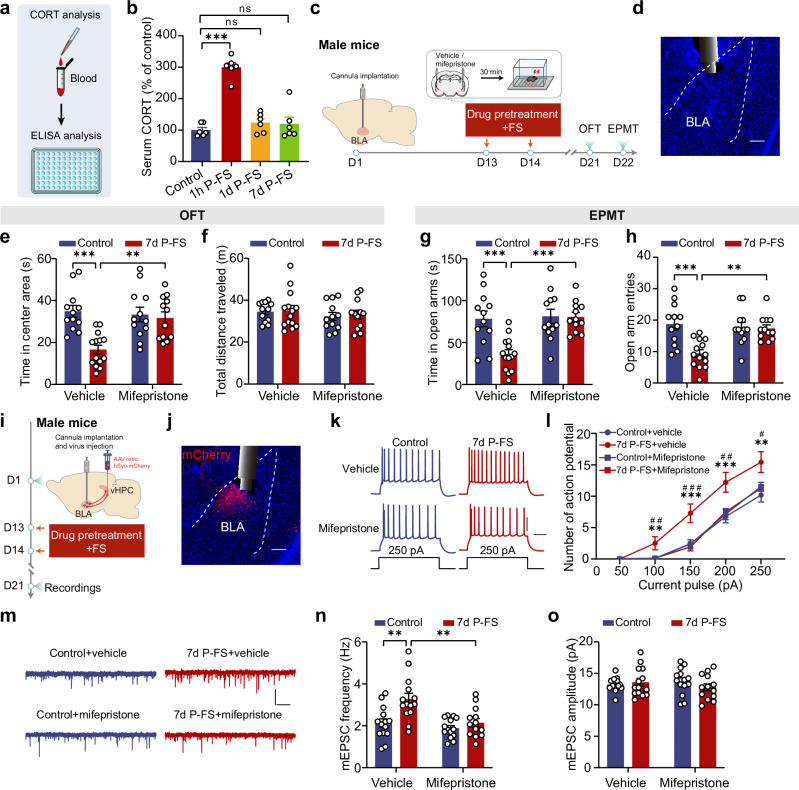
Serum corticosterone rose an hour after stress, without the same elevation at one day or one week. Reducing its synthesis or blocking glucocorticoid receptors (GR) before stress attenuated later avoidance and cellular changes; MR blockade did not have the same effect. Local BLA GR intervention supplied related evidence in both sexes.
The early surge subsided while later changes still emerged, and transcripts for the two receptor classes did not clearly increase. Screening GR-related molecules offered a way to connect transient stress with longer cellular adaptation, turning a behavioral delay into a molecular question.
Source: Zou JX et al. · Nature communications · CC BY
Original figure and English caption ↗
Sgk1 emerges, with the projection target still important
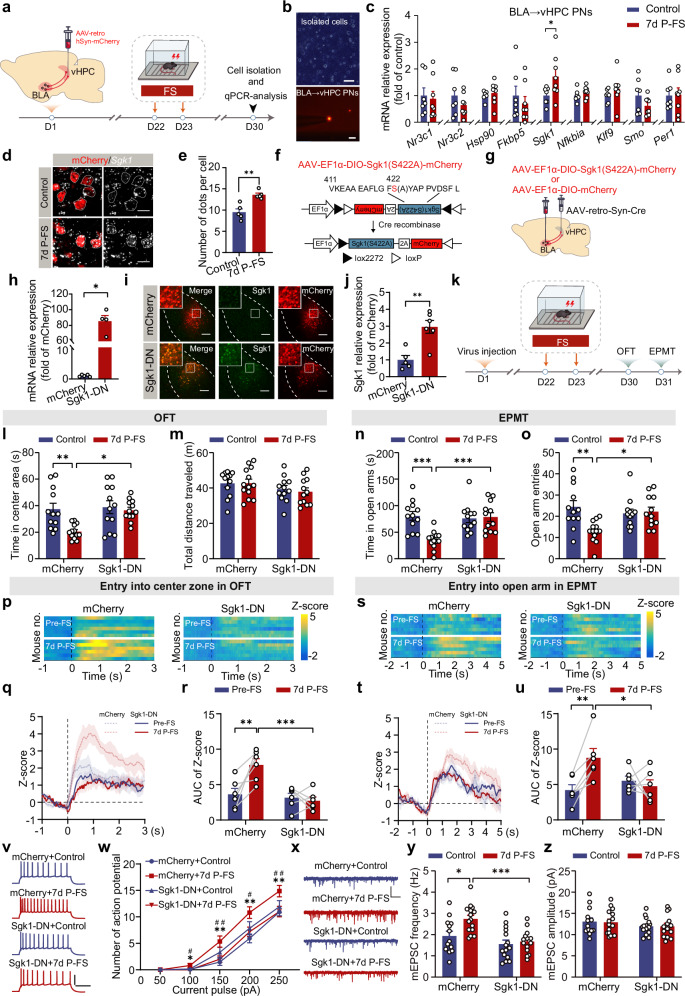
Serum- and glucocorticoid-regulated kinase 1 (Sgk1) came into view. At one week, its transcripts increased in vHPC-projecting BLA cells, but not NAc-projecting cells; several other GR-related genes were unchanged. The molecular pattern echoed the earlier projection-specific activity differences.
Reducing Sgk1 function in these cells beforehand attenuated later avoidance, calcium responses, firing and increased excitatory-event frequency. This extended Sgk1 from an expression candidate to a functional contributor, opening questions about its influence on inputs and intrinsic firing.
Source: Zou JX et al. · Nature communications · CC BY
Original figure and English caption ↗
More Sgk1 strengthens the response to weaker stress
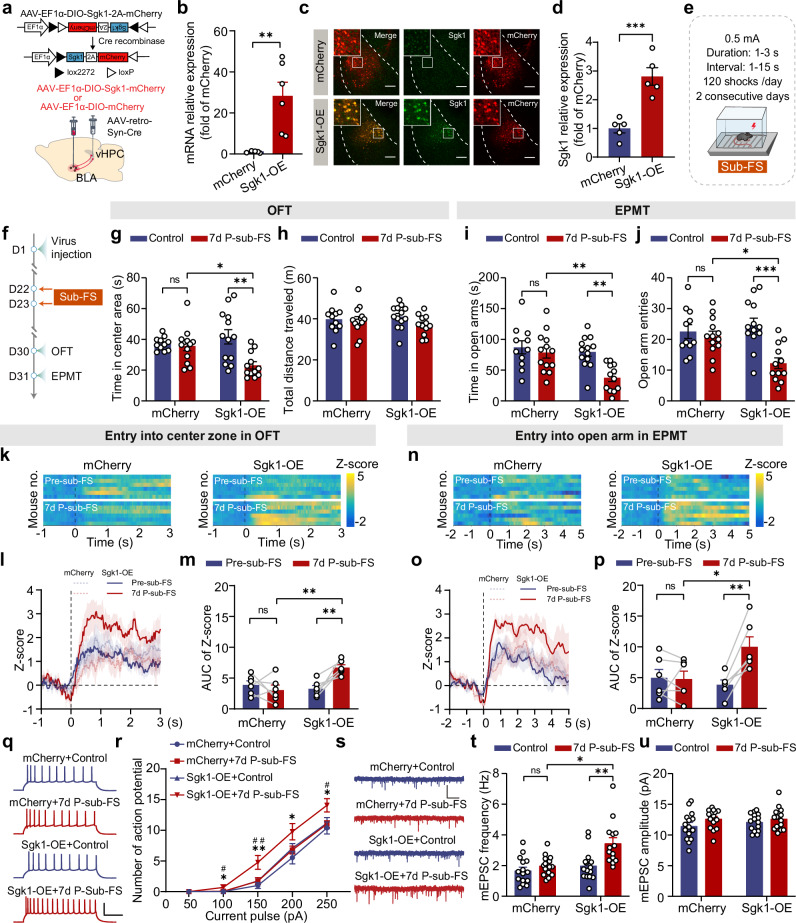
A revealing result followed: increasing Sgk1 alone did not clearly change avoidance or activity in unstressed mice. Adding weaker stress, which produced no clear avoidance in controls, led to stronger avoidance and cellular changes in overexpressing mice. Molecular state interacted with experience to change the outcome.
The pattern suggests altered stress susceptibility. The authors further propose feedback between Sgk1 and GR that could amplify a weaker stress response. This feedback model awaits direct testing, while the findings offer a molecular clue to why related experiences can yield different responses.
Source: Zou JX et al. · Nature communications · CC BY
Original figure and English caption ↗
Understanding stress includes understanding its delay
From elevated hormone levels an hour after stress to molecular, cellular and behavioral changes a week later, the study places timing within the circuit story. Different BLA outputs respond differently, and Sgk1 action depends on stress context, offering a more specific account of delayed avoidance.
The findings come from mouse models, with both sexes included in selected behavioral and GR experiments and distinct cohorts for detailed projection and molecular work. Testing intervention after avoidance is established, identifying Sgk1 targets and resolving collateral effects may reveal which changes remain adjustable and how stress leaves lasting circuit effects.
Source: Zou JX et al. · Nature communications · CC BY
Original figure and English caption ↗