Why does a familiar companion keep this circuit responding? Amygdala–hippocampal clues in fragile X mice
From choices between familiar and unfamiliar companions to a signal that fails to fade, a male-mouse study follows the links among Fmr1, ERK and social-novelty preference.
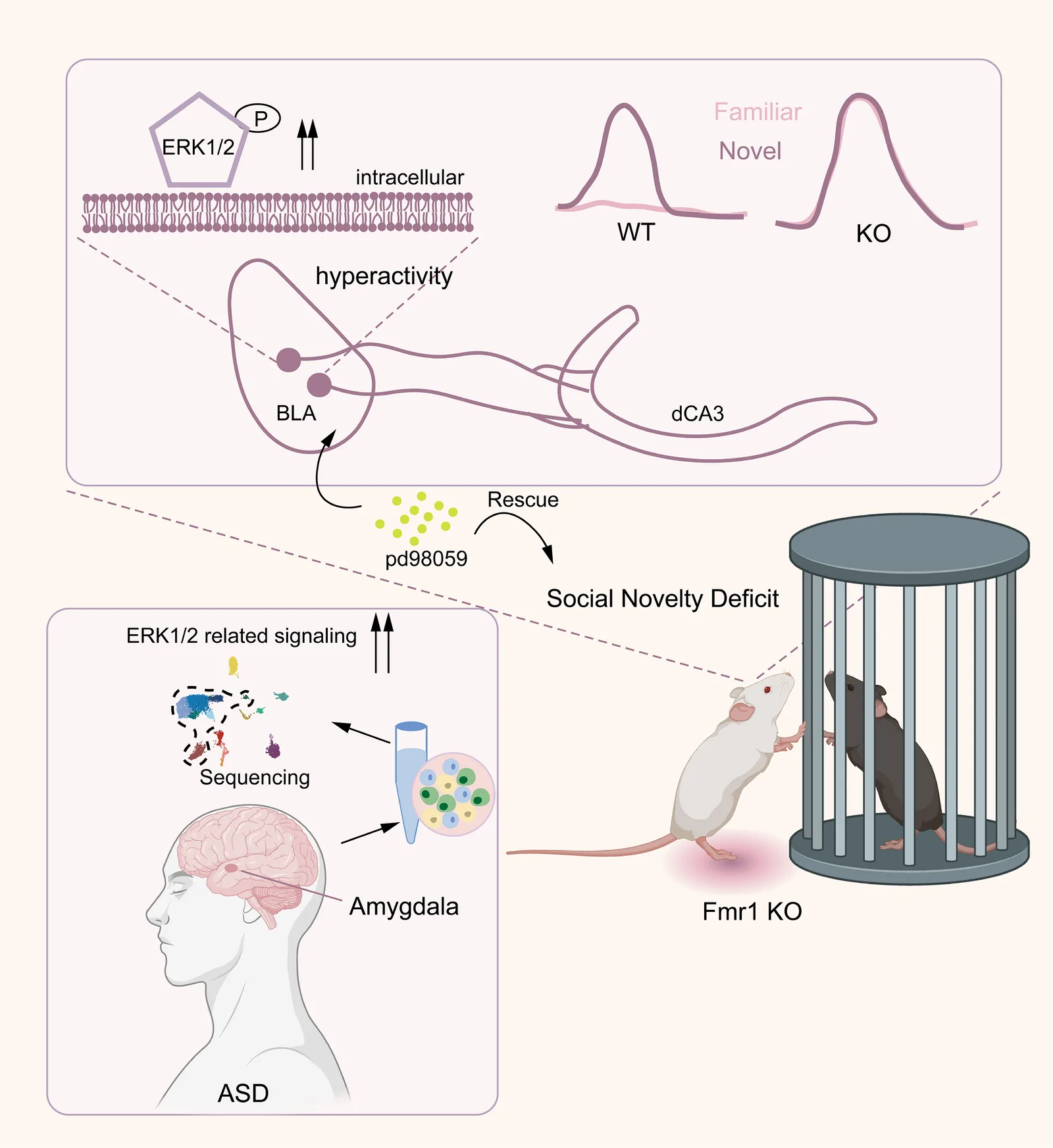
A first encounter and a reunion usually invite different amounts of exploration. Mice, too, often spend more time with an unfamiliar companion than one they already know. How does the brain let familiar information recede while giving new encounters attention? A 2026 EBioMedicine study found that an amygdala-to-hippocampus connection keeps responding strongly to familiar companions in male mice modeling fragile X syndrome. Following this clue, the researchers connected altered social-novelty preference with Fmr1 loss, ERK signaling and neuronal state.
The abnormality is most apparent during familiar interactions. Changing the timing of BLA–dCA3 activity, or reducing local ERK-pathway activation, alters how mice explore familiar and unfamiliar companions.
Contents · 7 sections
Sociable, but less drawn to a new companion
Fmr1 encodes FMRP, which participates in cellular protein-expression regulation. Mice lacking the gene are an important model for fragile X mechanisms. In this study, they still preferred a companion to an empty cage. The change appeared in the next choice: when familiar and unfamiliar companions were presented together, the usual preference for the newcomer was less apparent. Social approach and novelty preference diverged.
After social discrimination, model mice showed stronger activity-related labeling in basolateral amygdala (BLA) and dorsal hippocampal CA3 (dCA3). Anatomical and electrophysiological evidence linked the two nodes: an excitatory BLA population directly influences dCA3. The question became more specific: how does this connection respond to a newcomer and to a familiar companion?
A signal that fails to fade with familiarity
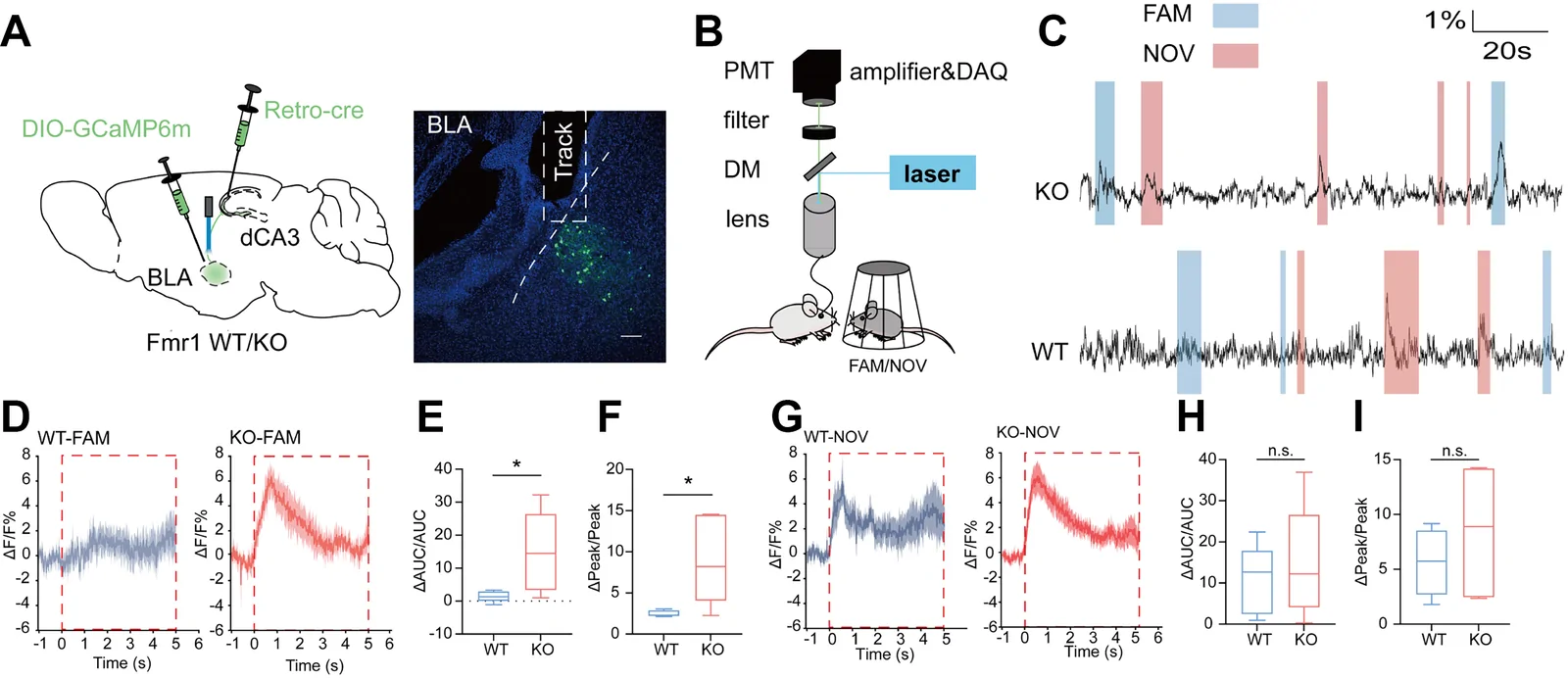
In controls, calcium signals in the relevant BLA population rose briefly during unfamiliar encounters and were weaker during familiar ones. Model mice responded during both. Group differences appeared in signal area and peak during familiar interactions, while corresponding unfamiliar-interaction comparisons were nonsignificant. The abnormality was a response that failed to subside with familiarity, rather than uniform amplification of every encounter.
With repeated encounters with the same companion, control signals gradually declined; model mice lacked this adaptation. Movement and climbing did not produce the same signal pattern. Familiarity thus appeared in both exploration time and the way this connection adjusted its response with experience.
Source: Wang S et al. · EBioMedicine · CC BY-NC
Original figure and English caption ↗
The same connection, a different moment, a different result
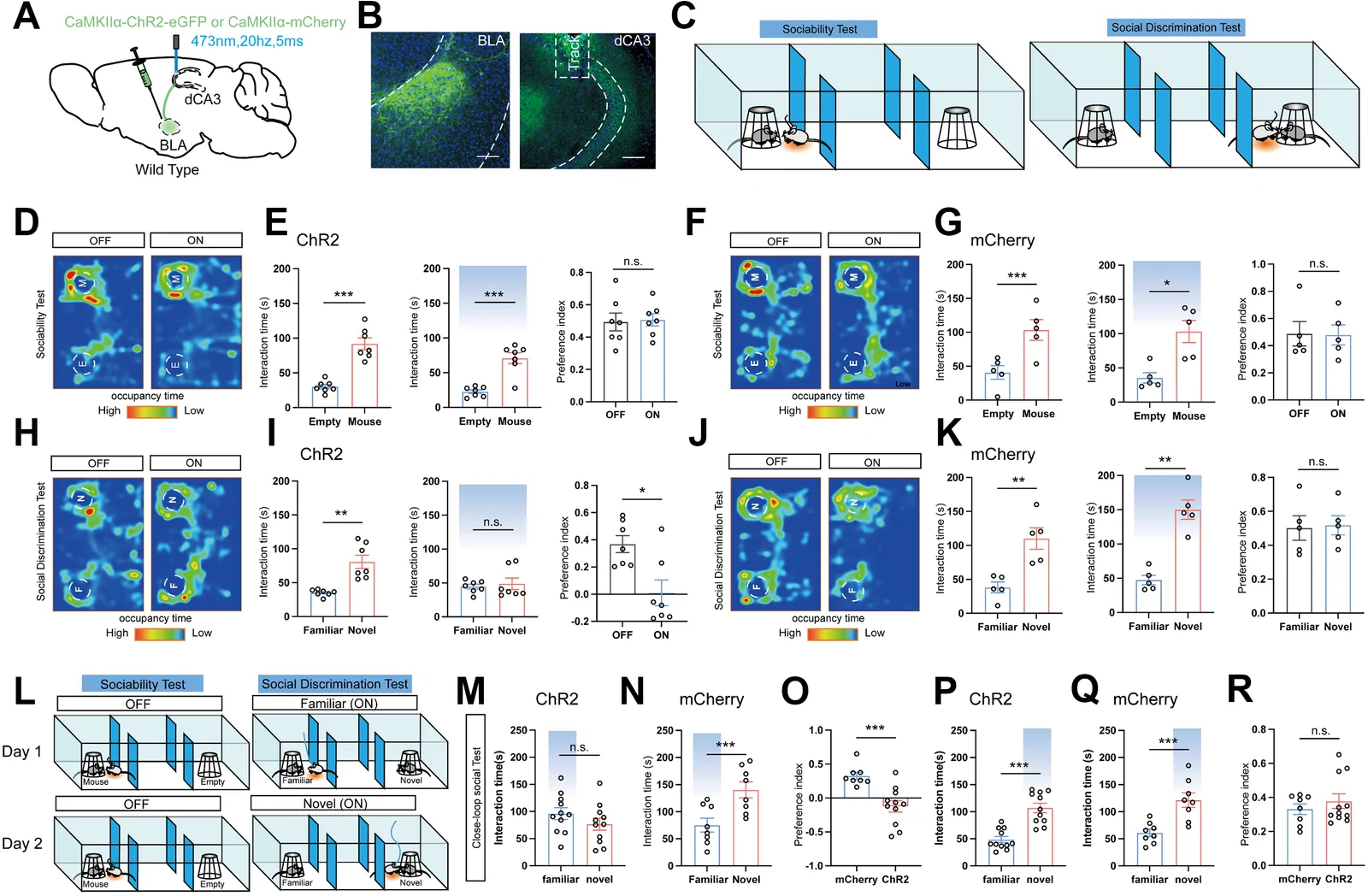
Increasing BLA–dCA3 activity in normal mice weakened novelty preference while largely preserving social approach. Timing proved revealing: increasing the signal during familiar interactions altered the choice between companions, whereas intervention during unfamiliar interactions did not have the same effect. Familiar information appeared to require a quieter response window.
Reducing the signal during familiar interactions in model mice decreased familiar-companion exploration and restored a within-group preference for the newcomer; the between-group preference-index difference remained nonsignificant. Inhibition during unfamiliar interactions also reduced exploration. Together, the findings connect this pathway with both familiar–unfamiliar processing and sustained social exploration.
Source: Wang S et al. · EBioMedicine · CC BY-NC
Original figure and English caption ↗
From circuit to molecule: clues from ERK activation
The researchers also sought molecular clues. Reanalysis of amygdala single-nucleus transcriptomes from five autistic individuals and five controls suggested increased ERK-related pathways in excitatory neurons. This general ASD sample offered a direction that resonated with the mouse work; the participant-level comparison of the proportion of high-FMR1 cells was nonsignificant.
In mouse BLA, total ERK1/2 did not change significantly, but phosphorylation increased: the shift concerned activation state. Reducing local Fmr1 expression in normal adults also changed social preference and increased some ERK phosphorylation measures. Genetic factors, molecular state and behavior converged on the same region.
Preference returns alongside some neuronal changes
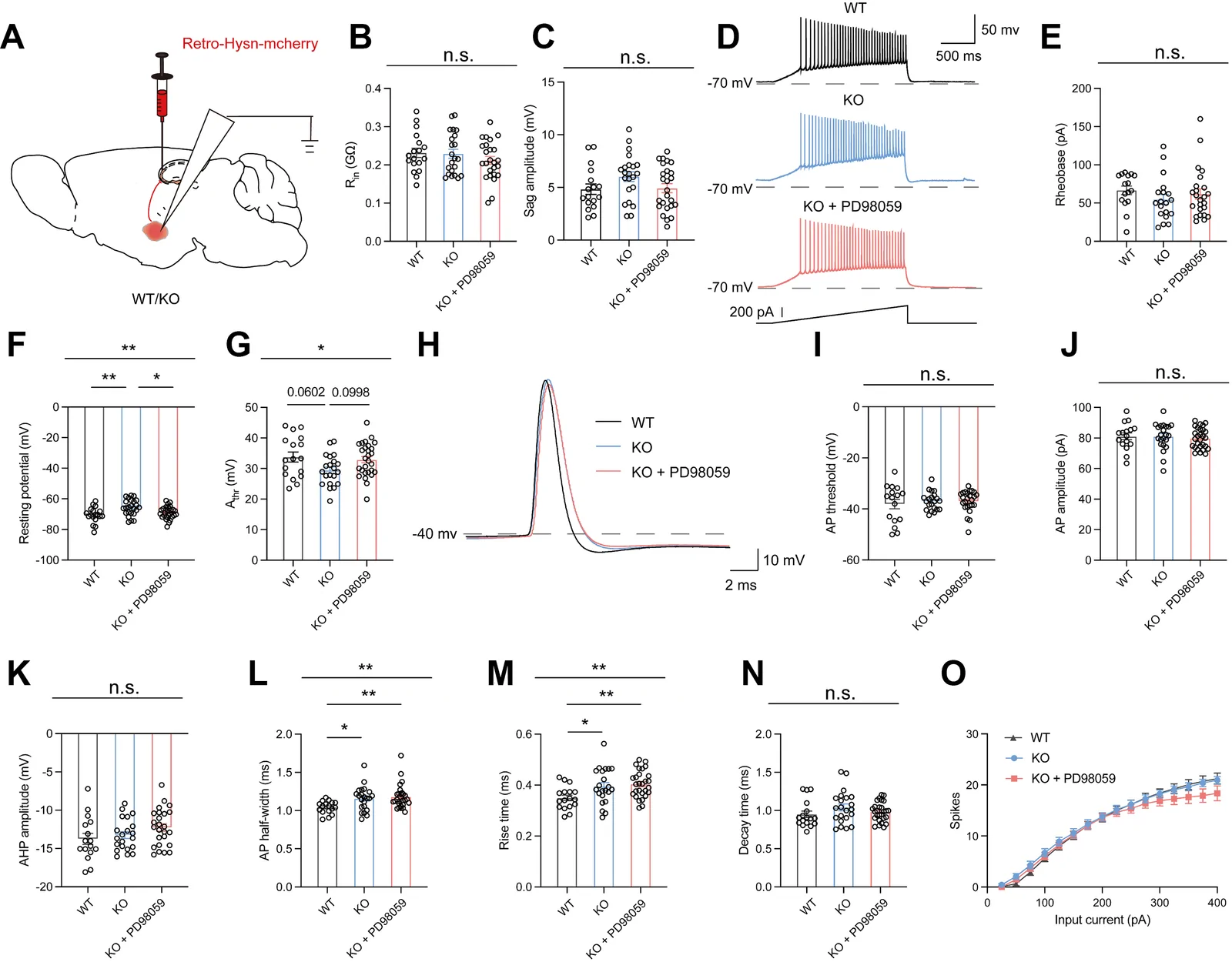
After local ERK-pathway reduction, model mice again preferred unfamiliar companions at thirty minutes and six hours, but not at twenty-four hours. General movement and anxiety-like measures showed no clear changes. This time-limited behavioral improvement prompted a further question: had the relevant neurons changed state?
The answer was selective. BLA neurons projecting to dCA3 had depolarized resting potentials, which were corrected. Abnormal action-potential half-width and rise time remained, and several other measures showed no significant differences. Other projection cells were also affected, placing the behavioral change within a local network broader than one connection.
Source: Wang S et al. · EBioMedicine · CC BY-NC
Original figure and English caption ↗
One explanation: familiar information retains an excessive novelty signal
The authors propose that an excessive response to a familiar companion could deliver an overly strong novelty signal to hippocampus, interfering with familiar–unfamiliar discrimination. This model connects repeated-interaction signals, intervention timing and exploration choices. This circuit model offers a new perspective on how familiar information is processed.
The model shifts attention from how high activity is to when it rises and when it fades. A connection that supports social interest may also change exploration of a newcomer when adaptation to a familiar companion is missing.
Bringing a broad behavioral change into a specific context
The work brings a broad social-behavior phenotype into a specific context: familiar interaction. Fmr1 loss accompanies altered ERK activation and neuronal state, alongside different BLA–dCA3 dynamics. Choosing between companions may depend not only on the strength of new information, but also on whether familiar information recedes appropriately.
The animal findings concern male-mouse exploration tasks, with possible contributions from other projections, neighboring CA2 and other hippocampal regions. The human transcriptomes provide an association. Sex differences, cellular specificity and the sequence of molecular changes remain open as this mechanism is followed further in fragile X-related social behavior.