Why do responses to the same stress differ? The difference may begin before exposure
A chronic-restraint mouse study follows prefrontal–striatal cells and links pre-stress activity peaks with later changes in selected behaviors.
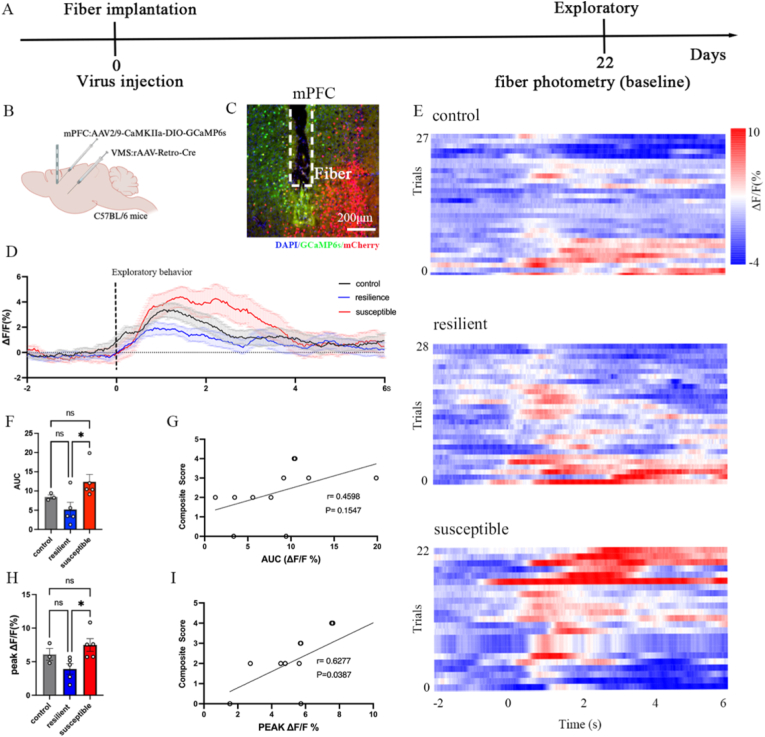
After the same ten days of restraint, some mice spend less time on open maze arms and groom longer after water spray, while others change less. Does stress create the difference, or does it have an earlier beginning? A 2026 Neurobiology of Stress study moves observation back in time, following medial prefrontal cells that project to ventromedial striatum. Mice with more pronounced later behavioral changes already had higher activity peaks before exposure, adding a baseline perspective to the stress-response story.
Projection-cell activity before stress relates to later behavior. Enhancement changes open-arm exploration and spray-evoked grooming; suppression mainly attenuates grooming changes.
Contents · 6 sections
Movement continues while exploration and grooming change
After chronic restraint, mice spent less time on open elevated-plus-maze arms and groomed longer after water spray. Open-field distance and center exploration showed no clear change, and ordinary grooming without spray remained similar. Effects appeared in defined contexts: an exposed space or a stimulus on the body changed how behavior was allocated.
Combining open-arm duration and entries with spray-evoked grooming bouts and duration, the team identified relatively susceptible and resilient groups within these tasks. Both experienced stress but responded differently. Rather than searching only for abnormalities afterward, the study returned to their initial neural activity.
An earlier clue appears in activity peaks
The medial prefrontal cortex (mPFC) contributes to stress-related behavior, and ventromedial striatum (VMS) is one of its output targets. In baseline free exploration, VMS-projecting excitatory mPFC cells had higher calcium peaks in mice later classified as relatively susceptible than in relatively resilient mice. A difference predating exposure was already related to subsequent task performance.
Across individuals, higher peaks related to higher composite behavioral scores, whereas the signal-area correlation was nonsignificant. Peaks and accumulated signal did not give identical answers. The baseline association prompted the next question: what trajectory would these cells follow once stress actually began?
Source: Tang Y et al. · Neurobiology of stress · CC BY-NC-ND
Original figure and English caption ↗
Activity remains elevated and cells fire more readily
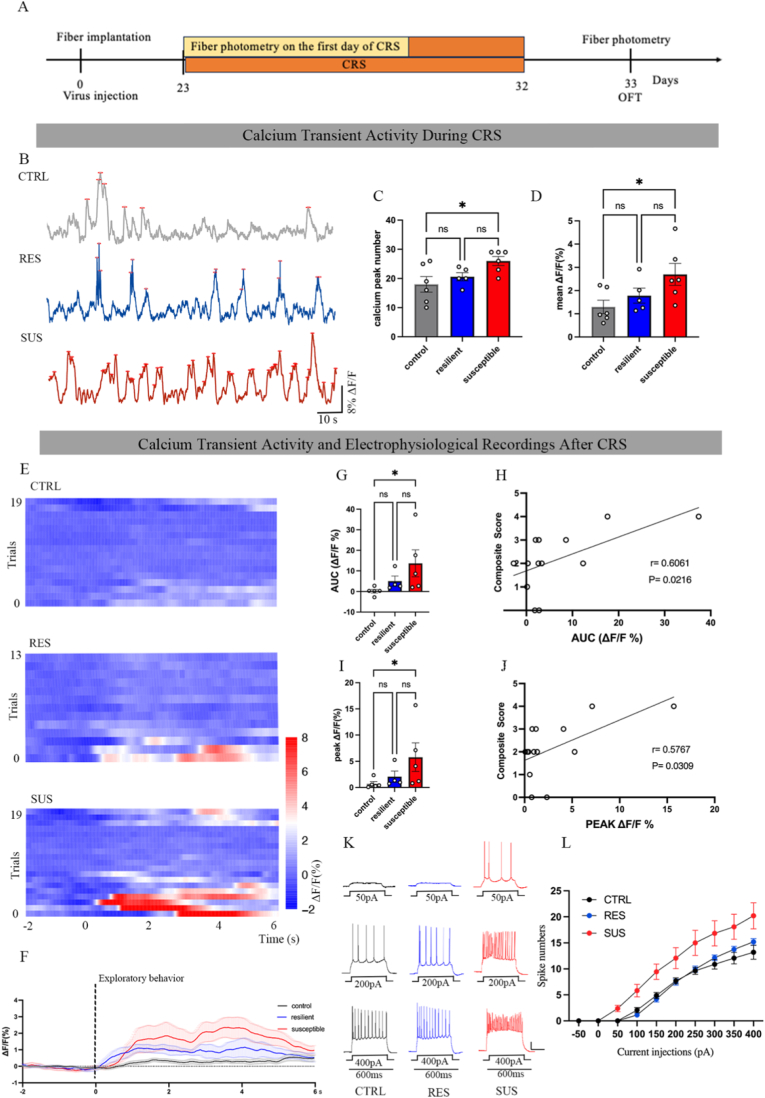
On the first restraint day and during exploration afterward, selected activity measures in susceptible mice exceeded unstressed controls, while differences from resilient mice were less clear at those times. Post-stress activity still correlated positively with behavioral scores. Variation resembled a continuum rather than a clean division in every measure at every moment.
Cellular recordings after stress added another level: susceptible-group projection neurons began firing with less input and produced more spikes under the same depolarizing drive. They resembled strings that had become easier to pluck. Baseline population calcium and post-stress intrinsic excitability describe different parts of the same timeline.
Source: Tang Y et al. · Neurobiology of stress · CC BY-NC-ND
Original figure and English caption ↗
Increasing activity changes behavior in two contexts
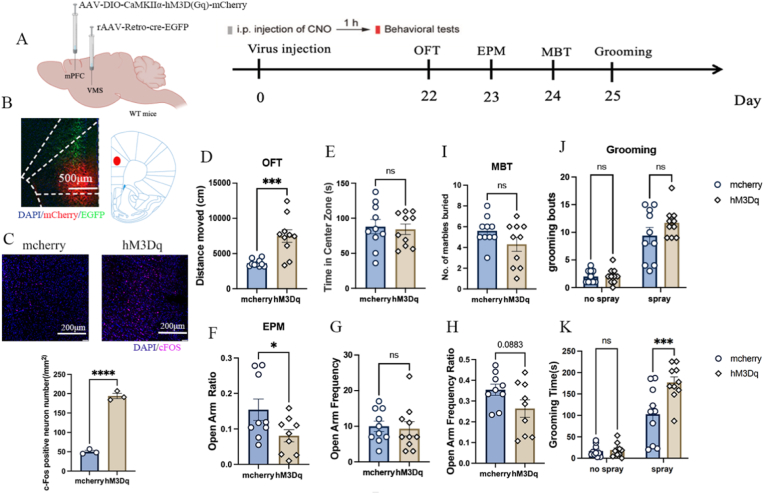
Enhancing the projecting cells in mice without prior restraint moved beyond association. Open-arm time decreased and spray-evoked grooming lasted longer, matching two chronic-stress outcomes. Open-field distance increased while center time remained unchanged: behavior was redistributed across contexts rather than reflecting generally reduced movement.
Some tests changed while others remained similar, giving the population a context-selective role. These prefrontal–striatal cells could influence time in exposed space and how long grooming continued after a stimulus. The functional experiment connected elevated activity with concrete actions.
Source: Tang Y et al. · Neurobiology of stress · CC BY-NC-ND
Original figure and English caption ↗
Grooming improves without matching open-arm recovery
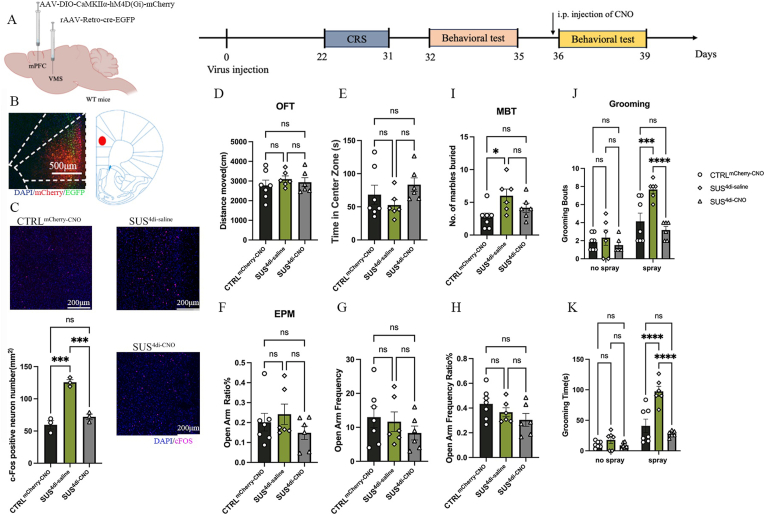
Reducing population activity in susceptible mice after stress lowered spray-evoked grooming duration and bouts. Open-field distance, center time and plus-maze measures did not improve significantly. Effects produced by enhancement did not all reverse under suppression; several network components may maintain behavior after chronic stress.
The incomplete symmetry makes grooming particularly informative. How long an animal tends its body after a water stimulus may relate more closely to this population. Following concrete actions separately reveals how a prefrontal output carries different weight in different contexts.
Source: Tang Y et al. · Neurobiology of stress · CC BY-NC-ND
Original figure and English caption ↗
Understanding stress responses also means looking back
In male C57BL/6J mice, the study connects pre-stress activity, post-stress excitability and behavioral modulation. The same experience may encounter different initial neural states and reshape specific behaviors. Baseline peaks are a candidate correlate within this experiment, with predictive ability in independent populations still to be tested.
Moving from the strength of stress to which cells are already more active adds an earlier starting point. Grooming and exploration do not always recover together, giving the prefrontal–striatal connection a defined role. Different responses to the same stress become a sequence with timing, cells and concrete actions.