When stress weakens a warning: a circuit linking expectation and learning
In male mice, prolonged exposure to conspecific defeat weakened learning-related responses to a threat cue. A TH-positive pathway from zona incerta to basomedial amygdala offers a circuit-level clue.
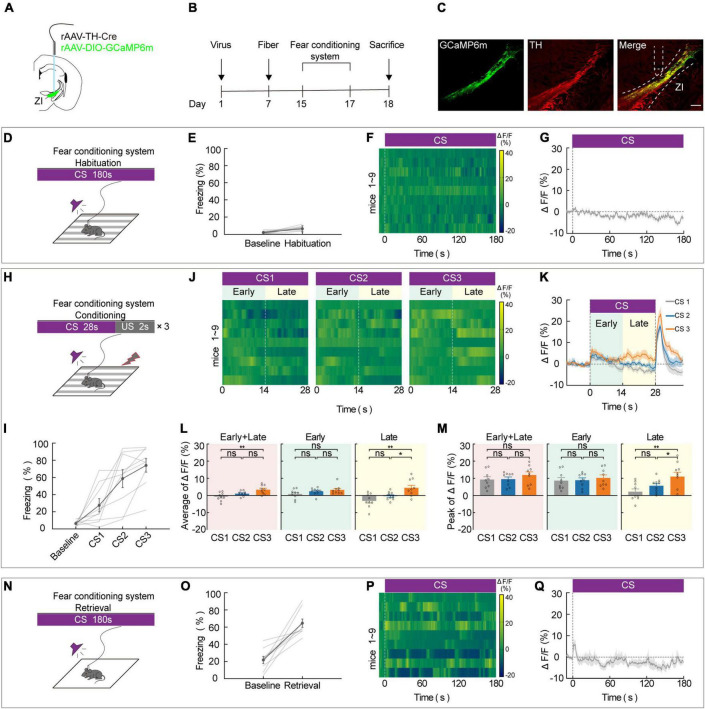
A warning sound matters because of what follows it. How does the brain turn an initially neutral cue into a prediction of danger, and how does stress disrupt that learning? A male-mouse study published in Frontiers in Cellular Neuroscience on August 26, 2022 examined zona incerta and amygdala circuitry. TH-positive cell activity changed during cue learning; after prolonged exposure to conspecific defeat, both this activity and later learned responses were reduced. The connecting pathway links stress, expectation and memory at a circuit level.
A TH-positive ZI-to-BMA pathway contributes to cue-associated aversive learning. Enhancing its activity late in learning increased subsequent cue-evoked freezing in emotionally stressed mice.
Contents · 6 sections
Learning begins before the aversive event
A tone becomes predictive through repeated association with an unpleasant event. The study tracked cue-evoked freezing, a common behavioral readout of learning, rather than a direct measurement of subjective fear.
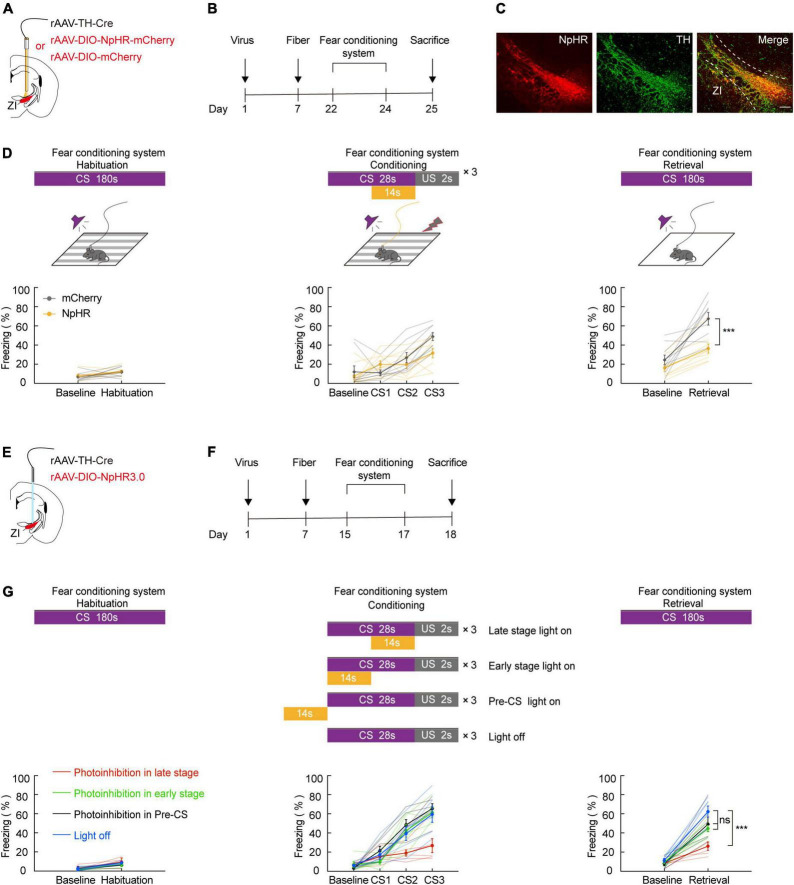
The focus was the zona incerta, or ZI, and its tyrosine hydroxylase-positive cells. TH marks a population associated with catecholamine synthesis; the transmitter and receptor mediating the behavioral effects remain unresolved.
Source: Zhang L et al. · Frontiers in cellular neuroscience · CC BY
Original figure and English caption ↗
The period close to the outcome matters
Before learning, the tone elicited no marked calcium response. By the third pairing, late-cue mean and peak signals exceeded those in the first. Whole-cue mean activity also increased, whereas the corresponding whole-cue peak comparison was not significant.
Reducing activity during learning decreased freezing during subsequent cue recall. In a timing comparison, late-cue inhibition produced weaker later responses than early-cue inhibition, emphasizing when the population contributes, beyond whether it contributes at all.
Source: Zhang L et al. · Frontiers in cellular neuroscience · CC BY
Original figure and English caption ↗
A connection to the amygdala
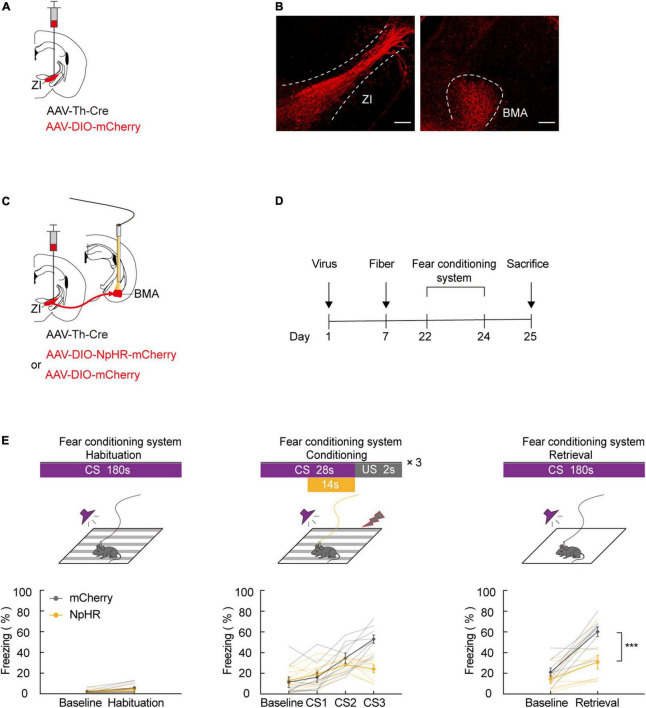
The ZI does not operate in isolation. Axons from its TH-positive cells reach the basomedial amygdala, or BMA. Identifying this particular subdivision gives the circuit a more specific anatomical focus than referring to the amygdala as a whole.
Reducing terminal activity in this output late in cue learning decreased freezing during the third pairing and subsequent recall. Population activity, anatomy and output-level behavior thus converge, while the responsible BMA recipient cell types remain unidentified.
Source: Zhang L et al. · Frontiers in cellular neuroscience · CC BY
Original figure and English caption ↗
More anxiety-like behavior, weaker learned responses
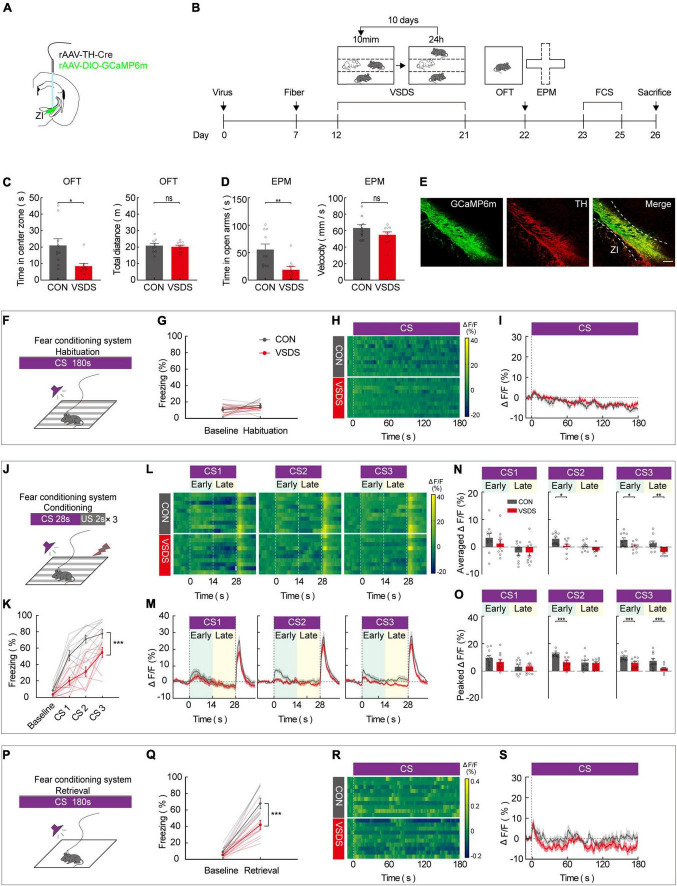
Mice exposed to prolonged observation of conspecific defeat did not receive the physical attacks themselves, yet showed more anxiety-like behavior in open-field and elevated-plus-maze tests. Corresponding distance or speed comparisons were not significant.
More anxiety-like behavior did not coincide with stronger cue learning. Stressed mice froze less during conditioning and recall, with weaker ZI TH-positive calcium signals in parts of learning. Recall-phase calcium signals did not differ significantly, so neural and behavioral changes were not uniform across all phases.
Source: Zhang L et al. · Frontiers in cellular neuroscience · CC BY
Original figure and English caption ↗
Enhancing the output increases later recall responses
Enhancing the TH-positive ZI-to-BMA output late in cue learning increased subsequent cue-evoked freezing in stressed mice. This intervention shows that pathway activity can alter the later learned response in this model.
The clearest improvement appeared at later recall; the third conditioning-pairing comparison was not significant. The experiment did not establish a cure for anxiety-like behavior or recovery of all learning abilities. It identifies a specific cue–outcome response that remains modifiable under stress.
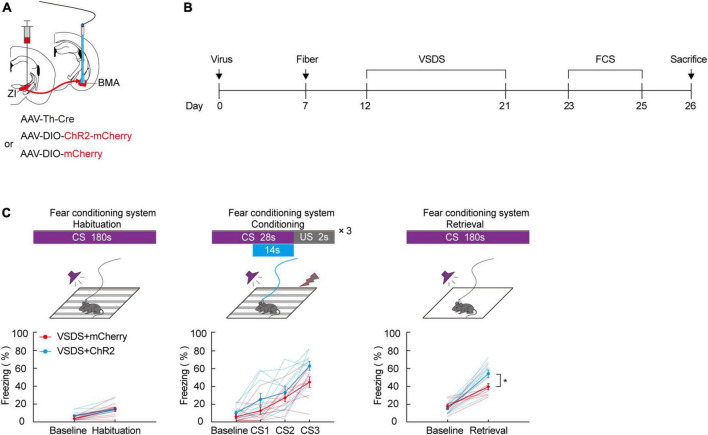
Source: Zhang L et al. · Frontiers in cellular neuroscience · CC BY
Original figure and English caption ↗
Stress can alter the link between a warning and its outcome
The work shows that greater anxiety-like behavior can coexist with weaker aversive learning. Understanding stress requires attention to cues, timing and circuitry. Whether anxiety-like state, stress-related exhaustion or other factors drive the learning difference remains unresolved.
From ZI population activity to the behavioral role of its BMA output, the study provides a concrete neural lead. The findings concern male mice in a specific cue task; transmitter identity, recipient cells and extension to females remain open questions.