When neurons grow quieter, look next door: astroglial potassium channels and social changes
Offspring in a glufosinate-exposure model show selected social changes. Increased astroglial Kir4.1 in anterior cingulate cortex accompanies neuronal hypoactivity, with local modulation improving some measures.
Neuronal signaling depends on both the cell and its surroundings. Astrocytes help regulate extracellular ions, and changes in these cells may make nearby neurons harder to activate. A 2026 Acta Pharmaceutica Sinica B study of offspring in a glufosinate ammonium (GLA) exposure model finds lower anterior cingulate (ACC) neuronal activity alongside increased astroglial Kir4.1. Reducing local channel expression improves selected neuronal and social measures, highlighting the influence of the cellular environment.
Offspring social approach and grooming changes accompany ACC excitatory-neuron hypoactivity and increased astroglial Kir4.1. Astroglial Kcnj10 reduction and pharmacology improve selected physiological and behavioral measures.
Contents · 6 sections
Social approach changes while novelty preference remains
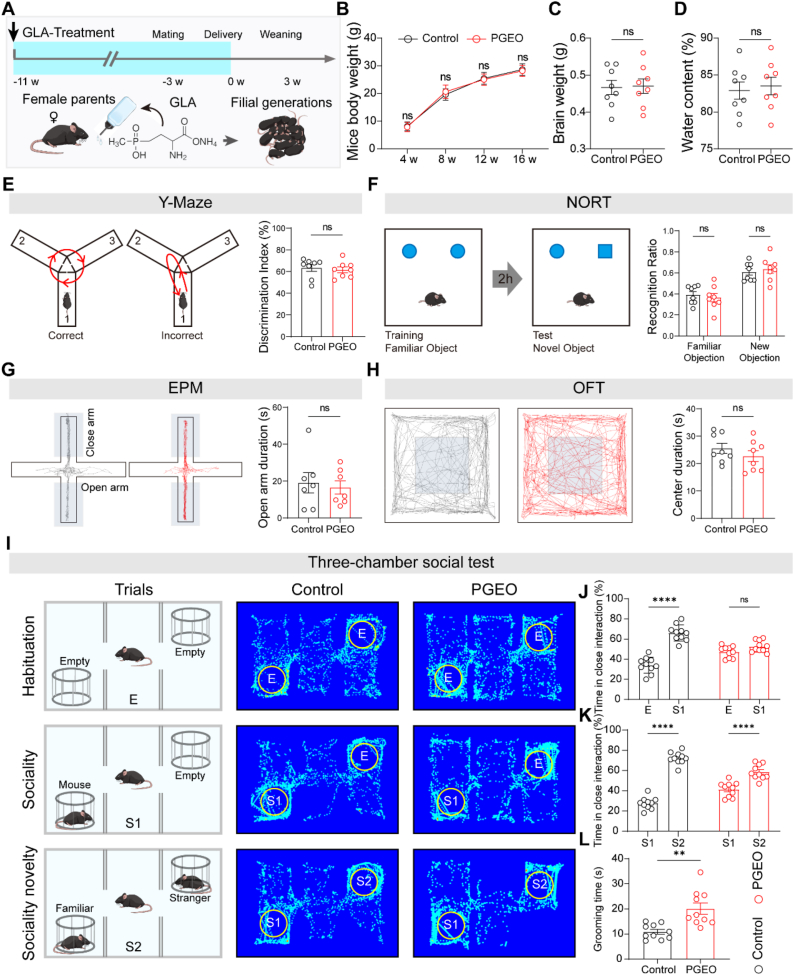
Dams received GLA in drinking water before mating through delivery. Offspring lacked a clear stranger-versus-empty preference and groomed more, yet retained a preference for new over familiar partners. Social approach and partner discrimination therefore showed different profiles rather than a change across every social component.
Weight, brain weight, water content and several vascular measures remained broadly unchanged. Y-maze, object-recognition, open-field and elevated-maze tests also lacked matching differences. The pattern focused attention on selected behaviors rather than simultaneous decline across exploration, memory and anxiety-related tasks.
Source: Li Z et al. · Acta pharmaceutica Sinica. B · CC BY-NC-ND
Original figure and English caption ↗
ACC excitatory cells become harder to activate
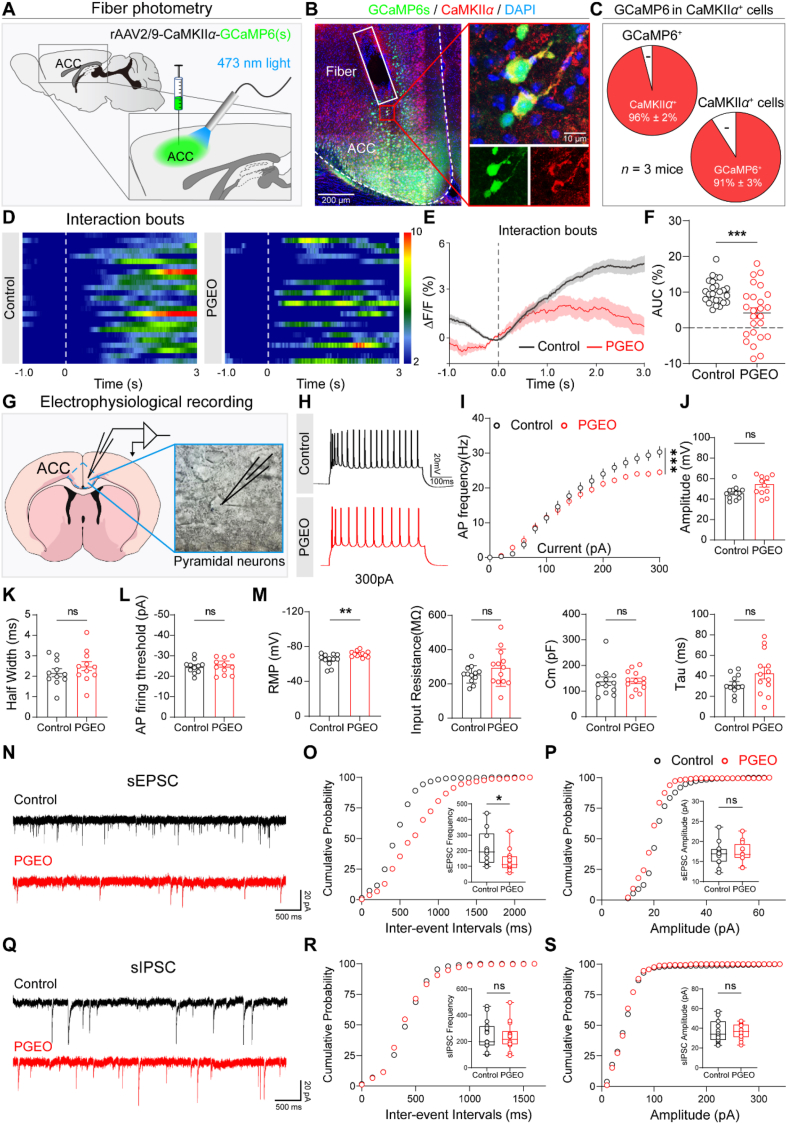
After social interaction, c-Fos declined in ACC and hippocampus. ACC excitatory-cell co-labeling changed more clearly, while inhibitory-cell labeling and overall neuronal density were comparable. Reduced social calcium responses and evoked slice firing converged on functional hypoactivity in neurons that remained present.
Resting potentials were more negative, placing the cells farther from spike initiation. Excitatory currents occurred less often but had comparable amplitudes, while inhibitory-current frequency and amplitude remained broadly stable. Hypoactivity involved resting state and excitatory drive rather than uniformly weaker currents.
Source: Li Z et al. · Acta pharmaceutica Sinica. B · CC BY-NC-ND
Original figure and English caption ↗
Potassium channels draw attention to astrocytes
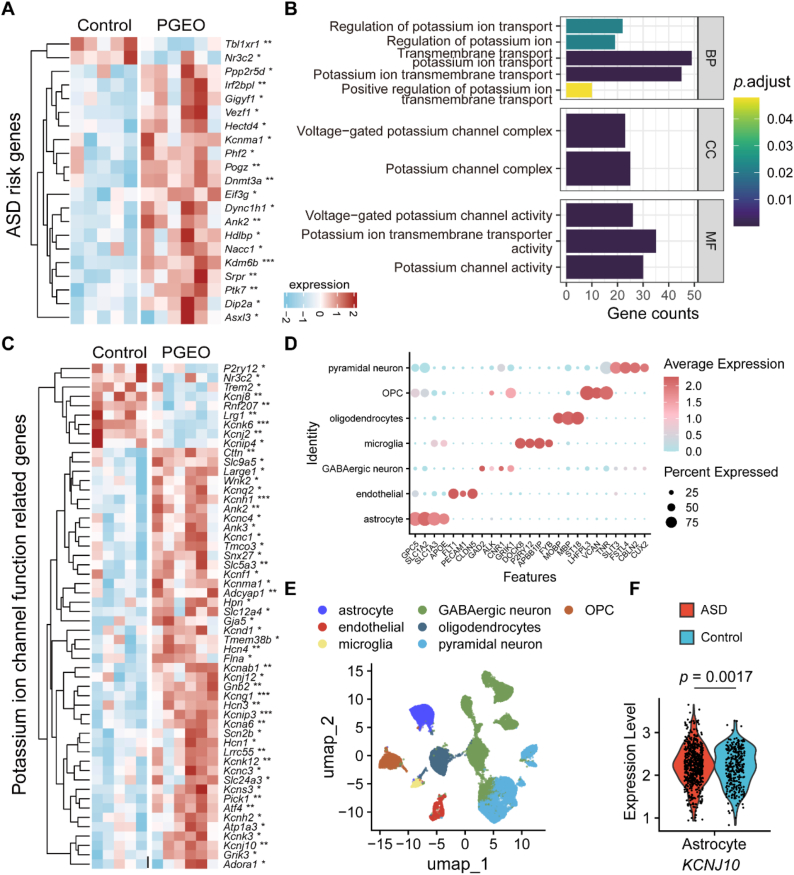
Glial and potassium-channel expression changes directed attention to neuronal surroundings. Stronger S100β/GFAP measures correlated inversely with pyramidal c-Fos, and astroglial Kir4.1 protein increased. This inward-rectifier channel participates in astroglial ion handling, making the influence of surrounding cells on neuronal excitability testable.
Existing human ACC single-nucleus data offered another lead: astroglial KCNJ10 was higher in nine autistic individuals than nine controls. This was observational convergence with the mouse channel direction. The human dataset did not document GLA exposure, so the two sources addressed different questions.
Source: Li Z et al. · Acta pharmaceutica Sinica. B · CC BY-NC-ND
Original figure and English caption ↗
Reducing the glial channel restores selected activity
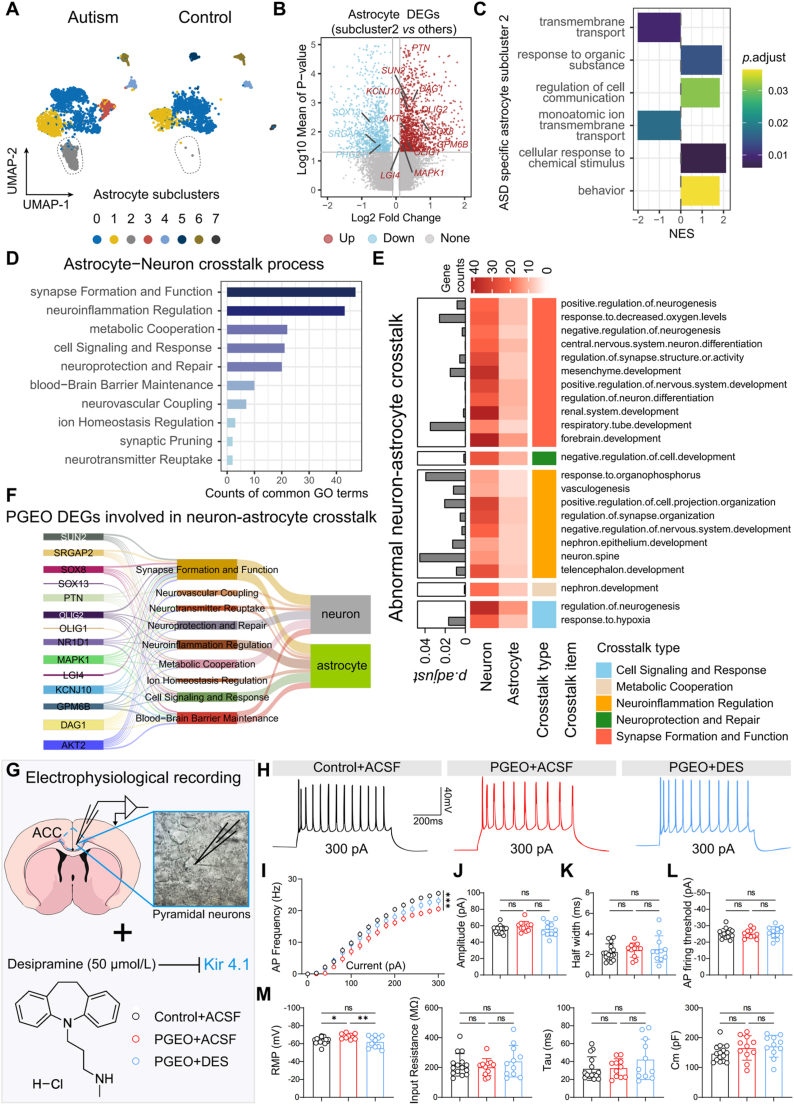
Stronger barium-sensitive inward-rectifier currents accompanied channel enhancement in model astrocytes. Reducing ACC astroglial Kcnj10 partly restored pyramidal firing and resting potential, while several membrane parameters remained comparable. This provided functional support for astroglial influence on neighboring neurons.
Behavioral improvement after local modulation was most evident in the social-novelty phase. Changing astrocytes affected both electrical activity and partner exploration, with distinct responses across measures. The result connected cellular surroundings with action and showed why neuronal hypoactivity need not originate entirely within neurons.
A second modulation improves selected measures too
Desipramine improved partner interaction, novelty-phase preference and grooming. Slice firing and hyperpolarization also improved while some baseline membrane measures stayed stable. The direction agreed with channel reduction, adding support for channel involvement.
The proposed model links enhanced astroglial potassium handling with an altered ionic environment and reduced neuronal activation. Extracellular potassium was not directly measured, and the drug has other actions. Local channel modulation and pharmacology clearly changed selected measures, while the precise ionic process awaits direct observation.
Source: Li Z et al. · Acta pharmaceutica Sinica. B · CC BY-NC-ND
Original figure and English caption ↗
A surrounding environment shapes neuronal activity
Circuit stories often follow synapses from one neuronal group to another. Here, the ionic environment maintained by astrocytes also changes a cell’s starting state. Astroglial channels, hypoactivity and selected social changes converged in ACC, providing a concrete example of interaction between cell populations.
Functional evidence comes from a mouse exposure model, while human findings are expression associations in existing data. They identify Kir4.1 for further study without establishing real-world exposure risk or treatment effects. The central finding is that selected neuronal activity and partner exploration can be modulated through channels in neighboring astrocytes.