When danger is near food: thalamic CRF cells contribute to choice
In rats, aPVT CRF-associated cells participate in conflict between food and predator cues. Accumbens output and hypothalamic input affect food seeking and defense differently.
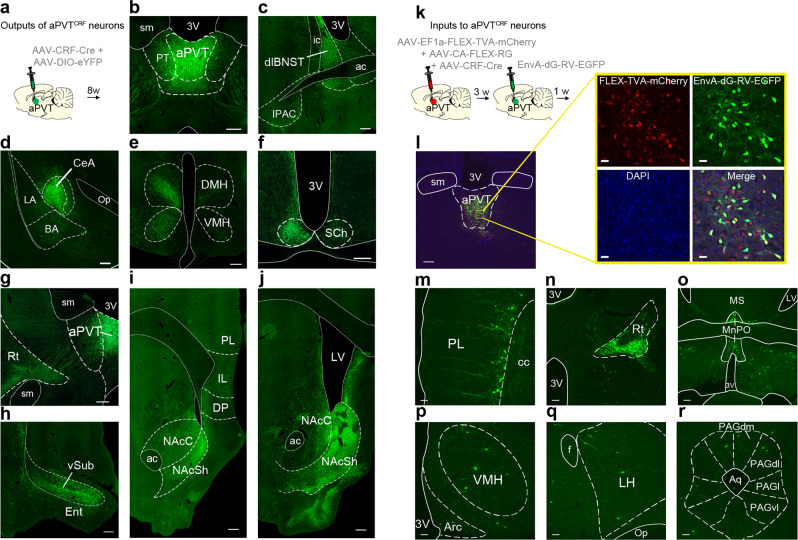
Food is within reach, but a threatening odor is nearby. How does a hungry animal choose? A rat study published in Nature Communications on May 4, 2021 examines anterior paraventricular thalamus, aPVT. CRF-associated cells respond differently when food and predator cues coincide, and reducing their activity increases approach toward food. Accumbens outputs and hypothalamic inputs reveal that food-seeking suppression and defense are not uniformly controlled by the same component.
aPVT CRF-associated cells and accumbens output suppress seeking and promote avoidance. Reducing VMH–aPVT projection-associated activity weakens defense during conflict without significantly lifting food-seeking suppression.
Contents · 8 sections
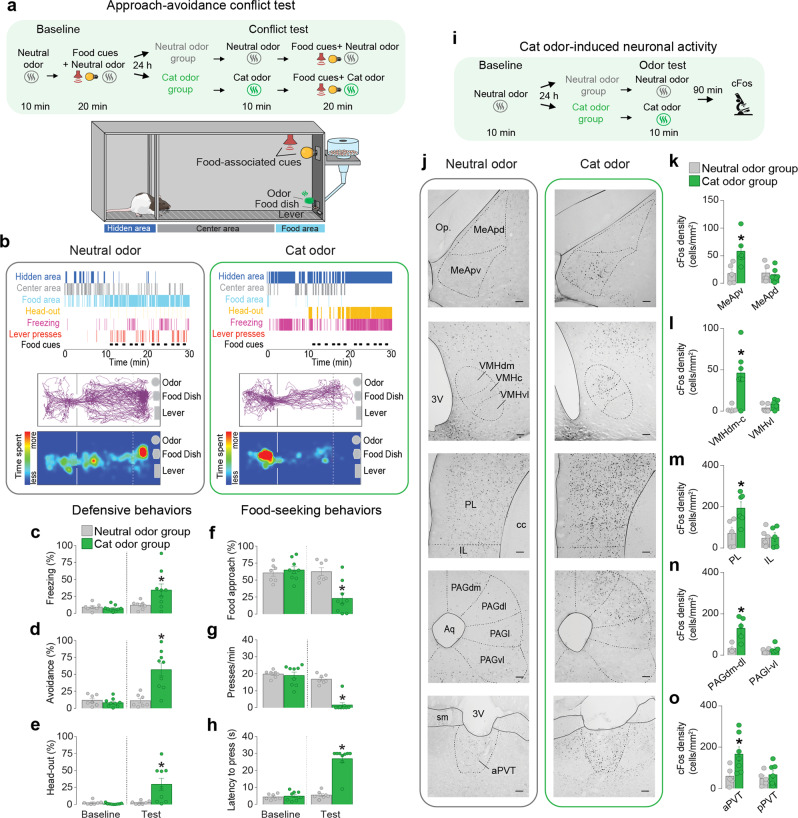
Food cues remain, but seeking declines
With food cues alone, rats approach the food area and respond for reward. Predator odor adds freezing, avoidance and risk-assessment postures, while food-area time and lever pressing decline and responding begins later.
The odor changes the potential cost of approaching rather than the food itself. Greater hunger reduces some defensive responses without similarly lifting seeking suppression, separating effects of bodily need and threat cues.
Initial behavioral comparisons included both sexes, with increased defense and reduced seeking in each, while females pressed less. This provides context for individual differences within the model.
Source: Engelke DS et al. · Nature communications · CC BY
Original figure and English caption ↗
Conflict recruits heterogeneous cellular responses
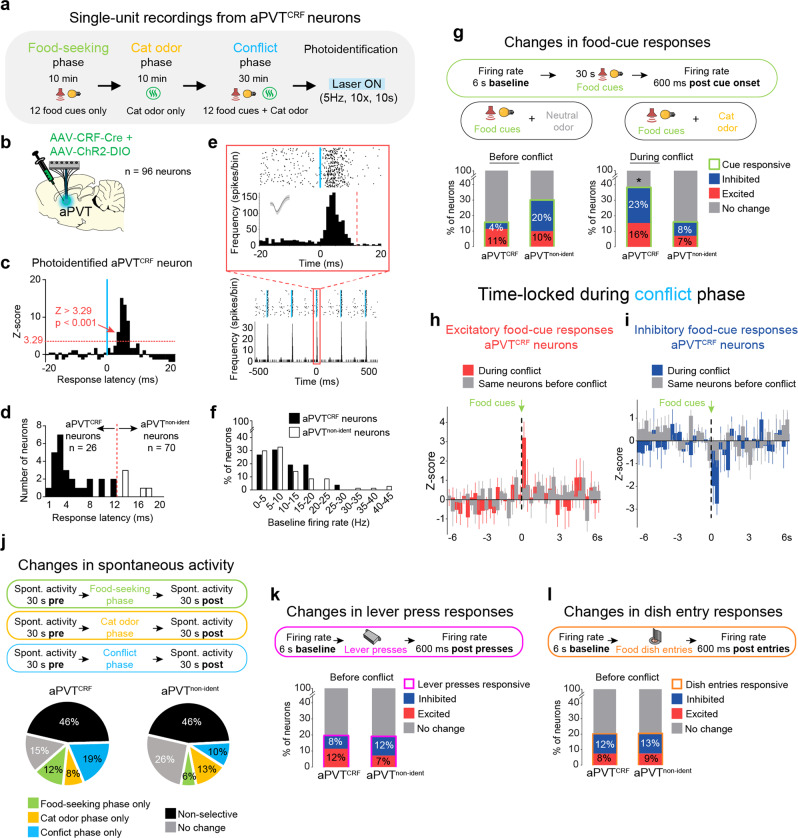
aPVT encounters food and threat information. General recordings show that cells responsive to food cues can lose those responses during conflict, while others become responsive, reorganizing the population pattern.
Within identified CRF-associated cells, the proportion responding to food cues increases during conflict, including both firing increases and decreases. The marker narrows the population without making its response uniform.
Source: Engelke DS et al. · Nature communications · CC BY
Original figure and English caption ↗
Reducing CRF population activity shifts behavior toward food
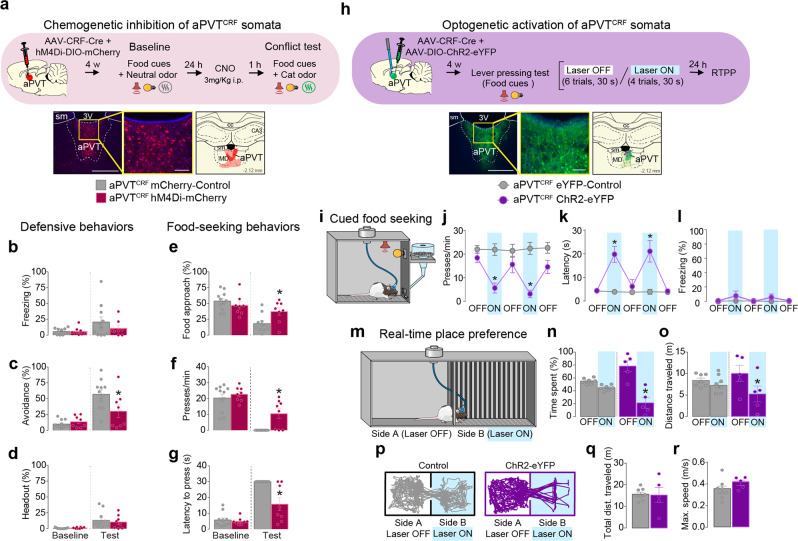
Reducing aPVT CRF-associated activity during conflict reduces avoidance, increases food approach and responding and speeds response initiation. Freezing and risk-assessment comparisons are not significant, so defense does not disappear uniformly.
Controls with isolated threat or food cues do not show the same significant effects. Conversely, activation without predator odor reduces seeking and induces place avoidance without significantly increasing overall movement or freezing.
Source: Engelke DS et al. · Nature communications · CC BY
Original figure and English caption ↗
Multiple inputs and outputs converge on the thalamic node
Anatomical tracing identifies multiple aPVT CRF-associated outputs, particularly dense fibers in accumbens shell, NAcSh. Prefrontal, hypothalamic and periaqueductal inputs connect food-seeking and defensive networks.
This distribution guides functional testing without defining one closed route. CRF is a cellular identity marker here; the study does not isolate the peptide’s contribution to every behavioral effect.
Source: Engelke DS et al. · Nature communications · CC BY
Original figure and English caption ↗
Accumbens output enhancement suppresses seeking and promotes avoidance
Enhancing aPVT CRF-associated terminals in NAc reduces food responding, delays response initiation and promotes avoidance of the activation-associated compartment, even without predator odor.
Total distance, maximum speed and freezing comparisons are not significant. Reduced activity within one compartment is therefore distinct from a general locomotor reduction, leaving the relevant downstream recipients to be identified.
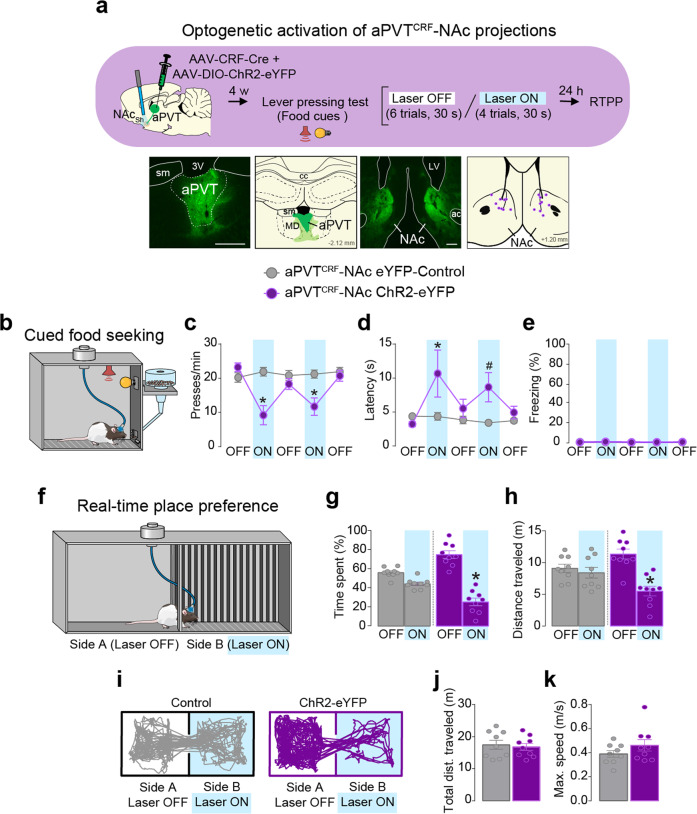
Source: Engelke DS et al. · Nature communications · CC BY
Original figure and English caption ↗
One input has different dynamics across recipients
Both medium spiny neurons, MSNs, and cholinergic interneurons, CINs, receive excitatory input. Most paired recordings show larger MSN currents, while successive inputs facilitate CIN responses more strongly, revealing different short-term dynamics.
Downstream effects may depend on input timing as well as initial current size. Whether CINs are a decisive behavioral relay is not directly established here.
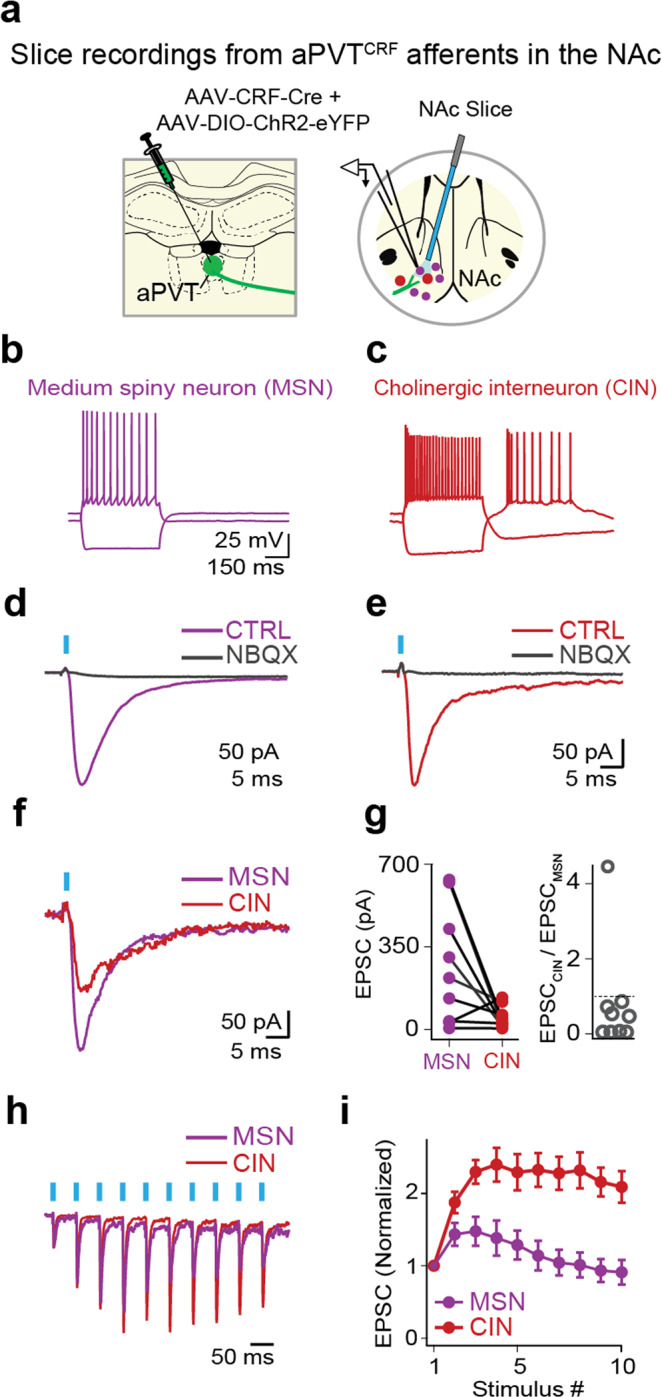
Source: Engelke DS et al. · Nature communications · CC BY
Original figure and English caption ↗
Reducing hypothalamic input weakens defense but leaves seeking suppressed
VMH cells projecting to aPVT show increased activity labeling after threat cues. Their input excites NAc-projecting aPVT cells, although the recipient recording does not independently restrict every cell to the CRF population.
Reducing VMH–aPVT projection-associated activity decreases freezing, avoidance and risk assessment during conflict, without significant changes in food approach, pressing or response latency. Isolated-threat controls lack the same effect. Less defense does not ensure renewed food seeking.
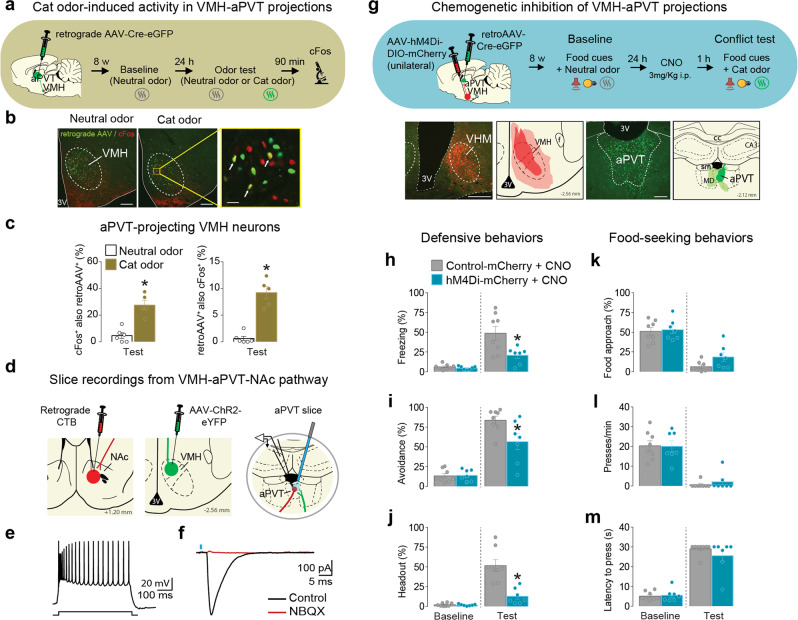
Source: Engelke DS et al. · Nature communications · CC BY
Original figure and English caption ↗
Stopping and avoiding are not identical commands
The rat findings divide food–threat conflict by cell identity, output and behavior. aPVT CRF-associated activity influences seeking suppression, whereas VMH-associated input more clearly affects conflict defense. Their roles are connected but not interchangeable.
Projection-defined cells can retain collaterals, and other inputs may maintain seeking suppression. The full cell-specific relay and natural activity patterns remain unresolved. The findings distinguish stopping approach from organizing defense within a connected network.