What an orexin pathway contributes to lost preference under stress
An adult male-mouse study links hypothalamic orexin cells targeting prefrontal cortex to reward-related changes after chronic stress. Weakening the pathway improves grooming and sucrose preference without parallel changes in tested anxiety-like measures.
After prolonged stress, mice may avoid open spaces, groom less and show reduced preference for sweet water. Does one pathway drive all these changes? A study published in Translational Psychiatry on March 16, 2024 follows an orexin pathway from lateral hypothalamus to medial prefrontal cortex. Increasing or reducing its activity mainly changes grooming and sucrose-related behavior, without parallel changes in tested anxiety-like measures or immobility. Sucrose preference compares choices between sweet and plain water, while grooming describes self-care behavior. These measures make reward-related changes observable, with distinct meanings. Behaviors that appear together may involve distinct neural contributions.
After chronic stress, prefrontal-projecting orexin cells become more excitable. Inhibiting this population or blocking orexin receptors in prefrontal cortex improves grooming and sucrose preference. Activating local prefrontal terminals reduces grooming without significant changes in tested anxiety-like or immobility measures.
Contents · 7 sections
Chronic stress changes several behaviors
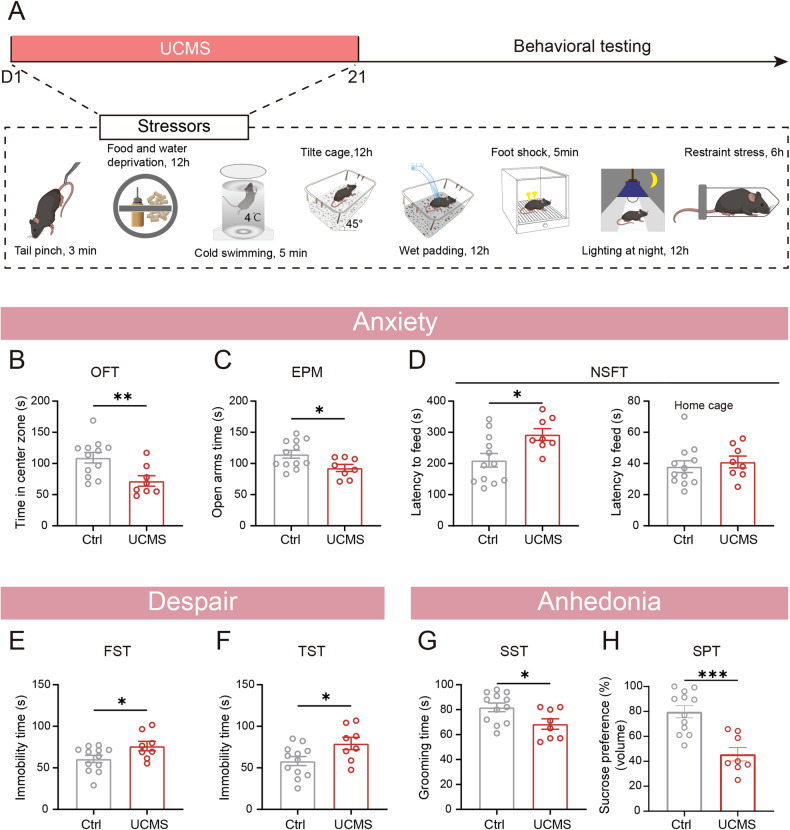
After weeks of unpredictable mild stress, mice spend less time in the center of an open field and on exposed maze arms, and take longer to begin feeding in a novel environment. Feeding latency in the home cage remains similar, as does total open-field distance, distinguishing exploration changes from simply moving less.
Immobility increases during swimming and suspension tests, while grooming and sucrose preference decline. Examining these measures alongside one another allows the study to ask which components an orexin pathway affects.
Source: Liu D et al. · Translational psychiatry · CC BY
Original figure and English caption ↗
Orexin cells change with behavioral context
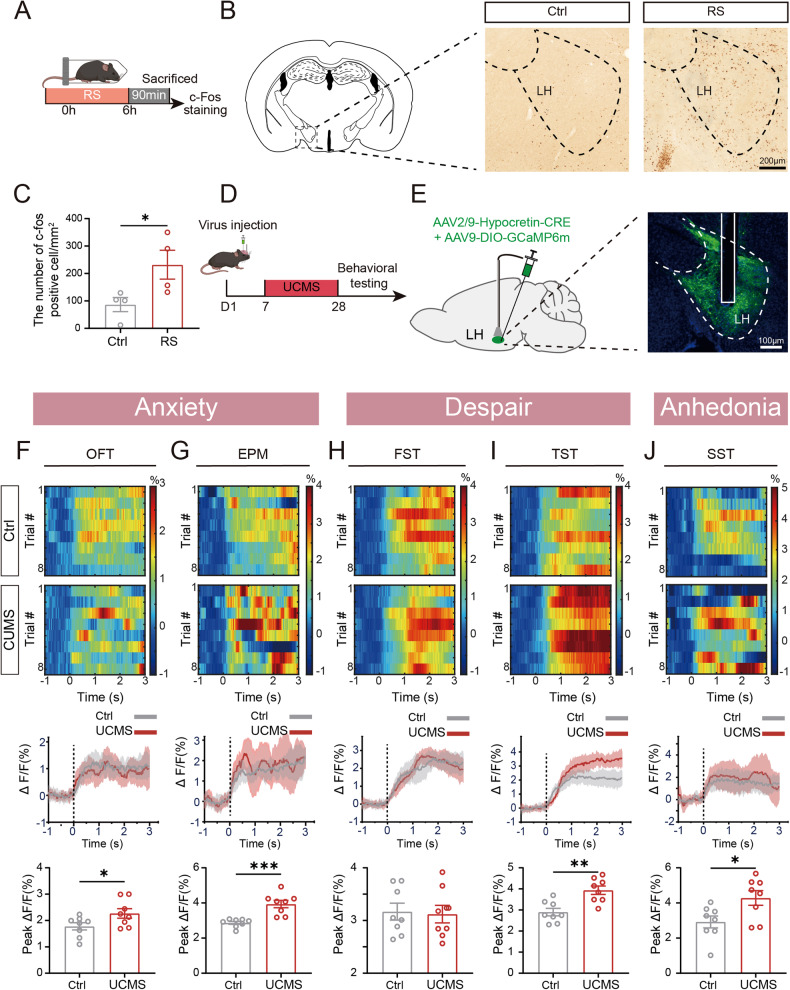
Orexin is known for regulating wakefulness and appetite, while its cells also send information to emotion-related regions. Restraint stress increases activity markers in hypothalamus. After chronic stress, orexin-cell calcium responses are stronger as mice enter the open-field center, step onto exposed arms or begin grooming.
The increase is context-dependent: calcium responses grow at immobility-to-struggling transitions during suspension, while the corresponding swimming comparison is not significant. Activity changes with particular events, motivating closer examination of the pathway.
Source: Liu D et al. · Translational psychiatry · CC BY
Original figure and English caption ↗
Tracing from hypothalamus to prefrontal cortex
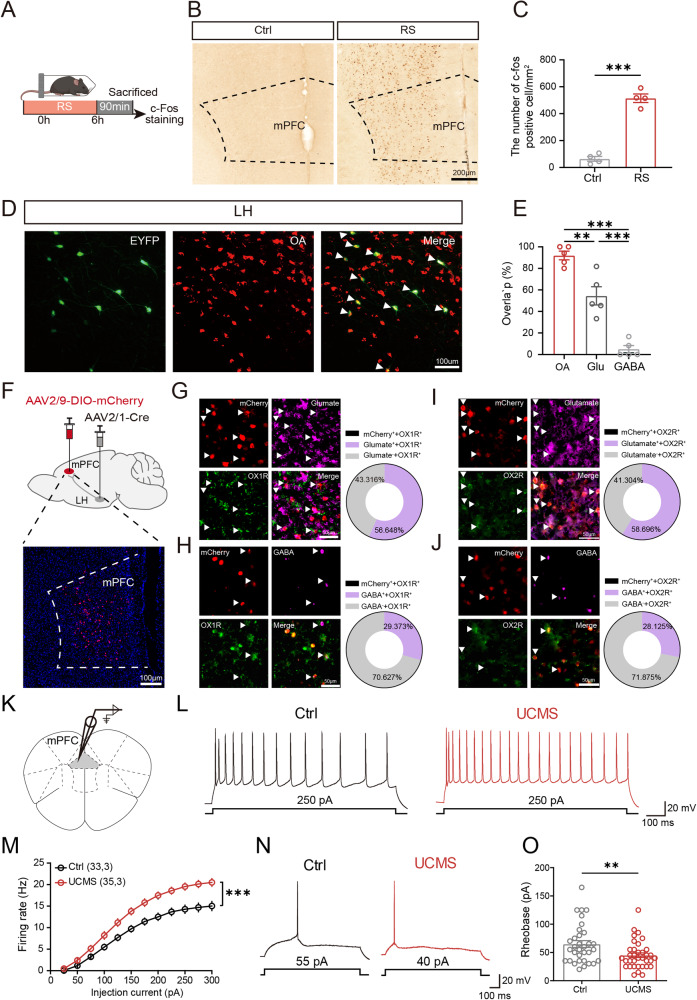
Tracing backward from medial prefrontal cortex labels hypothalamic cells predominantly bearing orexin. Connectivity tracing and receptor labeling further show that, among prefrontal cells receiving hypothalamic input, orexin-receptor-bearing populations are mainly glutamatergic, with a smaller GABAergic component.
After chronic stress, tested prefrontal glutamatergic cells are more excitable: the same current evokes more spikes and less current is required to elicit the first spike. The upstream–downstream connection provides a route for subsequent functional experiments.
Source: Liu D et al. · Translational psychiatry · CC BY
Original figure and English caption ↗
Greater excitability and rising local peptide signals
Recordings from hypothalamic orexin cells projecting to prefrontal cortex similarly show more evoked spikes and a lower firing threshold after chronic stress. Changes appear in the tested cells at both ends of the connection.
Prefrontal orexin-sensor recordings show rapid fluorescence increases during tail stimulation or restraint, followed by declines after stimulation ends. These local orexin-related changes associate with acute stress and complement the cellular-excitability findings.
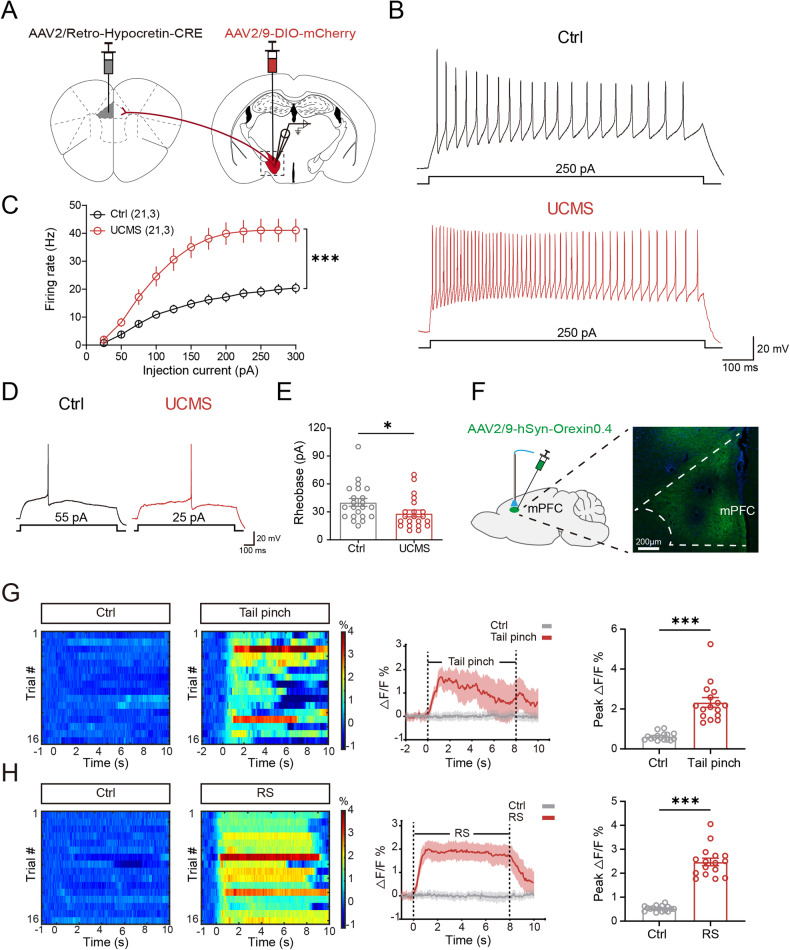
Source: Liu D et al. · Translational psychiatry · CC BY
Original figure and English caption ↗
Increasing the signal reduces grooming without changing exploration
In mice without chronic stress, activating orexin terminals within prefrontal cortex reduces grooming. Open-field center time, exposed-arm exploration, novel-environment feeding latency, swimming and suspension immobility, and total distance do not change significantly.
A separate experiment activates the hypothalamic population projecting to prefrontal cortex, reducing grooming and sucrose-related drinking measures. This population manipulation complements local-terminal activation but operates at a different location and may involve other axonal branches.
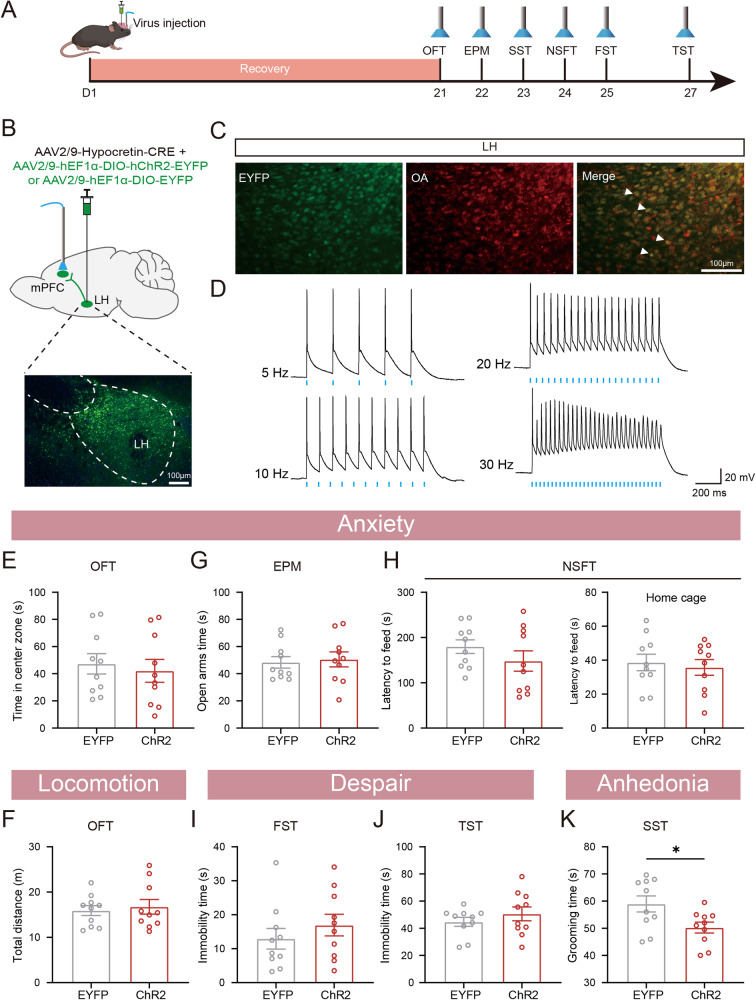
Source: Liu D et al. · Translational psychiatry · CC BY
Original figure and English caption ↗
Weakening the population improves selected reward-related behaviors
After chronic stress, inhibiting prefrontal-projecting orexin cells increases grooming and sucrose preference. Anxiety-like tests and immobility measures remain similar. Sucrose-drinking duration and bout number do not significantly improve, showing that the change affects selected behavioral components.
Orexin cells also project to anterior cingulate cortex, but inhibiting the population targeting that destination does not significantly change tested sucrose measures. Output destination helps distinguish contributions within the orexin system.
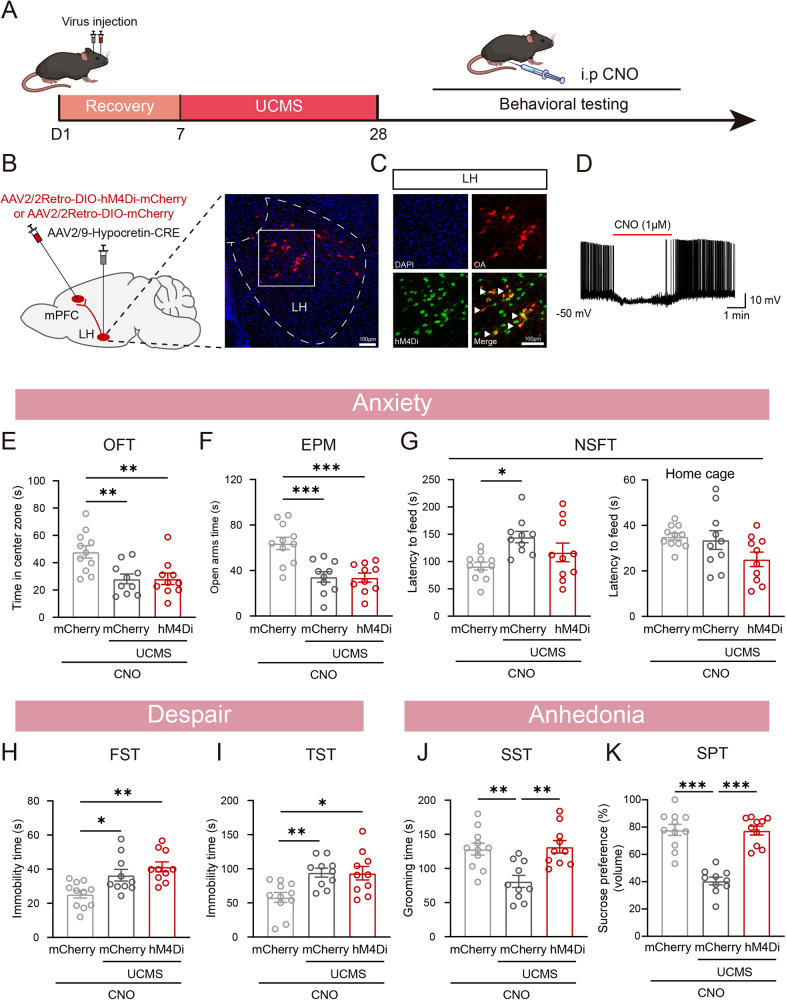
Source: Liu D et al. · Translational psychiatry · CC BY
Original figure and English caption ↗
Receptor-level results echo the behavioral distinction
Separately blocking OX1R or OX2R in prefrontal cortex also increases grooming and sucrose preference after stress. Drinking bouts increase while duration remains similar, without parallel improvements in anxiety-like or immobility measures. These local pharmacological results align with the behavioral direction of population inhibition.
The study uses adult male mice and behaviors such as grooming and sucrose preference to characterize reward-related changes. Its central distinction is that one pathway affects some behaviors following chronic stress more clearly than others. Examining these components separately reveals the contributions of different neural connections.
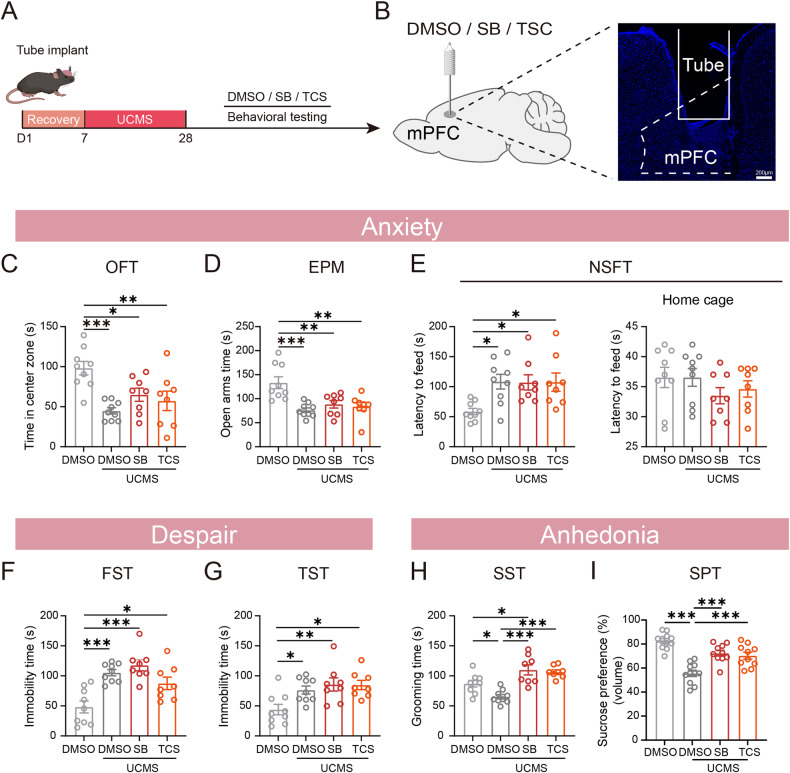
Source: Liu D et al. · Translational psychiatry · CC BY
Original figure and English caption ↗