What a VTA-projecting serotonin population changes under social stress
In male mice, VTA-projecting dorsal raphe serotonin cells are less active in stress-susceptible animals. Altering their activity affects social avoidance depending on stress history and timescale.
Similar social stress can leave some mice avoiding conspecifics while others continue to approach. A male-mouse study published in Nature Communications on August 24, 2020 examined dorsal raphe serotonin cells that project to the ventral tegmental area. These cells fired less in animals showing marked social avoidance, and altering their activity changed behavior under particular conditions. The findings connect serotonin and stress through projection identity, prior experience and timescale.
VTA-projecting dorsal raphe serotonin cells regulate behavior after social stress in a state- and timescale-dependent manner, with both serotonin- and glutamate-related output effects.
Contents · 6 sections
Different targets identify different populations
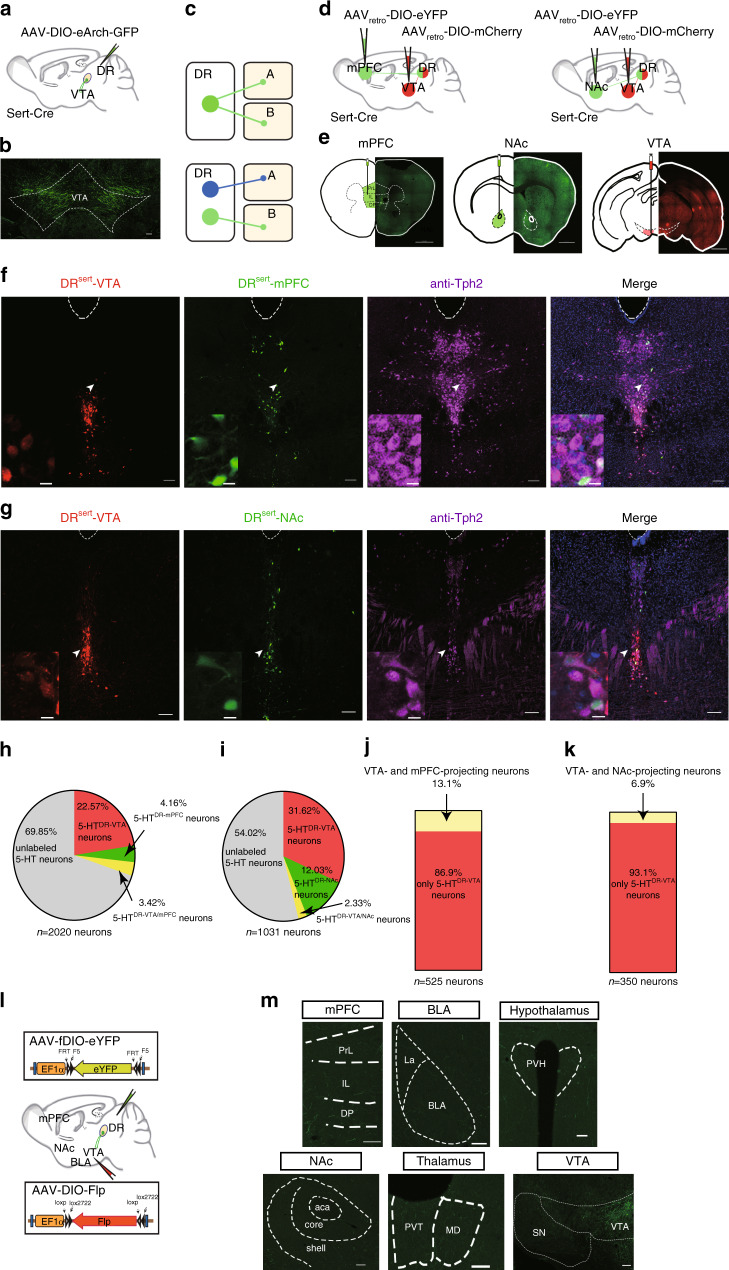
The dorsal raphe, or DR, is a major source of serotonin cells, while the VTA contributes to reward- and stress-related behavior. VTA-projecting DR serotonin cells overlapped relatively little with populations projecting to prefrontal cortex or accumbens and differed in spatial distribution.
Relative separation did not mean absolute isolation: some overlap and sparse collateral branches remained. Later behavioral experiments targeted projection-defined cells, not a closed line with only one possible target. Projection identity narrows the population without excluding every contribution from other outputs.
Source: Zou WJ et al. · Nature communications · CC BY
Original figure and English caption ↗
Serotonin identity does not imply serotonin-only signaling
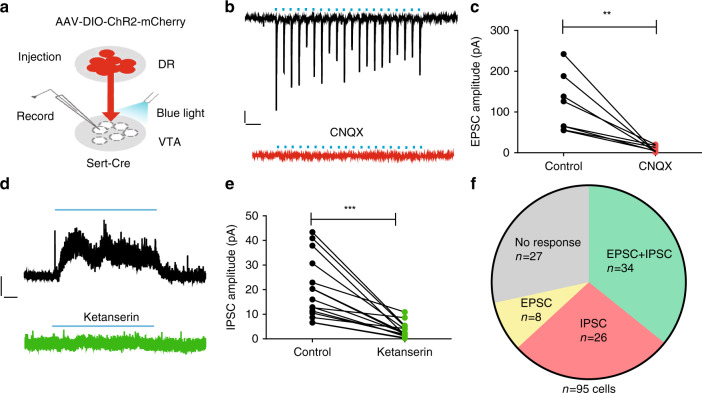
VTA recipient recordings revealed fast excitatory responses associated with glutamate receptors and slower inhibitory responses associated with serotonin receptors. Some recorded cells showed both, some one response type, and others neither detectable response.
A serotonin-cell identity therefore does not specify a single direction of influence. Recipient cells and receptors matter. These physiological findings reveal transmission diversity without separately establishing how much each transmitter contributes to the later social behavioral effects.
Source: Zou WJ et al. · Nature communications · CC BY
Original figure and English caption ↗
The population is quieter in socially avoidant mice
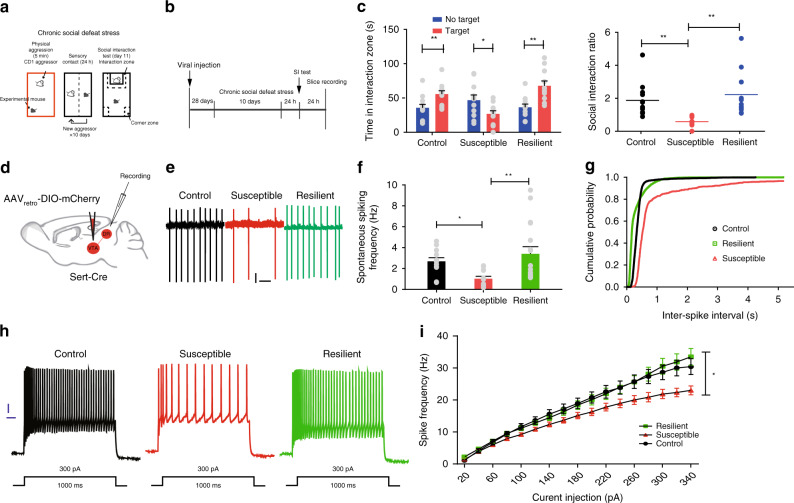
After chronic social stress, mice were classified as susceptible or resilient according to social approach. Susceptible animals interacted less near a social target, while resilient animals more closely resembled unstressed controls. These are model-based behavioral categories, not diagnoses of human depression.
In slices, VTA-projecting DR serotonin cells from susceptible mice showed lower spontaneous firing and reduced current-evoked excitability. Resilient cells did not show the same low-activity state. This association identifies a candidate mechanism without by itself separating cause from consequence.
Source: Zou WJ et al. · Nature communications · CC BY
Original figure and English caption ↗
Reducing activity has stress-dependent effects
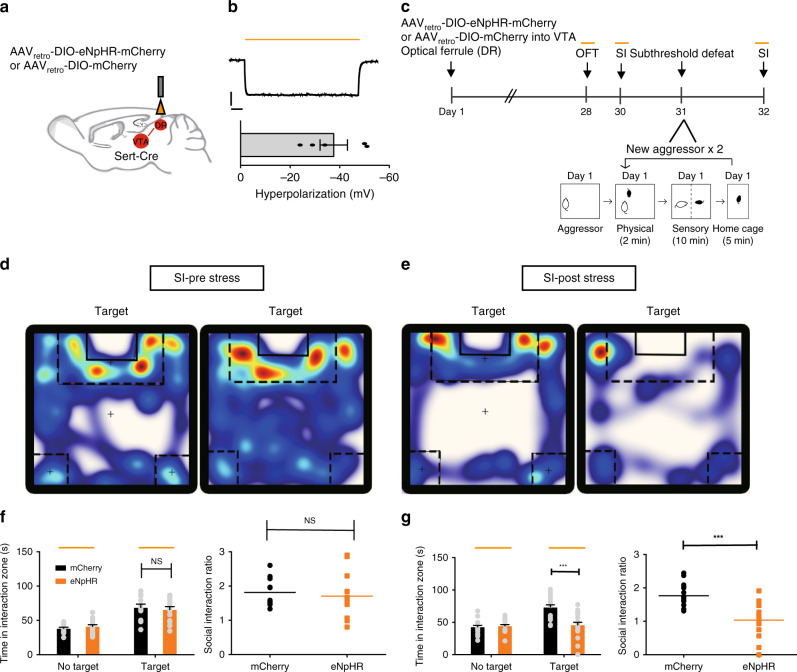
Reducing activity did not significantly alter baseline social approach without the corresponding stress history. Following weaker stress that alone did not produce marked avoidance, activity reduction produced social avoidance. The behavioral outcome depended on both cellular activity and experience.
The finding does not reduce to a general rule that less serotonin produces depression. It concerns social measures under particular stress conditions; other behavioral readouts did not all change together. State dependence remains essential even within a projection-defined population.
Source: Zou WJ et al. · Nature communications · CC BY
Original figure and English caption ↗
The timescale changes the behavioral effect
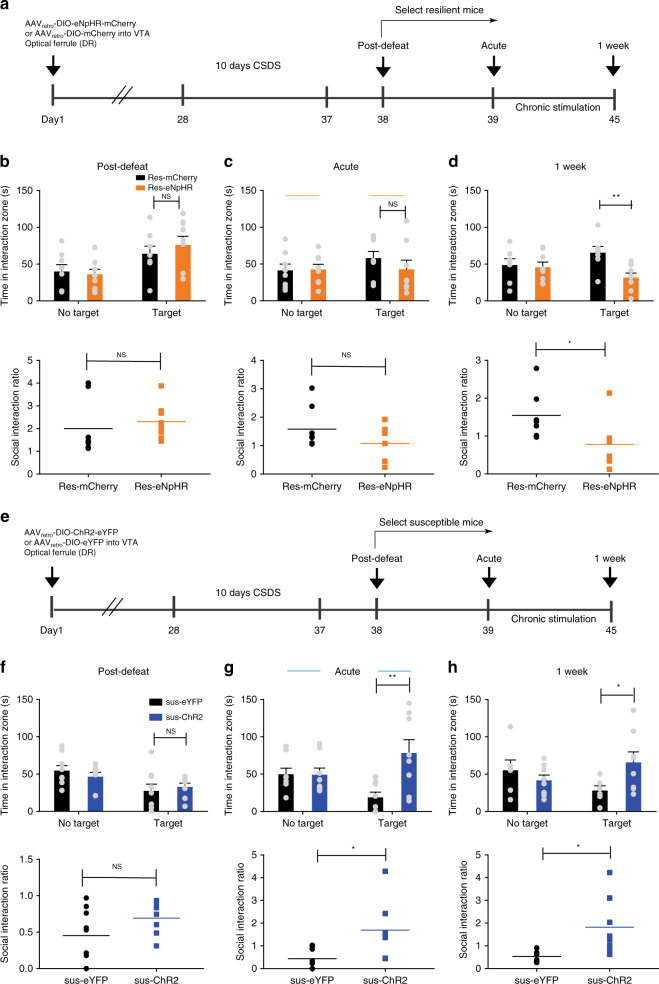
In resilient mice, acute activity reduction did not significantly change social measures, while repeated inhibition reduced approach. In susceptible mice, both acute and repeated activation increased interaction near the social target. The two directions were therefore not fully symmetric across conditions.
These manipulations altered DR cell-body activity in the VTA-projecting population, without isolating one VTA recipient type. Network adaptation may help explain the timescale difference, but was not fully resolved. Improved social measures do not establish recovery of every post-stress behavior.
Source: Zou WJ et al. · Nature communications · CC BY
Original figure and English caption ↗
Understanding stress requires specifying cells and state
The study makes the serotonin–stress relationship more specific: projection identity defines a population, physiology reveals individual differences, and interventions expose the importance of experience and timescale. Glutamate cotransmission, sparse collaterals and diverse VTA recipients remain important mechanistic questions.
The findings concern adult male mice in a particular social-stress model and do not establish human treatment efficacy. They motivate asking how distinct populations within one transmitter system regulate behavior under different experiences, beyond a single brain-wide high-or-low measure.