Neuronal recycling changes gears as stress persists
A male mouse study finds that acute stress enhances lateral-habenula autophagy while chronic stress suppresses it. Synaptic-receptor turnover links this change to neural activity and depression-like behavior.
Neurons must renew the proteins that receive signals as well as process the signals themselves. Autophagy packages intracellular material for lysosomal degradation as part of this renewal. A 2025 Nature study identifies a stress-duration-dependent response in lateral habenula (LHb): recycling activity rises during acute stress but falls after chronic stress. Following glutamate receptors and neuronal firing connects intracellular maintenance with behavior after stress.
LHb neuronal autophagy regulates synaptic glutamate receptors and activity. Enhancing it alleviates depression-like measures in tested mouse models, while reducing it increases stress sensitivity and alters selected drug-related behavioral effects.
Contents · 7 sections
Acute and chronic stress shift recycling in opposite directions
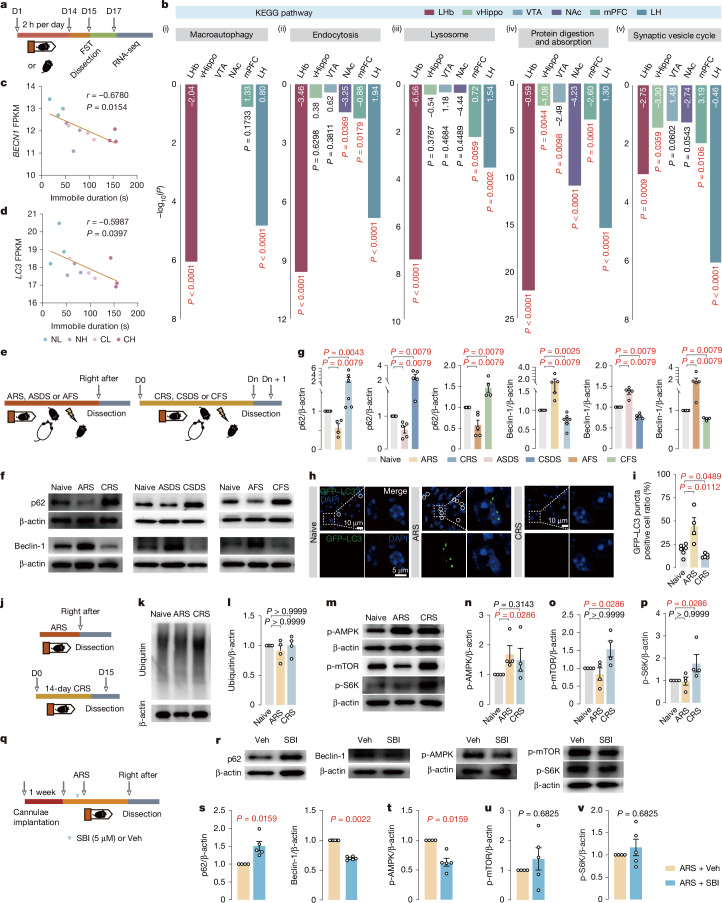
Restraint, social defeat and aversive foot stimulation involve different sensory and behavioral settings. Brief exposure enhances LHb autophagy-associated readouts, while repeated prolonged exposure reduces them. Protein markers, LC3 puncta and electron-microscopic autophagosomes show concordant directions.
The changes are not uniform across regions. Tested ventral hippocampal measures lack the same stress-related autophagy change, and markers of another protein-degradation system remain similar. The study focuses on how LHb maintains its state during stress-related input.
Source: Yang L et al. · Nature · CC BY-NC-ND
Original figure and English caption ↗
Different processes initiate and suppress recycling
Acute stress increases phosphorylation of energy-state regulator AMPK without clear mTOR-related changes. Chronic stress increases mTOR and downstream readouts without the same AMPK change. Regulation differs across stages.
Blocking acute-stage AMPK–ULK1-related signaling weakens autophagy enhancement and prevents the subsequent decline in excitatory synaptic activity. Sucrose preference decreases, while suspension immobility and open-field behavior do not clearly change.
Selected behavioral improvements depend on recycling
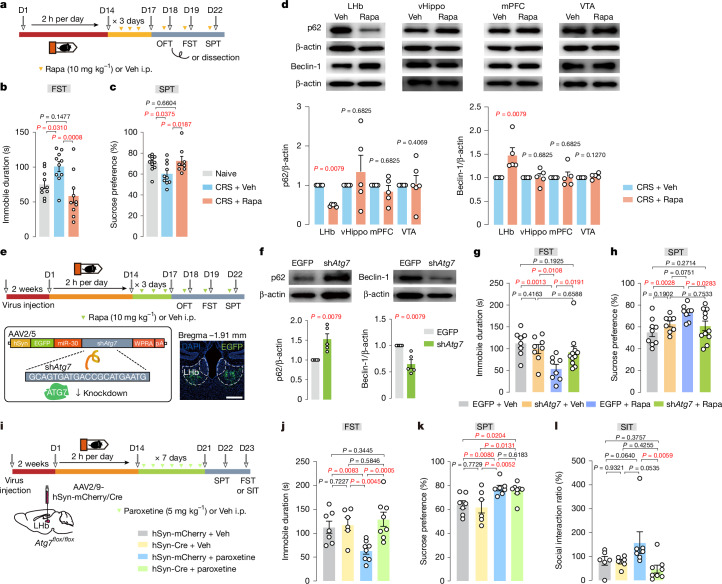
Several drugs enhance LHb autophagy-associated measures in chronically stressed mice. Rapamycin-related improvements in swimming and sucrose measures disappear after LHb Atg7 reduction. Atg7 is an important autophagy component, providing a testable link between recycling and behavior.
Paroxetine reveals a finer distinction: Atg7 deletion weakens swimming and social-interaction benefits, while sucrose-preference improvement remains. Ketamine also lacks the tested behavioral benefits under the corresponding deletion condition. Shared mechanisms can coexist with endpoint-specific differences.
Source: Yang L et al. · Nature · CC BY-NC-ND
Original figure and English caption ↗
Local enhancement changes cellular activity and behavior
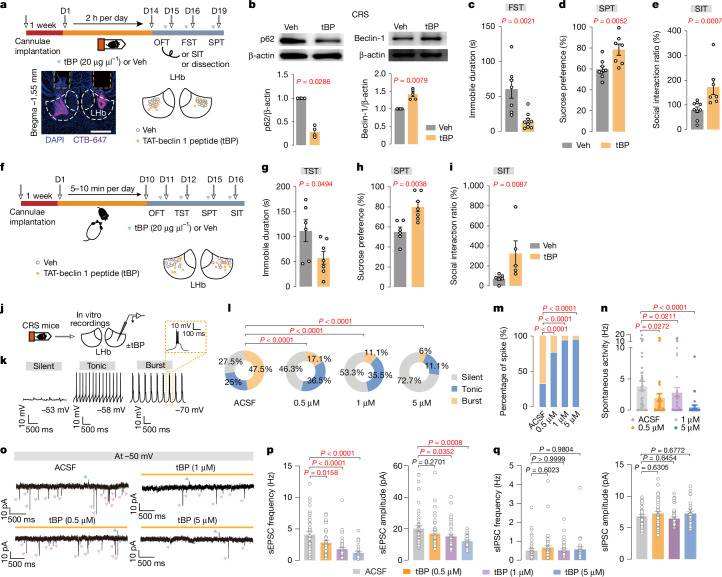
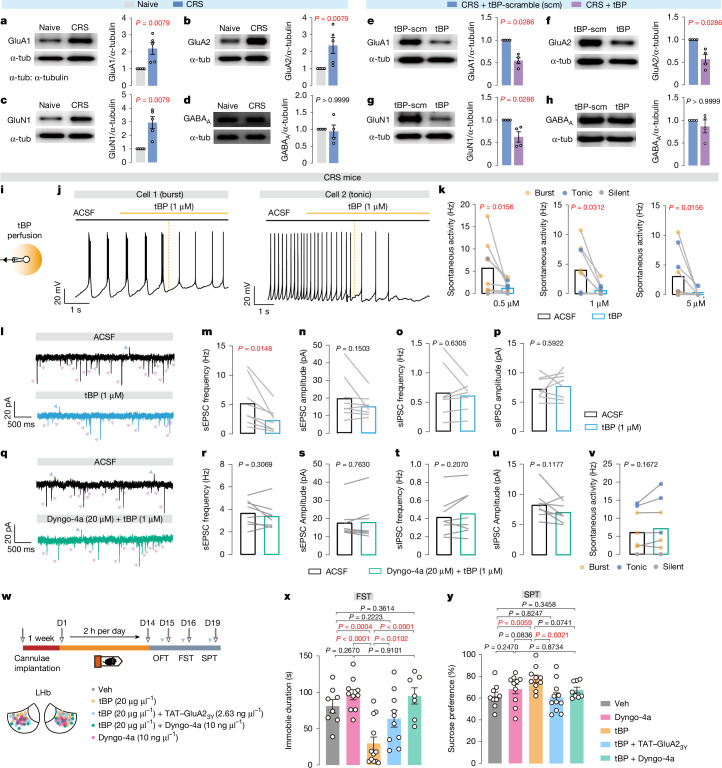
The study uses TAT–Beclin-1 peptide (tBP) to enhance LHb autophagy. Selected behavioral improvements appear within half an hour in chronic-restraint or social-defeat models, without clear changes in locomotion or tested anxiety-like behavior.
LHb neurons in slices become quieter: burst firing and excitatory transmission decrease while inhibitory transmission remains similar. Behavioral benefits remain visible at seven days but not at eighteen to nineteen days, defining the observed time range.
Source: Yang L et al. · Nature · CC BY-NC-ND
Original figure and English caption ↗
Glutamate receptors are important turnover targets
After chronic stress, several glutamate-receptor subunits increase in LHb membrane fractions without a clear GABA-receptor-subunit change. Autophagy enhancement lowers the former, linking signal-receiving proteins with regional excitability.
Immediate recordings show lower spontaneous excitatory-current frequency without clear amplitude or inhibitory-current changes. Blocking endocytosis weakens rapid activity suppression and behavioral benefit; interfering specifically with GluA2 internalization also affects behavior.
Microscopy also identifies receptor-subunit labeling within autophagy-related structures. Turnover can help adjust the weight of synaptic input and how a neuron responds to subsequent stimulation.
Source: Yang L et al. · Nature · CC BY-NC-ND
Original figure and English caption ↗
Autophagy loss strengthens stress responses
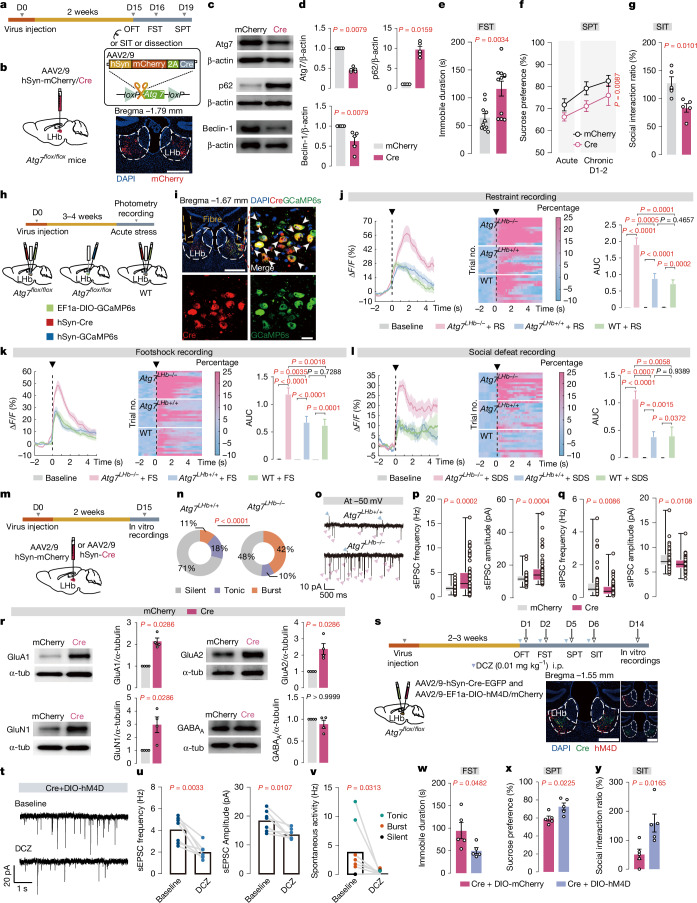
Deleting Atg7 in LHb neurons increases selected depression-like measures even without preceding chronic stress. Calcium responses to restraint, foot stimulation and social defeat grow, burst firing increases and excitatory/inhibitory transmission becomes imbalanced.
Reducing activity in autophagy-deficient cells improves swimming, sucrose and social-interaction measures. Corresponding phenotypes do not similarly appear after the tested deletion in LHb astrocytes or ventral hippocampal neurons, showing cellular and regional specificity.
Source: Yang L et al. · Nature · CC BY-NC-ND
Original figure and English caption ↗
Recycling can adjust synaptic weight
This adult male mouse study places autophagy within dynamic stress adaptation: brief stress engages synaptic-protein regulation, while prolonged stress weakens it and favors excessive activity. Cellular effects of autophagy enhancement also differ across regions and baseline activity states.
Autophagy contributes to whether neurons return toward a stable state after converging inputs, beyond background material clearance. Protein turnover, synaptic change and behavioral responses emerge as different levels of one question.