The cerebellum shapes avoidance: opposing outputs connect movement and affect
A male-mouse study finds that excitatory and inhibitory cerebellar projections to the zona incerta shape exposed-area exploration and place choice, with repeated activity and motor experience altering pathway effects.
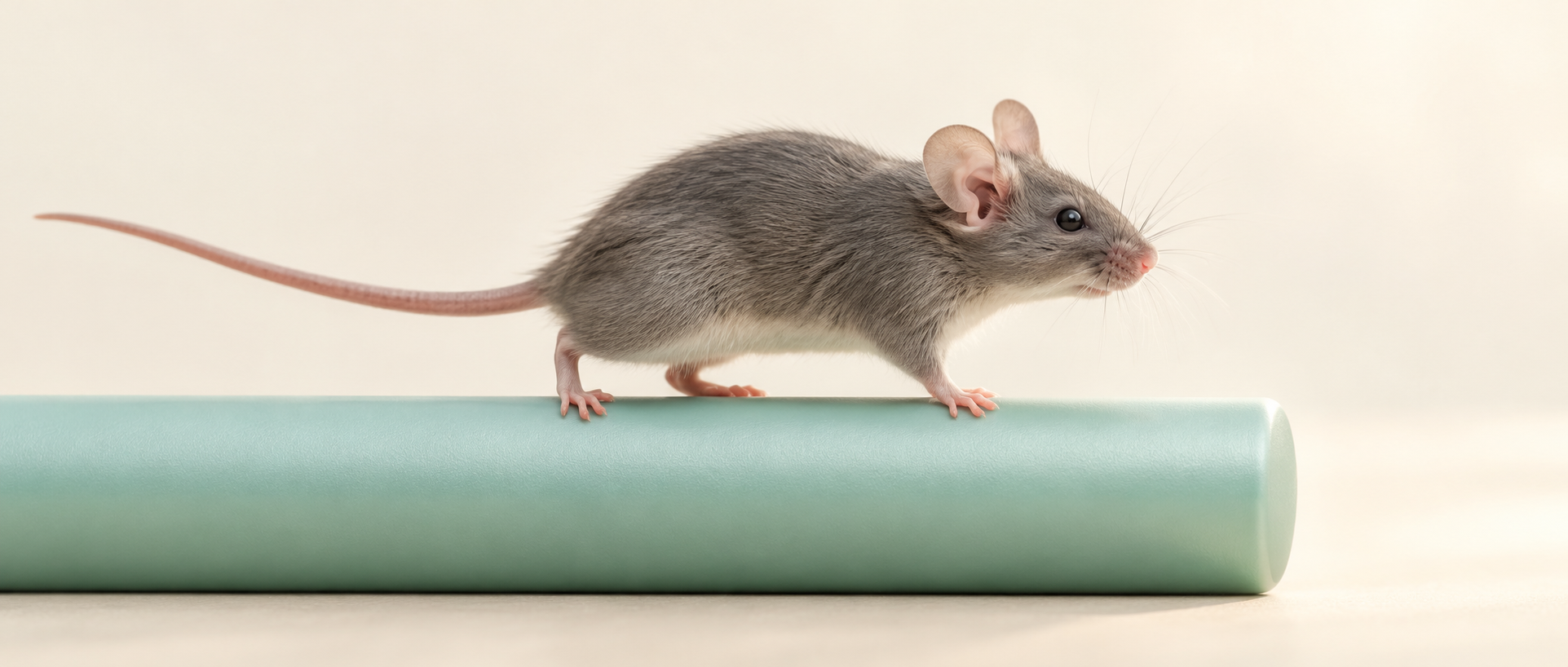
The cerebellum coordinates movement, but its outputs also enter affect-related networks. A study published on April 8, 2025 in Nature Communications finds two opposing signals from mouse cerebellar nuclei to the zona incerta: glutamatergic outputs promote avoidance, whereas GABAergic outputs increase exploration of exposed areas. Both respond to acute stress yet differ in place choice, synaptic changes after repeated activity and behavioral regulation following motor experience. Their effects reveal a story of cell identity and pathway balance.
The cerebellar–zona-incerta pathway contains two projection types with opposing effects; repeated activity accompanies synaptic potentiation, and these pathways also modulate exploration changes after motor experience.
Contents · 7 sections
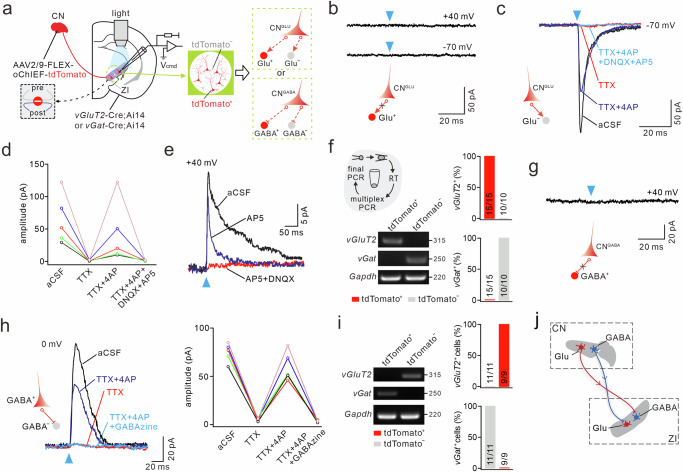
Excitatory inputs reach inhibitory cells, and vice versa
Tracing from the interposed and dentate cerebellar nuclei reveals both glutamatergic and GABAergic projections to nearby parts of the zona incerta. Their targets differ: the former provide excitatory input to GABAergic cells, while the latter provide inhibitory input to glutamatergic cells.
Electrical recordings and cellular markers further support these direct connections. Their crossed organization makes the recipient central: effects depend on both transmitter type and downstream cells. The regional connection contains two branches capable of different outcomes.
Source: Zhao Y et al. · Nature communications · CC BY-NC-ND
Original figure and English caption ↗
Both branches respond, with different amplitudes and durations
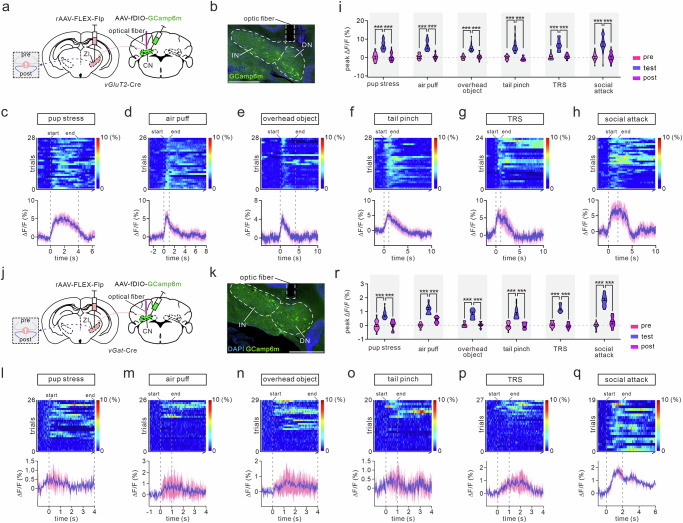
During acute stress events such as air puffs, overhead objects and social attacks, both cerebellar projection populations show calcium responses. Glutamatergic responses are generally larger and longer, whereas GABAergic responses are smaller and briefer, showing distinct dynamics for shared events.
During a brief sucrose-pellet consumption observation, neither population shows a clear calcium change. The contrast with stress responses motivates a behavioral question: how does activating these outputs alter exploration of exposed areas and choice of location?
Source: Zhao Y et al. · Nature communications · CC BY-NC-ND
Original figure and English caption ↗
Activating glutamatergic output reduces exposed-area exploration
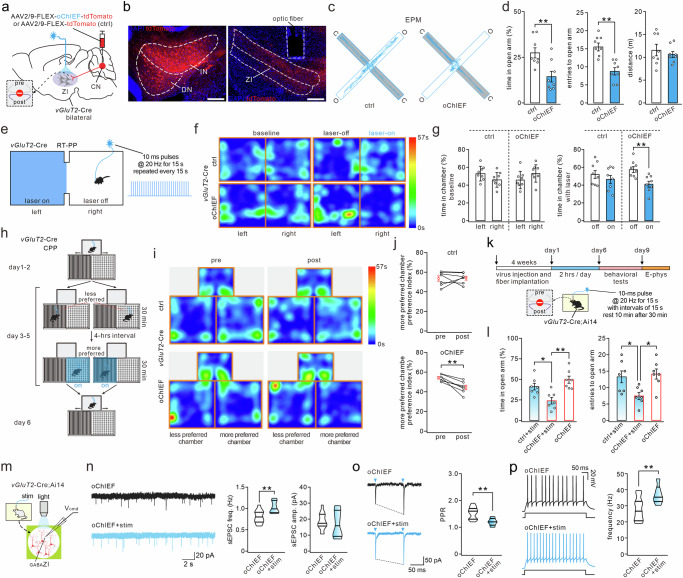
Activating glutamatergic terminals reduces open-arm entries and time in the elevated plus maze, and reduces open-field center exploration, while overall travel and other locomotor measures remain broadly unchanged. Mice also avoid the stimulation-associated compartment, with learned place avoidance after conditioning.
The branch influences both exposed-area exploration and place choice, extending the findings beyond an activity marker. These observations indicate stronger avoidance, while relatively stable locomotor measures focus attention on how animals choose among environments.
Source: Zhao Y et al. · Nature communications · CC BY-NC-ND
Original figure and English caption ↗
Suppressing this output increases open-arm exploration
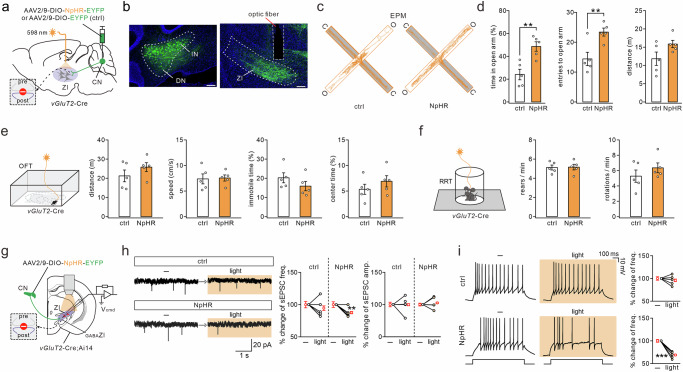
Suppressing glutamatergic output increases open-arm entries and time. Open-field center exploration does not clearly change in unstressed mice, but after acute restraint stress, suppression increases both center and open-arm exploration. Effects therefore vary with behavioral context.
At the cellular level, zona-incerta GABAergic recipient cells show lower spontaneous excitatory-event frequency and reduced firing. Alongside the regional connection, transmission strength and recipient-cell responsiveness change with the behavioral effect.
Source: Zhao Y et al. · Nature communications · CC BY-NC-ND
Original figure and English caption ↗
GABAergic output shifts place choice in the opposite direction
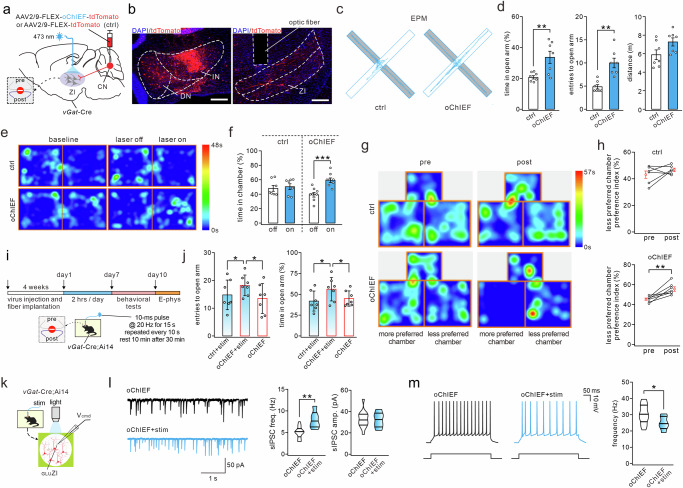
Activating GABAergic output increases open-arm entries and time, and promotes preference for the stimulation-associated compartment. Baseline open-field center exploration does not clearly change, but increases after stress. Outputs from nearby cerebellar regions show opposing tendencies through different cellular connections.
Their recipient effects also differ: GABAergic input inhibits zona-incerta glutamatergic cells, whereas glutamatergic input excites another GABAergic group. Behavioral direction depends on the combination of transmitter, target cells and network position, rather than the transmitter name alone.
Source: Zhao Y et al. · Nature communications · CC BY-NC-ND
Original figure and English caption ↗
Synaptic changes persist for days after repeated activation
After repeated glutamatergic-branch activation, excitatory-event frequency increases and paired-pulse ratio falls, supporting stronger presynaptic transmission. Repeated GABAergic activation increases inhibitory-event frequency. Event amplitudes remain broadly unchanged in both, with some changes still detectable four days later.
Associated exploration changes run in opposite directions: the former reduces open-arm exploration and the latter increases it. Open-field center time does not change in parallel after repeated glutamatergic activation. Activity leaves longer-lasting pathway effects that differ in their expression across tasks.
Motor experience shapes more than movement
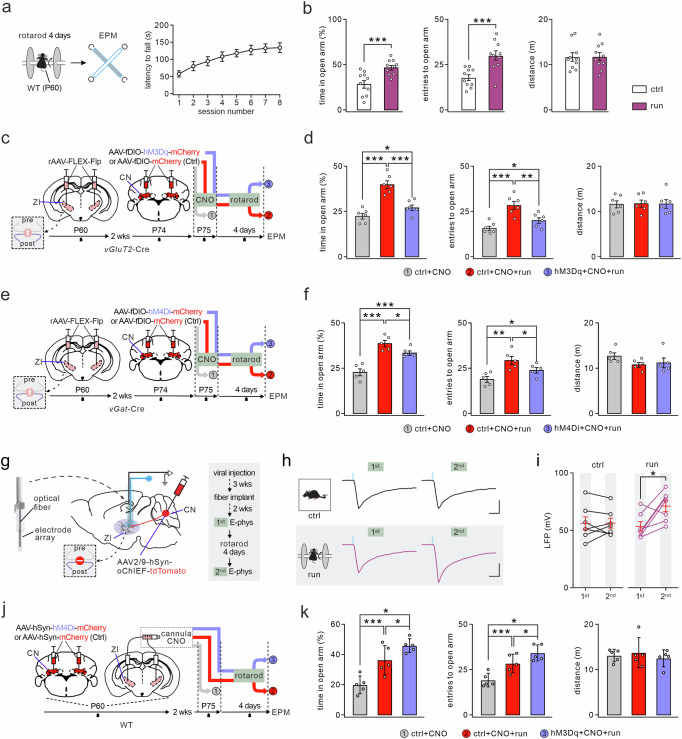
After rotarod motor experience, open-arm exploration increases while travel distance remains broadly unchanged. Increasing glutamatergic activity or suppressing GABAergic activity before training weakens this increase. The overall optically evoked cerebellar–zona-incerta response also strengthens after training, linking motor experience to pathway regulation.
Intriguingly, suppressing the entire cerebellar–zona-incerta output further enhances post-training open-arm exploration. This male-mouse study reveals opposing branches jointly participating in regulation. Which downstream zona-incerta outputs shape exploration remains an open part of the story.
Source: Zhao Y et al. · Nature communications · CC BY-NC-ND
Original figure and English caption ↗