Ketamine’s regional selectivity: activity and receptor reserves
Comparing lateral habenula and hippocampal CA1 in male mice, researchers link ketamine’s early effects to cellular activity and NMDA-receptor reserves, with habenular changes connected to later hippocampal signals.
The same receptor can be found throughout the brain without a drug producing identical effects everywhere. Ketamine’s rapid antidepressant action sharpens the question: which regions respond early, and which changes follow? A 2024 Science study compares lateral habenula and hippocampal CA1 in chronically stressed male mice. Receptor presence is only a starting point; current cellular activity and available receptor reserves influence the strength and persistence of the drug’s effects.
In chronically stressed mice, ketamine rapidly suppresses lateral-habenular NMDA responses and firing without matching early CA1 changes. Manipulating cellular activity changes this sensitivity, and habenular NR1 intervention affects post-ketamine hippocampal signals.
Contents · 7 sections
The same receptor responds differently across two regions
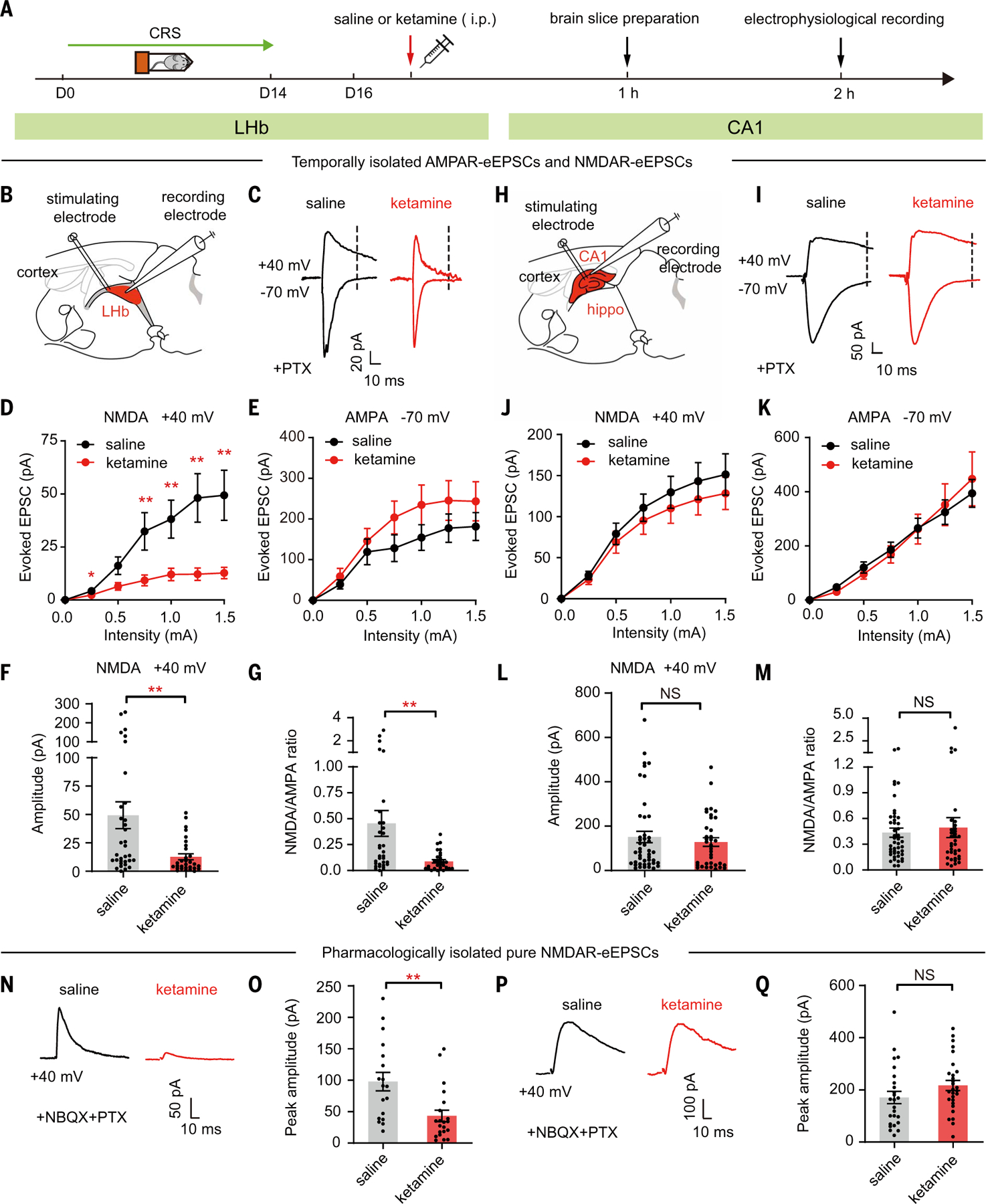
Lateral habenula (LHb) connects with networks involved in negative affect, while CA1 is widely studied in memory and plasticity. Slice recordings after drug administration in chronically restrained mice reveal reduced LHb NMDA-receptor currents without a significant matching decrease in CA1 pyramidal cells.
The difference concerns the tested NMDA responses: AMPA currents do not significantly change in either region. Surface NR1-subunit levels in habenular tissue also remain unchanged after treatment, distinguishing the current reduction from a simple loss of surface receptors.
Source: Min Chen et al. · Science · TDM
Original figure and English caption ↗
More active habenular cells show an earlier firing decrease
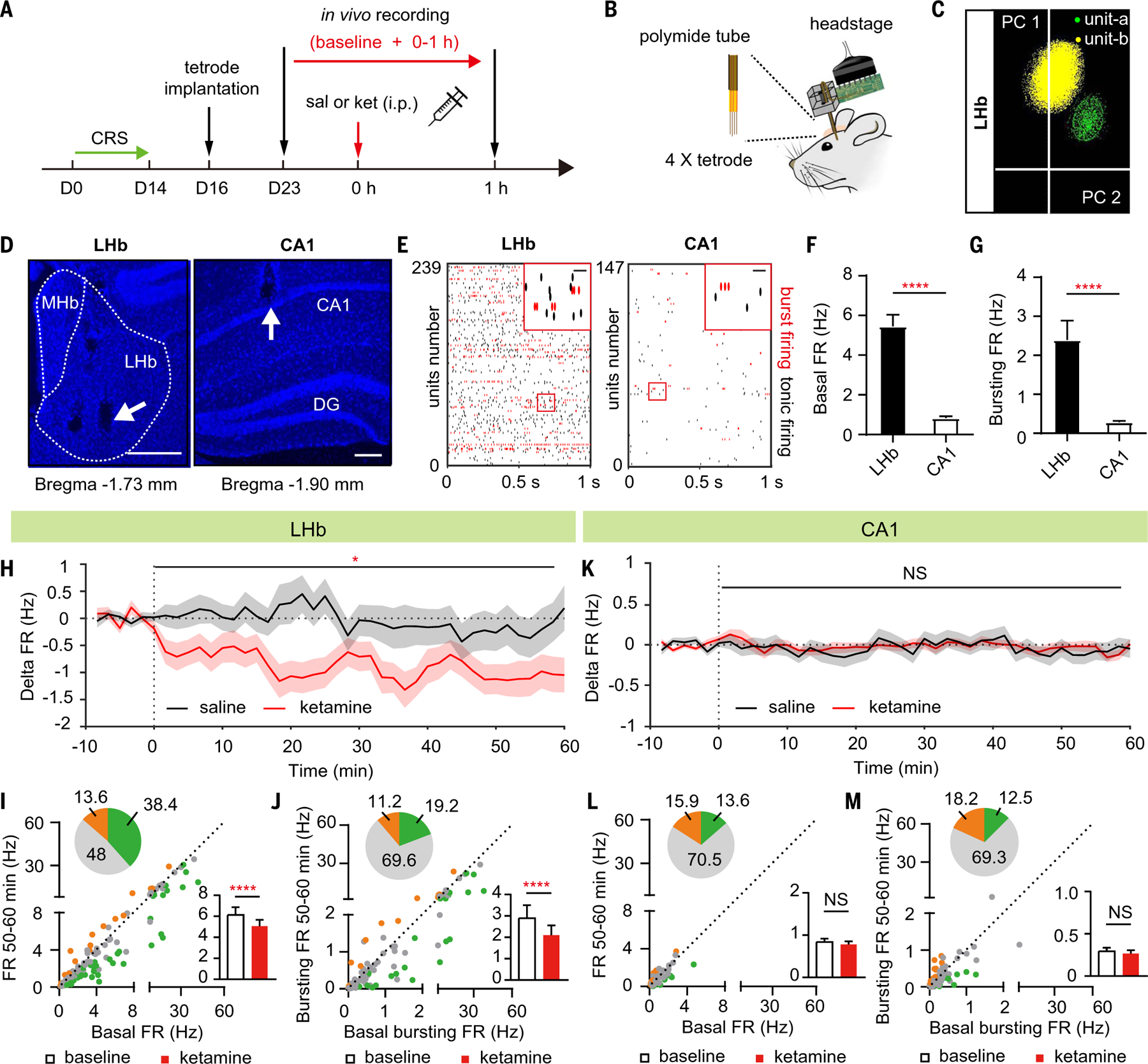
In-vivo recordings establish the timing. Stressed mice show higher baseline overall and burst firing in LHb than in CA1 pyramidal cells. LHb firing decreases rapidly after treatment and remains reduced through the tested hour, whereas CA1 overall and burst firing do not change significantly.
Ketamine can block open NMDA-receptor channels, making activity an important context. More opportunities for receptors to open provide more opportunities for blockade. Within LHb, cells with stronger baseline bursting are also more represented among inhibited cells.
Source: Min Chen et al. · Science · TDM
Original figure and English caption ↗
Without chronic stress, the habenula lacks the same response
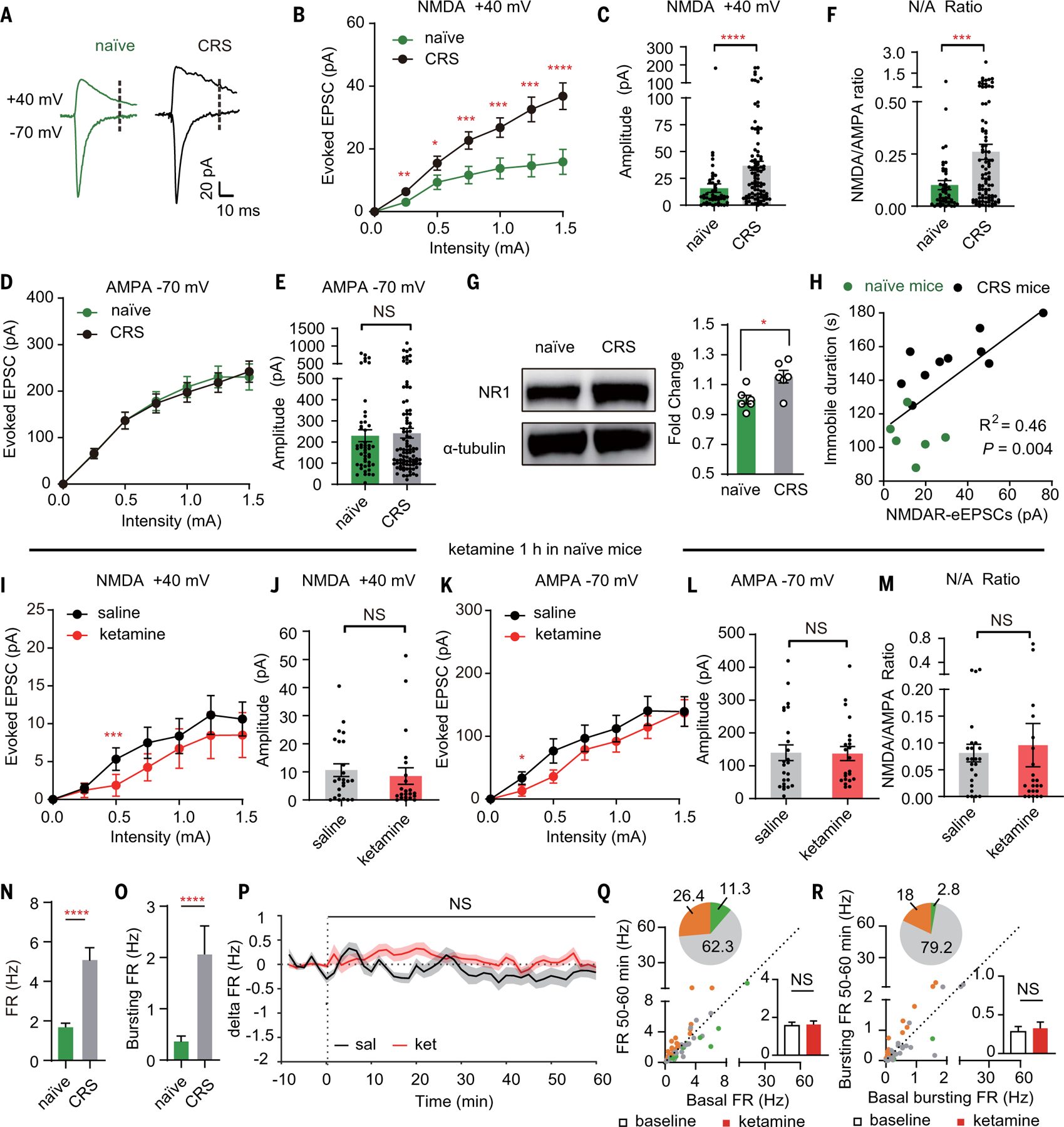
Compared with unstressed mice, stressed mice show stronger LHb NMDA responses, higher membrane NR1 levels and greater firing activity. NMDA-current amplitude correlates with forced-swim immobility, associating cellular responses with the measured behavior.
In unstressed mice, the same treatment does not significantly change overall or burst firing. Current curves differ at some stimulus intensities, but NMDA and AMPA currents at the selected main comparison intensity do not significantly change. The same region can therefore respond differently across states.
Source: Min Chen et al. · Science · TDM
Original figure and English caption ↗
Raising hippocampal activity changes drug sensitivity
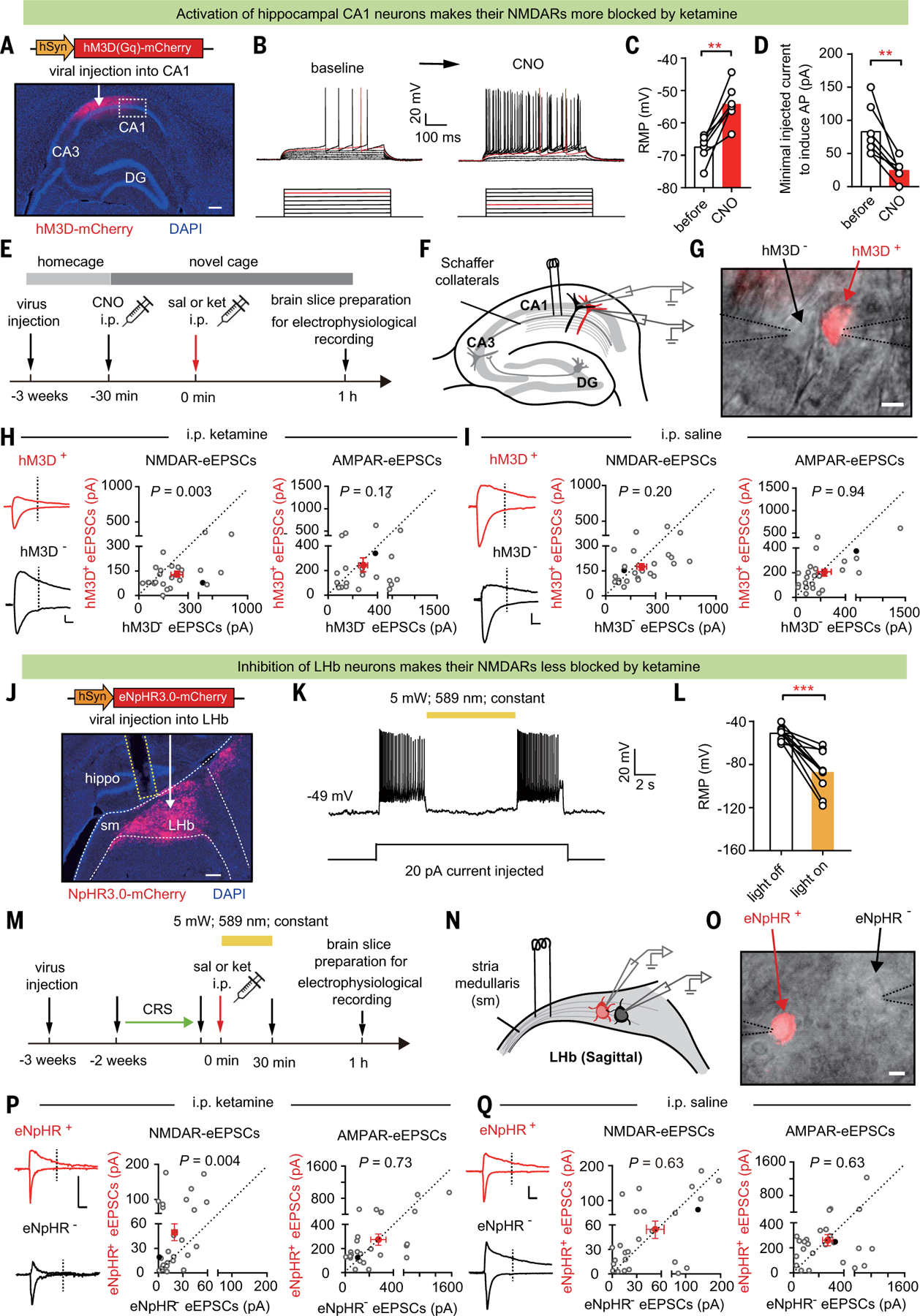
The researchers then manipulate activity rather than only compare existing differences. After increasing activity in a subset of CA1 pyramidal cells, ketamine produces smaller NMDA currents in those cells than in neighboring unactivated cells, while AMPA currents remain similar. Changing activity reveals an early inhibitory effect.
Conversely, reducing activity in a subset of stressed-mouse LHb cells during treatment leaves larger subsequent NMDA currents and weaker blockade in those cells. These complementary results support a contribution of activity to regional drug selectivity.
Source: Min Chen et al. · Science · TDM
Original figure and English caption ↗
Similar blockade can be followed by different recovery
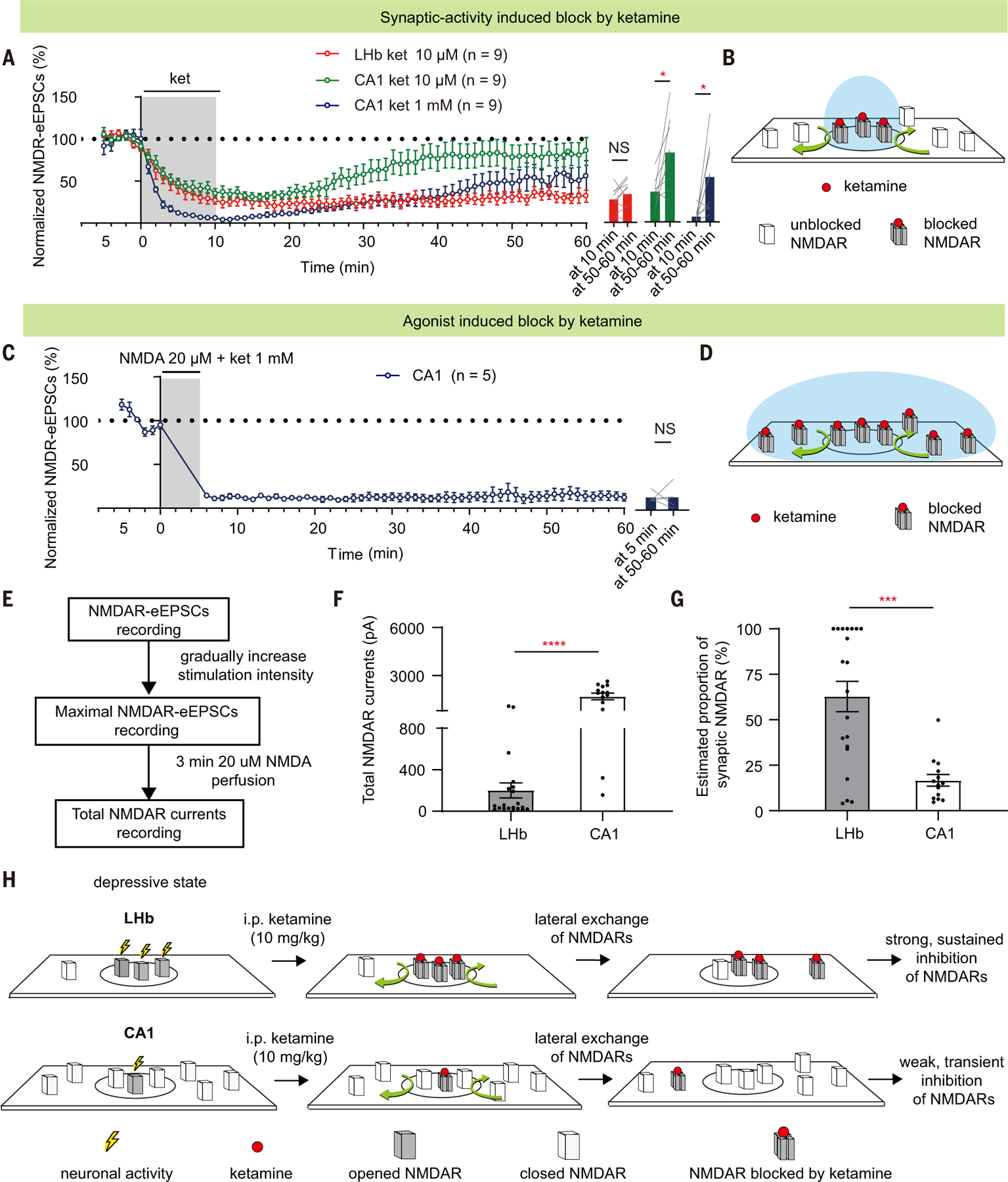
In slices, NMDA currents decrease in both regions during drug exposure, but recover more rapidly in CA1 after washout while LHb remains inhibited. Current-based estimates suggest a larger extrasynaptic receptor reserve in CA1 and a higher synaptic fraction in LHb. Different reserves may shape recovery.
Membrane receptors can exchange laterally between synaptic and extrasynaptic locations. When extrasynaptic CA1 receptors also become available for blockade, washout no longer produces the same rapid recovery. This supports replacement by unblocked receptors as an explanation, with less reserve for replacement in LHb.
Synaptic receptors can be pictured as active stations, with extrasynaptic receptors available as replacements. If some stations are blocked, an adequate unblocked reserve may restore responses; recovery is harder when that reserve is also blocked or initially small. This analogy reflects the proposed membrane-receptor exchange model.
Source: Min Chen et al. · Science · TDM
Original figure and English caption ↗
Habenular changes connect with later hippocampal responses
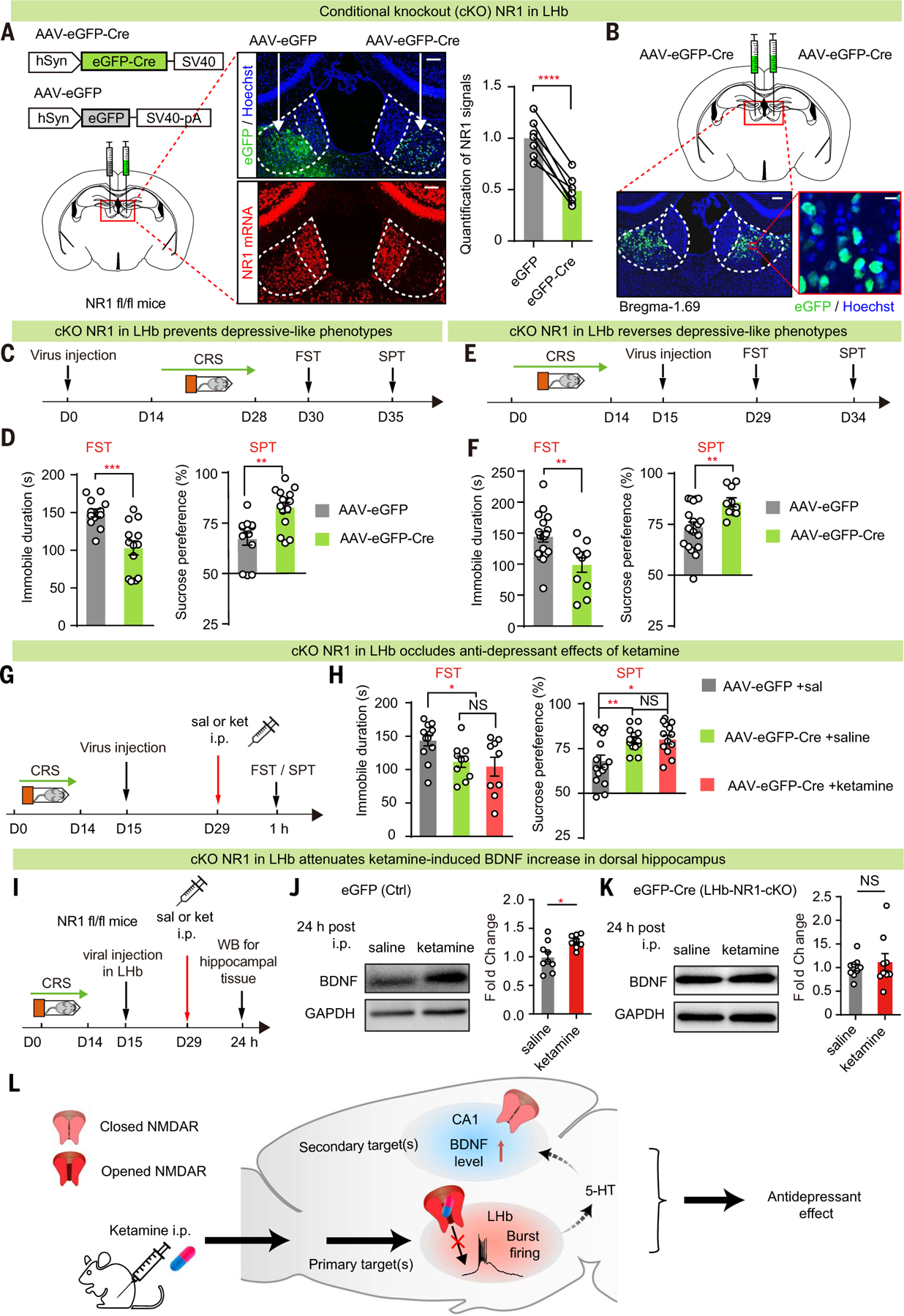
Reducing the obligatory NR1 subunit in LHb shifts forced-swim and sucrose-preference measures toward improvement, whether intervention precedes or follows chronic stress. Ketamine produces no further significant behavioral improvement in mice already receiving the NR1 intervention.
The hippocampus still participates. In controls, hippocampal serotonin signals rise after treatment, followed by a later BDNF increase. These treatment-associated increases are no longer significant after LHb NR1 intervention. The findings support a temporally ordered interregional model linking early habenular changes with subsequent hippocampal signals.
Source: Min Chen et al. · Science · TDM
Original figure and English caption ↗
Regional selectivity emerges from cellular conditions
This adult male mouse study relates drug action to receptor state, cellular activity and available reserves. LHb and CA1 show different early responses while remaining connected through later effects. Understanding how a drug affects the brain therefore involves both its molecular target and when, and in what state, different regions enter the process.