How the mouse brain softens a learned alarm during feeding
A hypothalamic–hindbrain–mammillary pathway regulates learned defensive responses during consumption. Reduced freezing and restored feeding have distinct conditions.
When a danger cue interrupts a meal, should an animal stop or continue replenishing energy? Threat avoidance and nutrition both matter for survival. A study published in Nature Communications on September 4, 2024 examines their interaction in male mice. A sound previously paired with shock interrupted feeding and elicited freezing, yet later cue-evoked freezing declined when fasted mice had food available. The researchers followed connections among the hypothalamus, hindbrain and mammillary body to investigate this regulation.
Threat cues during consumption recruit LH GAD2-marked neurons and NI RLN3 cells. Their connections and LM relaxin signaling contribute to reduced learned freezing, with feeding outcomes not always changing in parallel.
Contents · 6 sections
A meal changes the response to the same cue
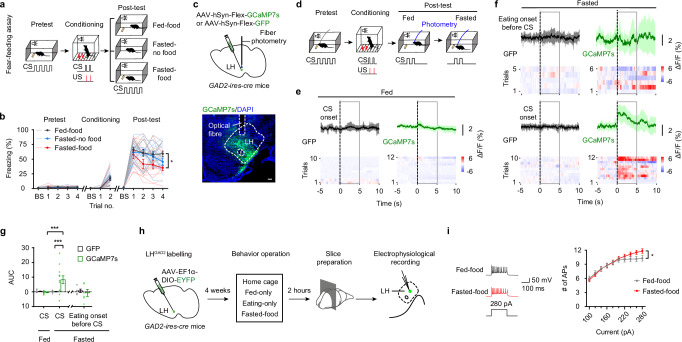
The study compared fed mice with food, fasted mice with food and fasted mice without food. After threat conditioning, the first cue still interrupted consumption. Fasted mice with food showed less freezing during later cues and a modest recovery of eating, connecting defensive responses with bodily need and food availability.
LH GAD2-marked cells increased activity to threat cues during consumption. Corresponding analyses did not find a significant mean increase to cues in the fed state or at eating onset before the cue. This context-dependent response led the study along the population’s downstream connections.
Source: Wang Q et al. · Nature communications · CC BY-NC-ND
Original figure and English caption ↗
GAD2-marked inputs can produce net excitation
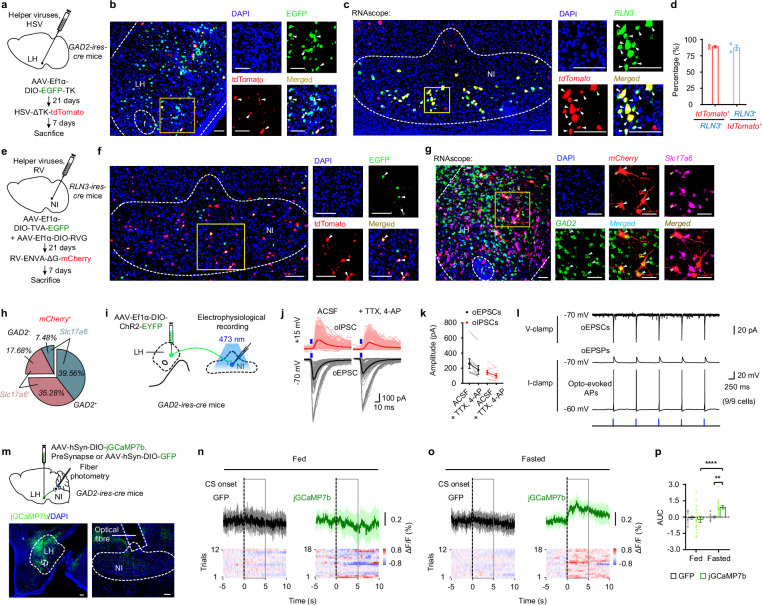
These hypothalamic cells connect to the hindbrain nucleus incertus, or NI, where RLN3-expressing neurons are major targets. Projecting LH cells have different molecular profiles, with some co-expressing glutamatergic and GABAergic transmission markers. Tracing and molecular characterization reveal heterogeneity within the population.
Stimulating these axons elicited direct excitatory and inhibitory inputs in the same NI cell, with depolarization or firing as net outcomes. Terminal activity also increased to cues during consumption in fasted mice. Connectivity and net responses therefore help explain transmission beyond the molecular label alone.
Source: Wang Q et al. · Nature communications · CC BY-NC-ND
Original figure and English caption ↗
Manipulating the connection changes freezing and feeding
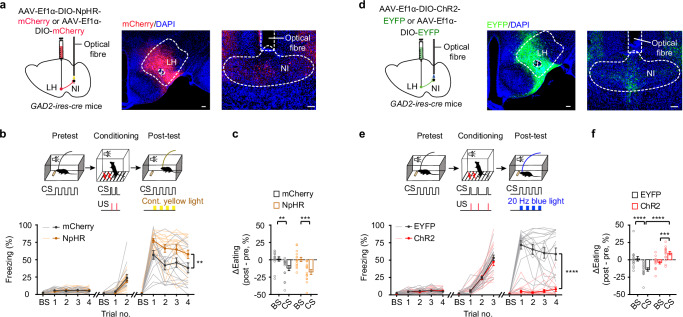
Inhibiting LH-to-NI inputs increased freezing during consumption without significantly changing cue-induced eating suppression. Activation reduced freezing and improved consumption during cues, linking the pathway with defensive regulation while revealing different feeding outcomes across manipulations.
After LH somatic silencing, terminal activation still reduced freezing but did not restore consumption. Activation also reduced learned freezing in a test without food. The pathway can influence defensive responses, whereas restored eating depends on broader LH function, separating components of behaviors occurring in the same setting.
Source: Wang Q et al. · Nature communications · CC BY-NC-ND
Original figure and English caption ↗
NI cells receive a context-dependent alarm
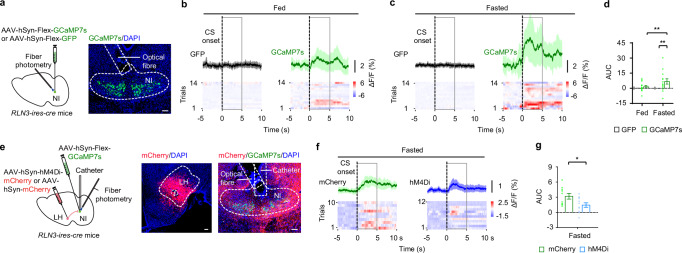
NI RLN3 neurons increased calcium activity to threat cues during consumption in fasted mice, without a significant corresponding increase in the fed state. Activity could decrease at ordinary eating onset, showing different response directions at eating onset and cue presentation.
Suppressing LH inputs weakened RLN3 cue responses without significantly changing eating-onset-related activity. These inputs thus connect hypothalamic function with NI processing of threat cues during consumption.
Source: Wang Q et al. · Nature communications · CC BY-NC-ND
Original figure and English caption ↗
Reducing freezing depends on how cells are recruited
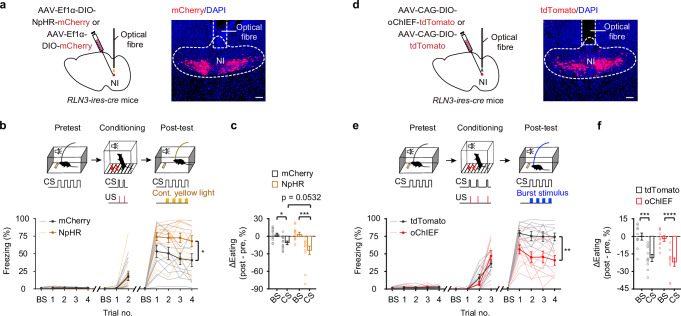
Inhibiting NI RLN3 cells impaired the reduction in freezing during consumption. Activation depended on stimulation pattern: the tested 20-Hz protocol did not significantly alter regulation, whereas burst-pattern recruitment reduced freezing. Different activity patterns produced different behavioral outcomes.
Burst activation did not significantly change cue-induced eating suppression or normal consumption. The measured RLN3 effect therefore centers on defensive responses, while upstream LH-to-NI inputs may affect feeding through additional cells or pathways.
Source: Wang Q et al. · Nature communications · CC BY-NC-ND
Original figure and English caption ↗
The lateral mammillary nucleus receives the signal
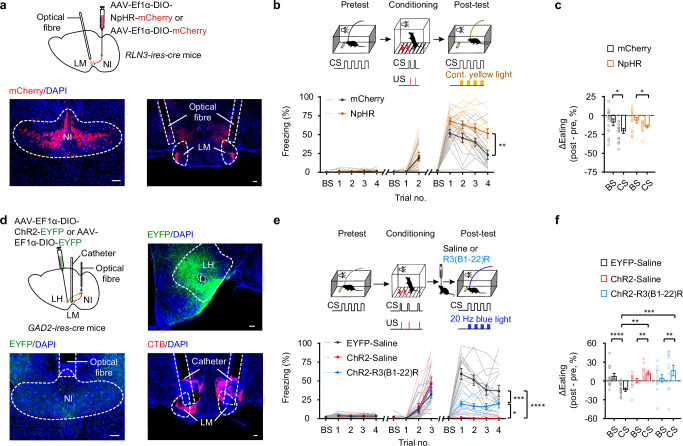
Following RLN3 outputs led to the lateral mammillary nucleus, or LM. Inhibiting NI-to-LM terminals increased freezing during consumption without significantly changing cue-induced eating suppression. Local RXFP3 antagonism partly weakened the freezing reduction from upstream LH-to-NI activation without significantly weakening its feeding effect.
This male-mouse study traces an adjustable LH–NI–LM relationship between bodily need and defensive responses. Connectivity, recruitment pattern and local peptide-receptor signaling contribute to learned freezing during consumption, while feeding recovery shows different intervention outcomes. When these needs meet, defensive and feeding behaviors have related but separable regulation.
Source: Wang Q et al. · Nature communications · CC BY-NC-ND
Original figure and English caption ↗