How ketamine’s effects can outlast its falling concentration
In mice, ketamine can remain trapped in lateral habenula NMDA receptor channels, sustaining inhibition for a day. Neural activity and the surrounding drug concentration influence this process, linking brief exposure to longer behavioral effects.
Why can an effect persist after the surrounding drug has largely disappeared? Ketamine is rapidly eliminated in mice, yet some antidepressant-like behavioral effects last a day. A study published in Nature on October 18, 2023 follows the lateral habenula (LHb) and finds an explanation inside receptor channels: closure can temporarily trap drug molecules that have entered. Average blood or brain-tissue concentrations do not fully describe this local process.
In chronically stressed male mice, ketamine suppresses LHb NMDA receptor currents and burst firing for up to 24 hours. Channel trapping and the opposite effects of neural activation at different ambient drug levels provide causal evidence for this persistence.
Contents · 6 sections
Drug levels and behavior follow different clocks
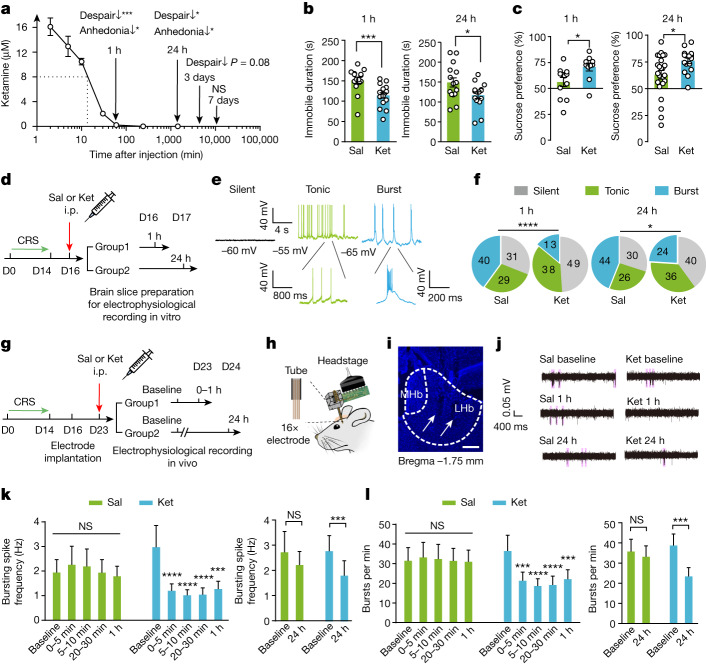
The study first compares two time courses. In male mice exposed to chronic restraint stress, ketamine reduces forced-swim immobility and increases sucrose preference at both 1 and 24 hours. By day 3, the swim measure shows only a nonsignificant trend and sucrose preference no significant improvement; behavioral differences are also nonsignificant by day 7.
Brain drug levels fall much sooner. LHb activity follows the slower time course: both slice recordings and recordings in freely moving mice show burst suppression at 24 hours, but no significant suppression by day 3. Cells with higher baseline bursting are preferentially affected.
Source: Ma S et al. · Nature · CC BY
Original figure and English caption ↗
NMDA currents remain low after ambient drug declines
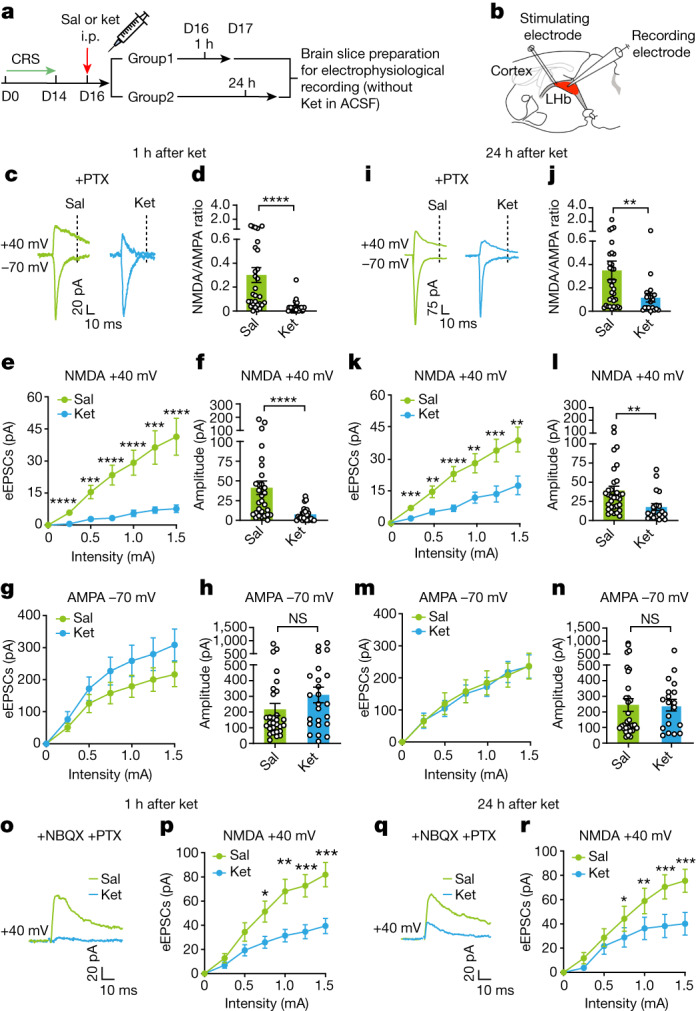
NMDA receptors (NMDARs) contribute to LHb bursting. At 24 hours, NMDAR currents in LHb neurons remain markedly reduced, while current amplitudes mediated by AMPA receptors show no significant change. The persistent effect therefore distinguishes receptor components rather than shutting down all excitation.
Notably, the slices have already been removed from the animals and spent considerable time in ketamine-free fluid before recording, yet the inhibition persists. Attention shifts from the total amount of drug in the brain to what happens after a molecule encounters its receptor.
Source: Ma S et al. · Nature · CC BY
Original figure and English caption ↗
A molecule can remain after the gate closes
Ketamine is an open-channel blocker: it can enter an open pore and remain inside when the channel closes. The analogy is a door that briefly opens and shuts; molecules outside may disperse while some remain within. Reopening provides an opportunity for release.
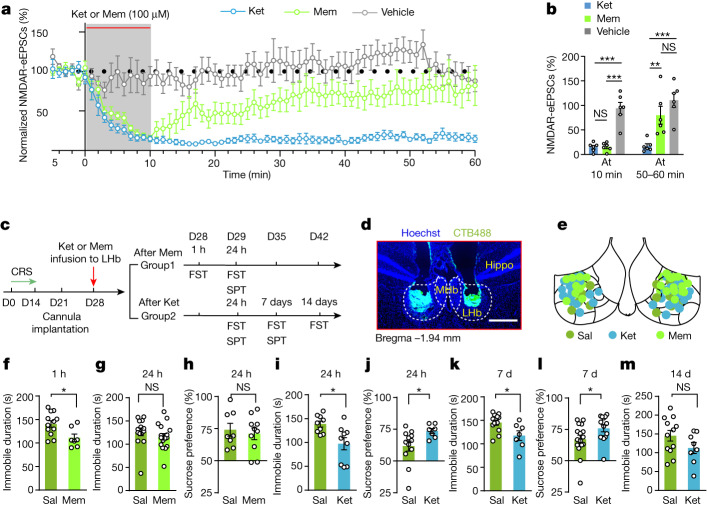
Slice comparisons support this explanation. Both ketamine and the channel blocker memantine reduce NMDAR currents, but after removal from the surrounding fluid, currents recover much faster with memantine. Ketamine-associated inhibition persists even when receptor endocytosis is inhibited, indicating more than simply moving receptors into the cell.
Local LHb treatment also produces different durations. Ketamine-associated behavioral improvements remain at one day and one week, while memantine’s one-day effects are nonsignificant. The swim measure is likewise no longer significantly improved two weeks after local ketamine, defining a time range for this persistence.
Source: Ma S et al. · Nature · CC BY
Original figure and English caption ↗
Reopening channels allows current recovery
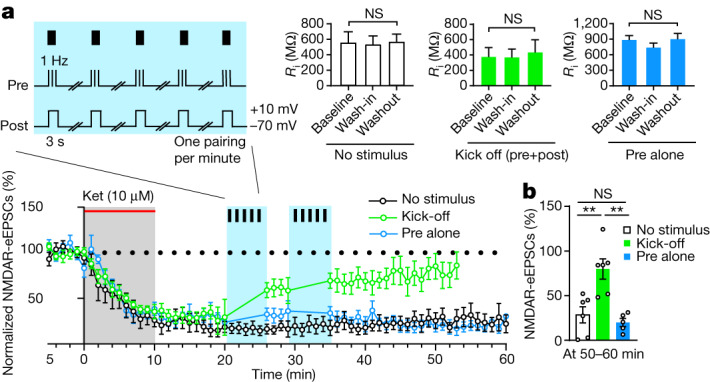
Can neural activity alter the fate of a trapped molecule? Combining synaptic input with postsynaptic depolarization creates conditions for NMDAR reopening. After ketamine has been removed from the surrounding fluid, this combined activity substantially restores the otherwise persistently suppressed current.
Presynaptic stimulation alone does not produce comparable recovery, and the combined activity does not cause sustained current enhancement in cells without prior ketamine exposure. These controls support relief of the existing blockade over an explanation based simply on new synaptic potentiation.
Source: Ma S et al. · Nature · CC BY
Original figure and English caption ↗
The same input can shift persistence in opposite directions
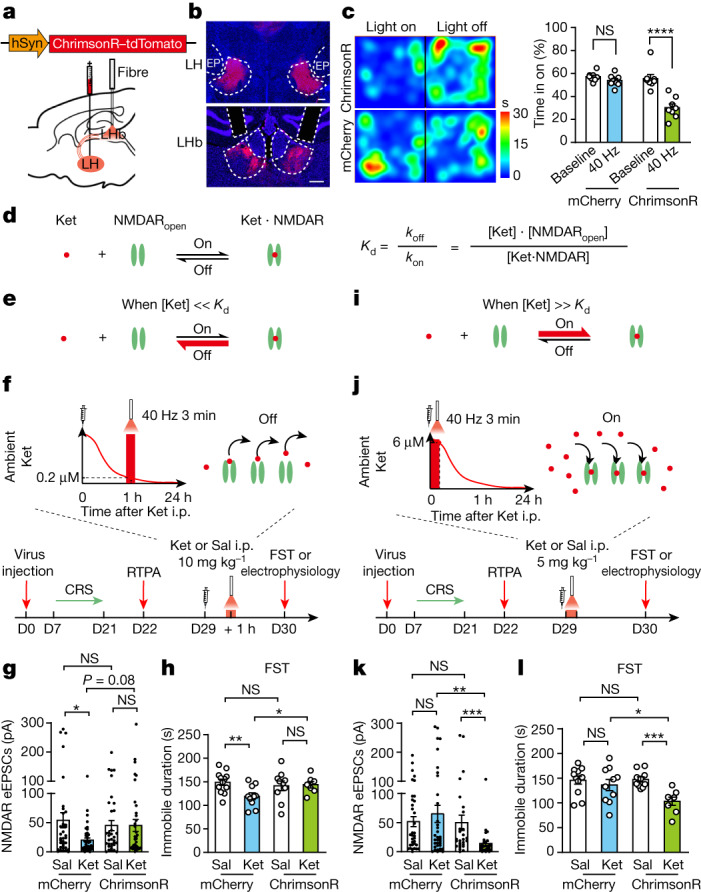
In living animals, the researchers examine input from the lateral hypothalamus to the LHb. Activating this input when ambient ketamine is low leaves no significant drug-associated NMDAR-current suppression or persistent swim improvement in the stimulated group at one day; the control group without light-driven activation retains the behavioral improvement.
A separate experiment increases input while ambient drug levels are high. Under this lower-dose condition, control animals no longer show significant behavioral improvement at one day, whereas input-activated animals retain lower NMDAR currents and reduced swim immobility. Channel opening can allow either exit of retained molecules or entry of surrounding molecules; the environment influences the net direction.
Source: Ma S et al. · Nature · CC BY
Original figure and English caption ↗
The target helps determine how long an effect lasts
The study adds a timescale beyond clearance from blood and tissue. Falling drug concentrations do not mean that every interaction with a receptor has ended. Channel openings and local neural activity can influence how long a drug remains at its target and how long behavioral effects persist.
These findings from adult male mice and brain slices reveal a contribution of LHb receptor trapping to persistence over one day. Longer effects may still involve synaptic plasticity and other processes. A brief exposure leaving a longer-lasting effect now has a testable molecular explanation.