How finely are partners distinguished? Oxytocin dose and timing in PAG
Mice show different recognition patterns for same- and other-strain partners. Early rearing and PAG oxytocin alter selected outcomes, with a notable low-dose effect late in testing.
Repeated encounters with one partner reduce investigation, while replacing it may restore interest. Does this response depend on partner origin and early experience? A Communications Biology study compares C57BL/6 and Kunming mice and examines oxytocin, or OXT, signals in ventrolateral periaqueductal gray, or vlPAG. Recognition responses vary with partner group and can change with rearing, local dose and treatment timing.
C57 mice respond clearly to a new same-strain individual but not equivalently to another Kunming mouse. OXT at 0.01 micromolar after the fourth encounter allows a response to a new other-strain individual; higher concentrations do not reproduce it.
Contents · 7 sections
A new same-strain partner renews investigation
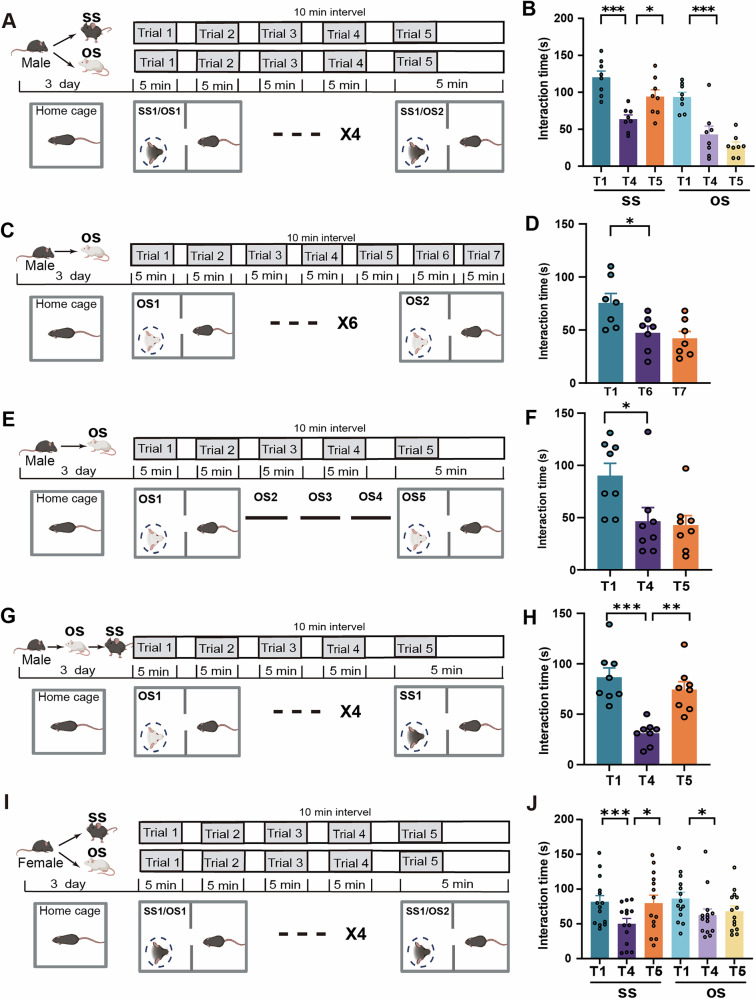
The first four encounters use one stimulus mouse and the fifth a new individual. C57 investigation falls with a repeated same-strain partner and rises on replacement. With Kunming partners it falls but does not significantly rise for another Kunming mouse.
The authors term these individualized and categorized patterns. More encounters do not restore a clear response to another Kunming individual, whereas switching from Kunming to C57 increases investigation. The initial female comparison shows the same direction; subsequent experiments focus on males.
Even when each of five encounters uses a different Kunming individual, C57 investigation declines. Repeated individual replacement within this group does not continually renew interest, unlike the same-strain replacement pattern.
Source: Peng K et al. · Communications biology · CC BY-NC-ND
Original figure and English caption ↗
Mixed-rearing outcomes depend on dam origin
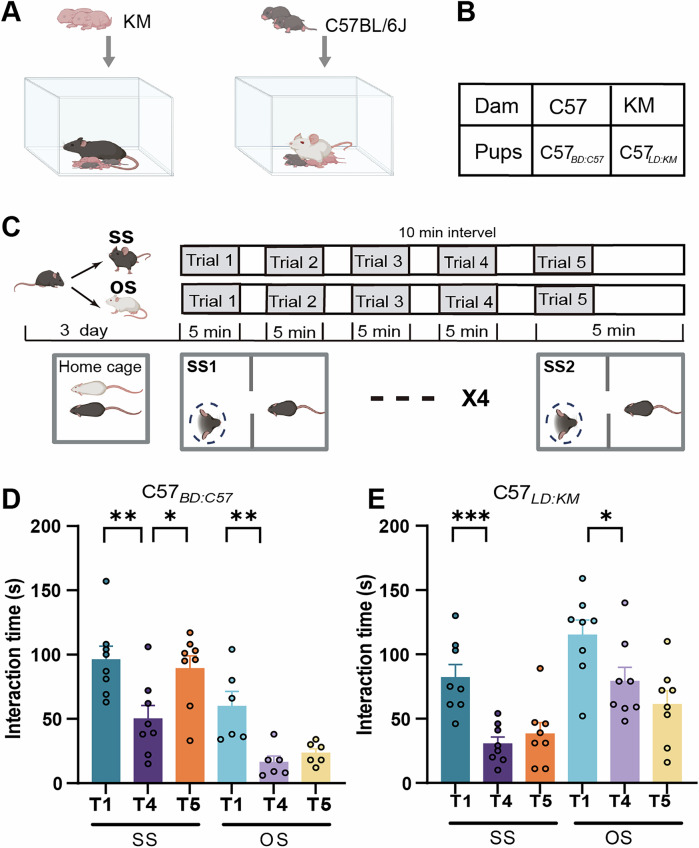
After mixed rearing under C57 dams, adult C57 mice retain same-strain individual discrimination and categorized Kunming responses. Increased early contact does not broadly improve other-group individual recognition.
Under Kunming dams, renewed interaction with a new same-strain individual becomes nonsignificant, including replacement among C57 littermates. Adult recognition patterns change in a rearing-dependent direction.
Source: Peng K et al. · Communications biology · CC BY-NC-ND
Original figure and English caption ↗
Weaker individual responses coexist with litter-related discrimination
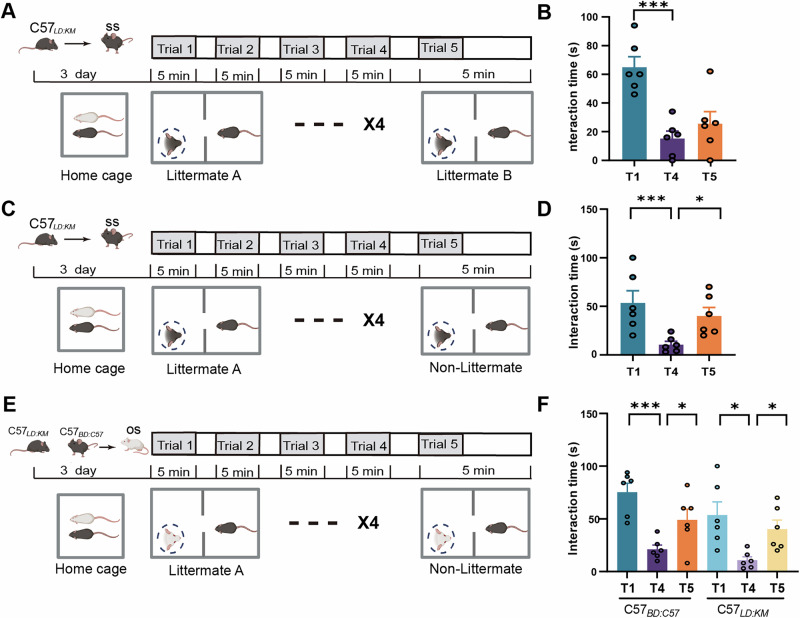
Kunming-reared C57 mice do not clearly renew interaction when one C57 littermate replaces another, but do so when the new C57 comes from another litter. Shared-rearing origin still differentiates responses.
Both mixed-rearing groups respond to replacement of a Kunming littermate with a non-littermate. Response patterns therefore differ across individual-level and shared-rearing distinctions.
Source: Peng K et al. · Communications biology · CC BY-NC-ND
Original figure and English caption ↗
Partner origin corresponds to different PAG oxytocin signals
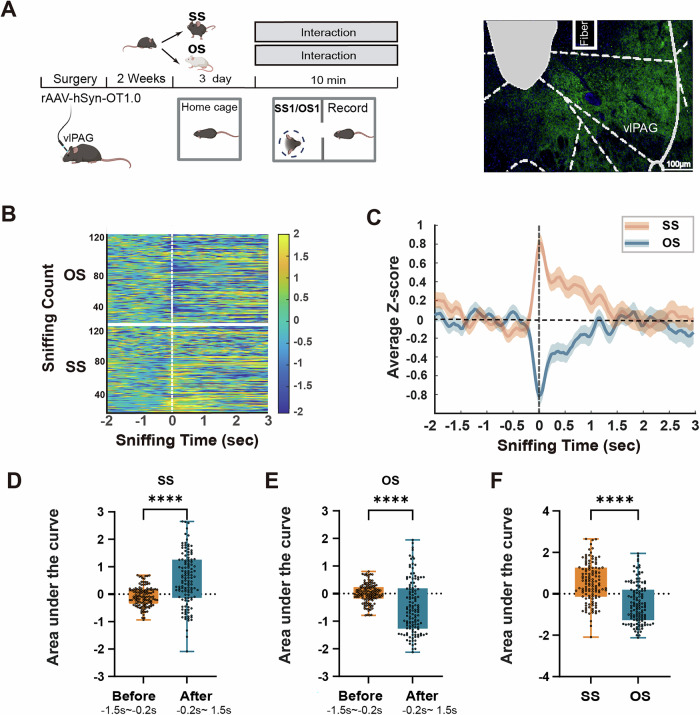
Social contact increases vlPAG c-Fos, more strongly after same-strain contact. Oxytocin-sensor signals rise during same-strain sniffing and fall during Kunming sniffing, diverging near sniff onset.
The changes associate partner origin with local neuropeptide signals. Region and interaction context motivate direct tests of receptor and OXT modulation in the recognition task.
Source: Peng K et al. · Communications biology · CC BY-NC-ND
Original figure and English caption ↗
Receptor blockade changes interaction-time patterns
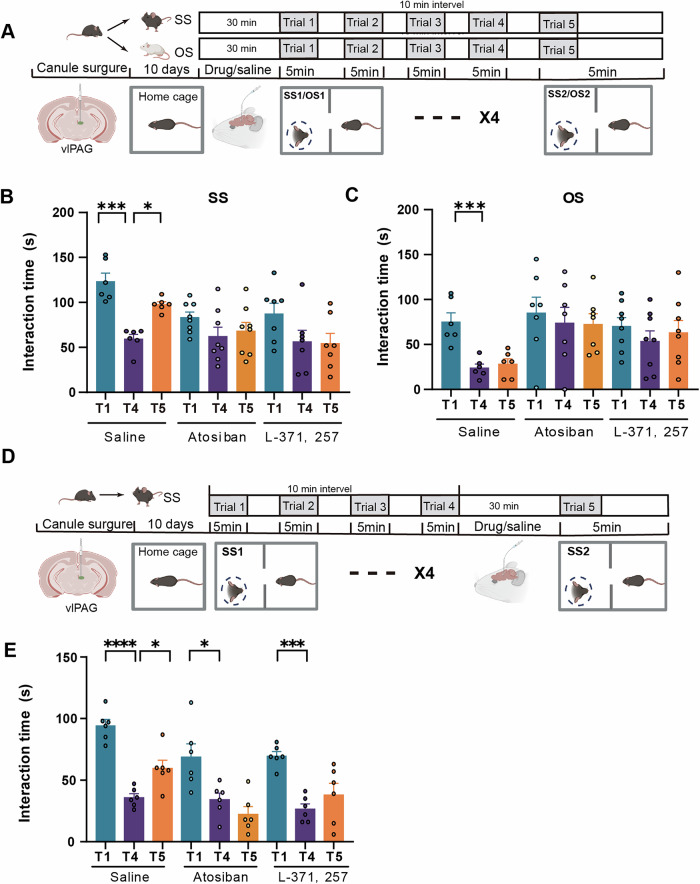
Local OXT-receptor blockade before testing leaves both repeated-encounter decline and replacement-related increase without clear differences. Two antagonists show similar patterns.
When blockade follows the fourth encounter, prior habituation is present but replacement-related interaction does not significantly rise. Timing distinguishes the effects on established habituation and renewed investigation.
Source: Peng K et al. · Communications biology · CC BY-NC-ND
Original figure and English caption ↗
Later low-dose treatment alters other-group recognition
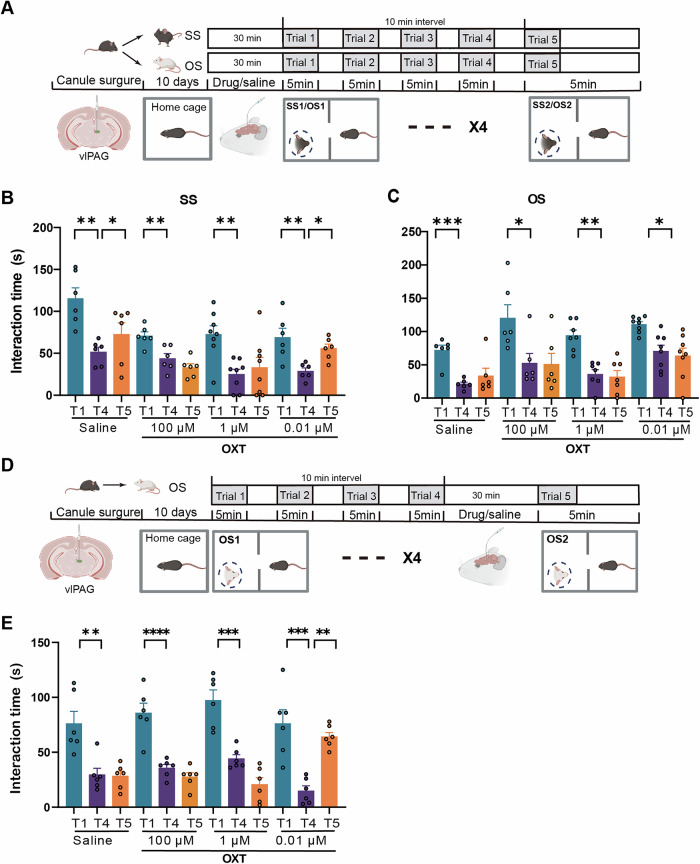
Before testing, two higher OXT concentrations shift same-strain individualized responses toward a categorized pattern; the lowest preserves the original response. None clearly restores a response to another Kunming individual when given before testing.
Changing the timing changes the outcome: after the fourth encounter, the lowest tested concentration produces a clear recovery of interaction with another Kunming mouse, whereas the two higher concentrations do not reproduce the effect. Dose and stage together influence the response to a new partner.
Source: Peng K et al. · Communications biology · CC BY-NC-ND
Original figure and English caption ↗
Recognition responses also relate to social novelty preference
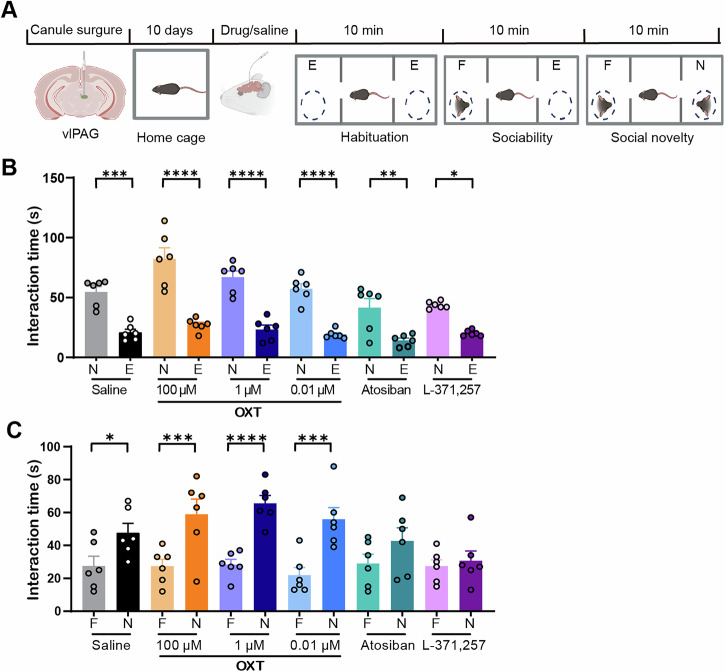
All treatment groups retain preference for a mouse over an empty cage. OXT groups also prefer a novel partner, while antagonist groups lack a significant novel/familiar difference, echoing altered replacement responses in the repeated-encounter task.
Partner origin, early experience and local neuropeptide modulation shape mouse recognition responses. Habituation, individual replacement and novelty preference have distinct patterns, with OXT effects depending on dose and timing.
Source: Peng K et al. · Communications biology · CC BY-NC-ND
Original figure and English caption ↗