How does the amygdala signal back upstream? Chemical feedback on a CCK input
Entorhinal CCK output contributes to stress-related behavior, while recipient mGluR5 and endocannabinoid signaling limit peptide release and potentiation.
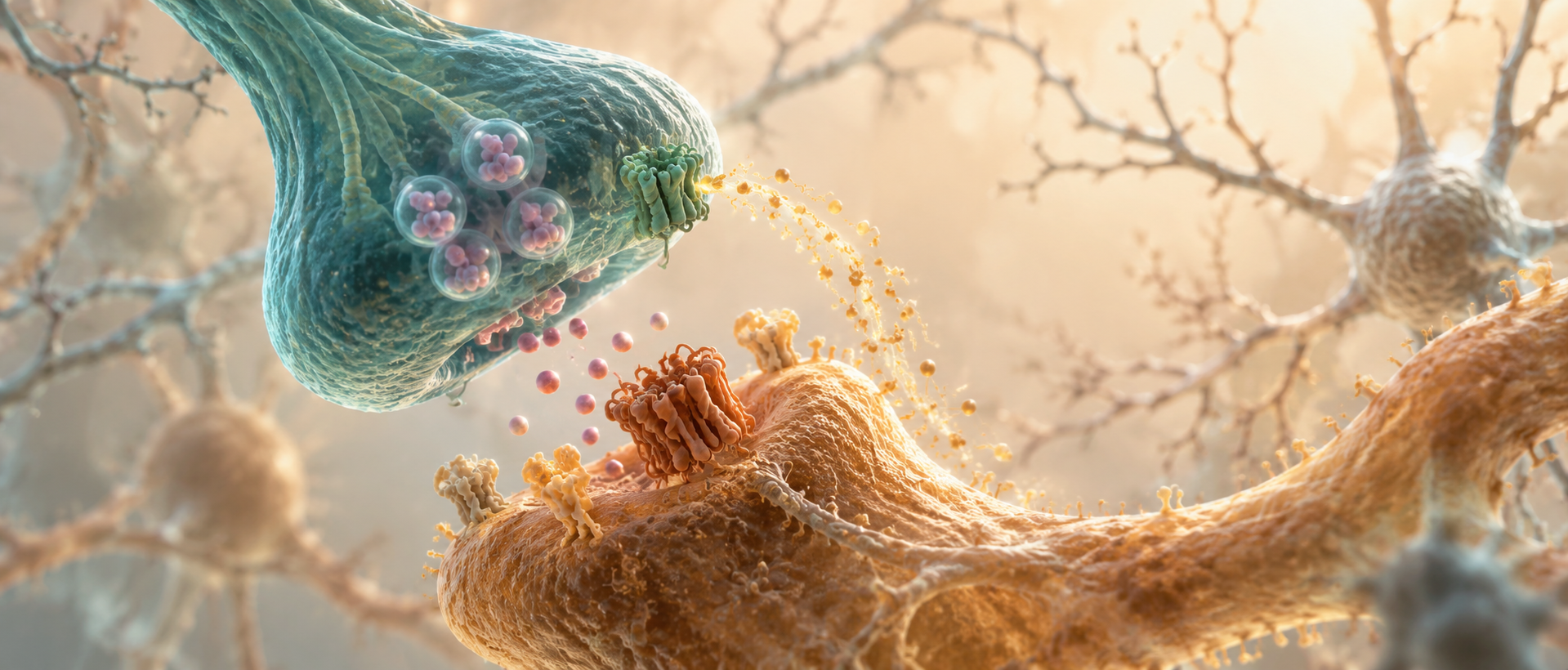
Signals reach a recipient cell, but the recipient can also influence the sending terminal. In an entorhinal–basolateral-amygdala connection, researchers linked CCK input to stress-related behavior and recipient mGluR5 to chemical feedback that changes peptide release and potentiation.
EC CCK output alters stress-model behavior. BLA mGluR5 activation reduces CCK-sensor signals and LTP, modified by CCK replacement or CB1 blockade, supporting a local feedback model.
Contents · 6 sections
CCK input reaches amygdala and affects behavior under stress
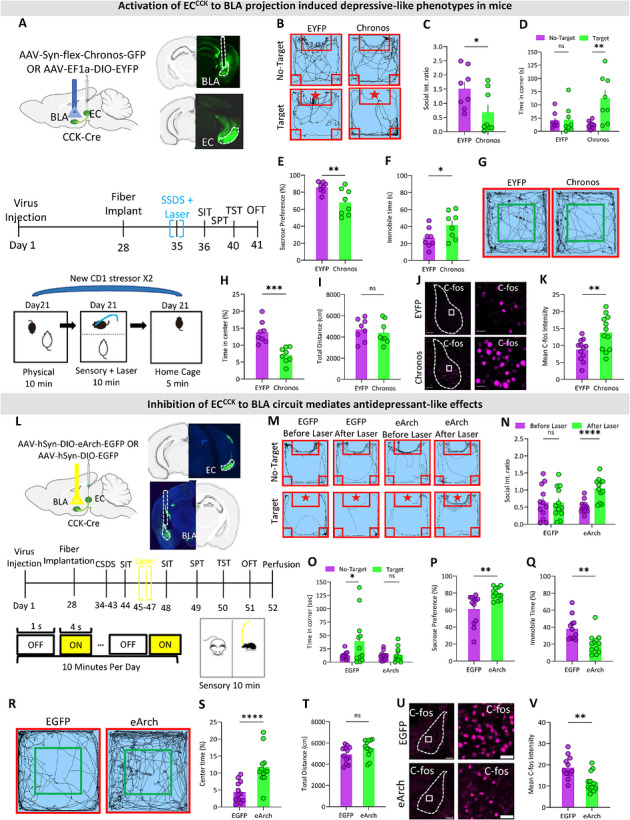
CCK, cholecystokinin, is a peptide signal that modulates neural communication. Tracing identified EC CCK projections to BLA. Stimulation increased excitatory-population calcium activity and produced place avoidance, linking the input to recipient activity and place choice.
Terminal activation during weaker defeat reduced social and sucrose preferences and increased immobility; inhibition in chronic defeat improved related measures with comparable distance. This led to a question about recipient-side regulation of the input.
Source: Asim M et al. · Advanced science (Weinheim, Baden-Wurttemberg, Germany) · CC BY
Original figure and English caption ↗
Recipient mGluR5 decreases after stress
After chronic defeat, BLA mGluR5 protein declined while total CB1 remained comparable. Expansion microscopy placed much mGluR5 near recipient excitatory cells/postsynaptic markers, with a smaller terminal signal, directing attention to the receiving side.
As a metabotropic glutamate receptor, mGluR5 regulates intracellular signaling. With upstream excitation and CCK release arriving together, the team combined receptor pharmacology and CCK conditions to test whether recipient regulation affects peptide-related behavior.
Receptor effects vary with CCK availability
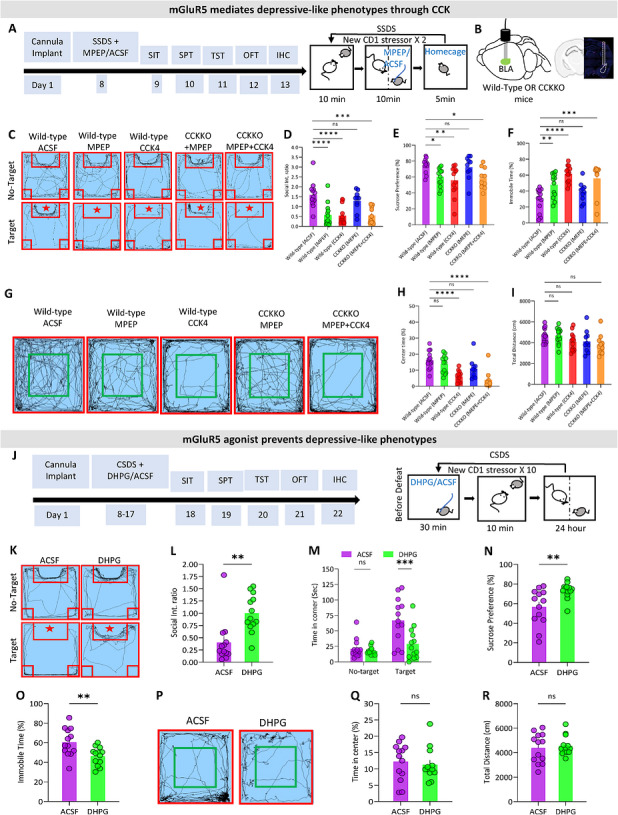
Local BLA mGluR5 blockade changed several measures after weaker defeat. Effects weakened in CCK-deficient mice and returned with CCK-4 replacement, implicating peptide availability in the receptor-related change.
Agonist before each defeat improved later social, sucrose and immobility measures, without significant center-time improvement and with comparable distance. Protection during stress therefore varied across tasks.
Source: Asim M et al. · Advanced science (Weinheim, Baden-Wurttemberg, Germany) · CC BY
Original figure and English caption ↗
Reduced peptide release accompanies weaker potentiation
Long-term potentiation describes a connection becoming stronger after stimulation. It is studied in learning, but stress-related connections are also plastic. Measuring it at EC–BLA input allowed comparison with stress-related behavior.
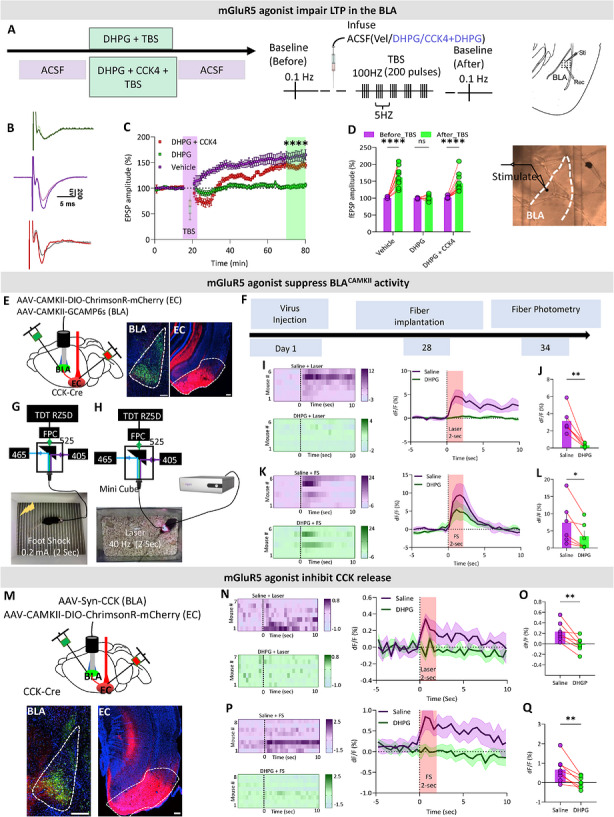
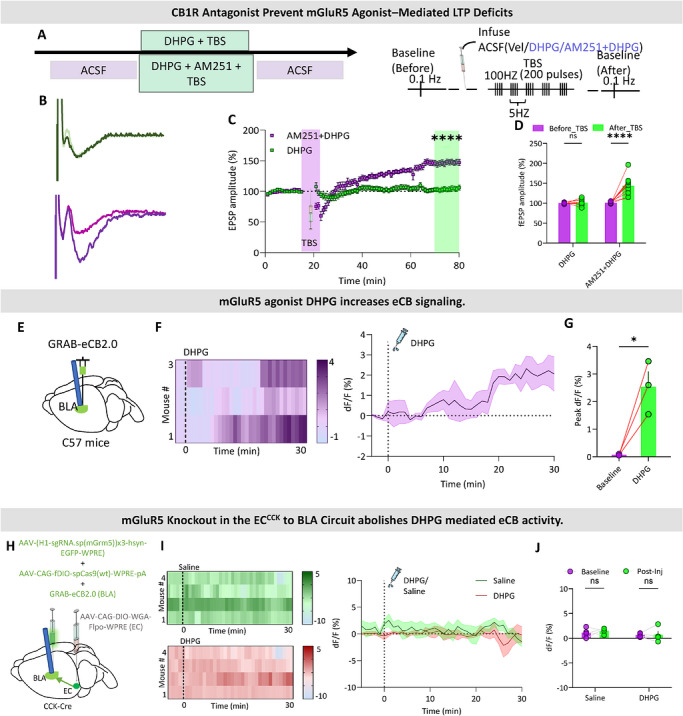
Agonism reduced BLA theta-burst-induced LTP, partly restored by CCK-4; CCK deletion also weakened potentiation. EC-evoked BLA calcium and CCK-sensor signals, and related footshock signals, decreased in vivo. These converge across peptide and input levels while remaining distinct measures.
Antagonism produced only a nonsignificant trend toward greater shock responses. Agonism weakened local potentiation while improving some stress measures, showing that plasticity must be read in circuit context. The next question concerned the retrograde chemical signal.
Source: Asim M et al. · Advanced science (Weinheim, Baden-Wurttemberg, Germany) · CC BY
Original figure and English caption ↗
Endocannabinoids provide a route back to the terminal
The proposed pathway recruits endocannabinoids through postsynaptic mGluR5, acting on terminal CB1 to limit CCK release. CB1 blockade weakened agonist-associated LTP suppression; chemical signals increased after agonism, absent after input-related mGluR5 deletion and under saline control. Together they support local feedback.
The model places much receptor signaling at the receiving side but its effect in upstream peptide release and potentiation. CB1 blockade and receptor-related genetics test the feedback from different directions, combining fast transmitter, peptide and endocannabinoid regulation.
Source: Asim M et al. · Advanced science (Weinheim, Baden-Wurttemberg, Germany) · CC BY
Original figure and English caption ↗
A connection is also regulated from its receiving side
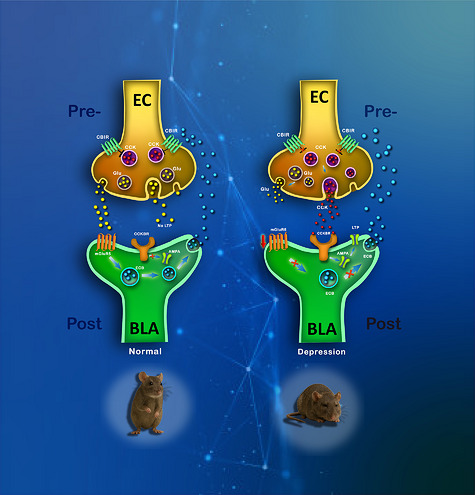
The adult-male study shows how CCK input and recipient signaling can interact through feedback toward the terminal. Stress changes regulation alongside local release and plasticity, making recipient response and behavioral context relevant to understanding connection strength.
The mGluR5–endocannabinoid–CB1 model explains a route for local retrograde regulation. Its clearest insight is that the sending terminal does not alone determine signal strength: the recipient can help adjust the exchange.
Source: Asim M et al. · Advanced science (Weinheim, Baden-Wurttemberg, Germany) · CC BY
Original figure and English caption ↗