How does stress change social exploration? Amygdala and oxytocin-cell inputs converge on prefrontal cortex
Male mice can still approach companions yet lose their preference for a newcomer. A study connects acute and chronic stress, prefrontal population patterns and two upstream inputs.
Approaching a companion and distinguishing a newcomer involve different processes. A 2026 Communications Biology study found that male mice still approached companions after acute stress but lost a clear novelty preference; repeated stress further altered general social exploration. Following prefrontal activity, the team linked amygdala and hypothalamic oxytocin-cell inputs with these outcomes through local inhibition.
Stress reduces prefrontal activity and stimulus-pattern separation. Altering BLA or PVN oxytocin-associated input improves some social outcomes, with effects depending on stress state and population selection.
Contents · 7 sections
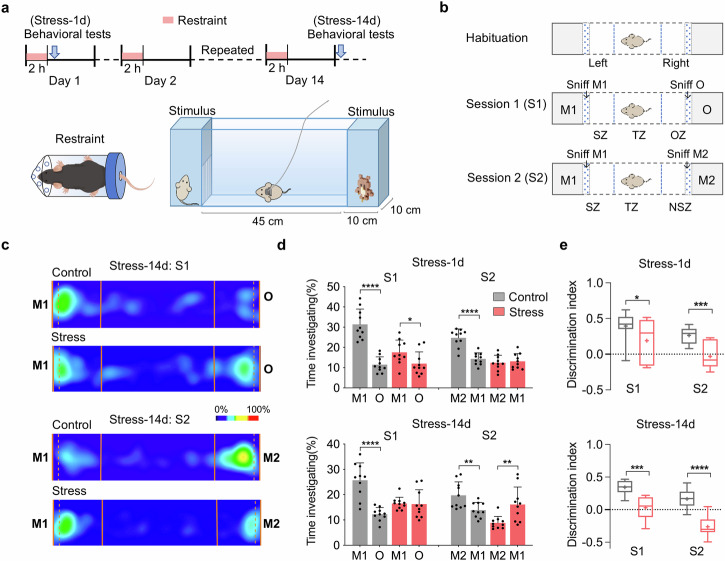
Acute and repeated stress alter different exploration choices
After acute stress, companions remained attractive relative to objects, but the newcomer’s advantage over a familiar mouse diminished; this recovered within a day. Repeated stress also lowered general social preference and had more persistent effects. Different stress histories left distinct traces in the choices.
Repeated encounters added another view: acutely stressed mice explored at first but did not reduce sniffing at the second encounter as controls did. Movement was largely preserved. Adjustment of exploration with familiarity became an important aspect of the change.
Source: Zhang Y et al. · Communications biology · CC BY-NC-ND
Original figure and English caption ↗
Event frequency falls and population patterns converge
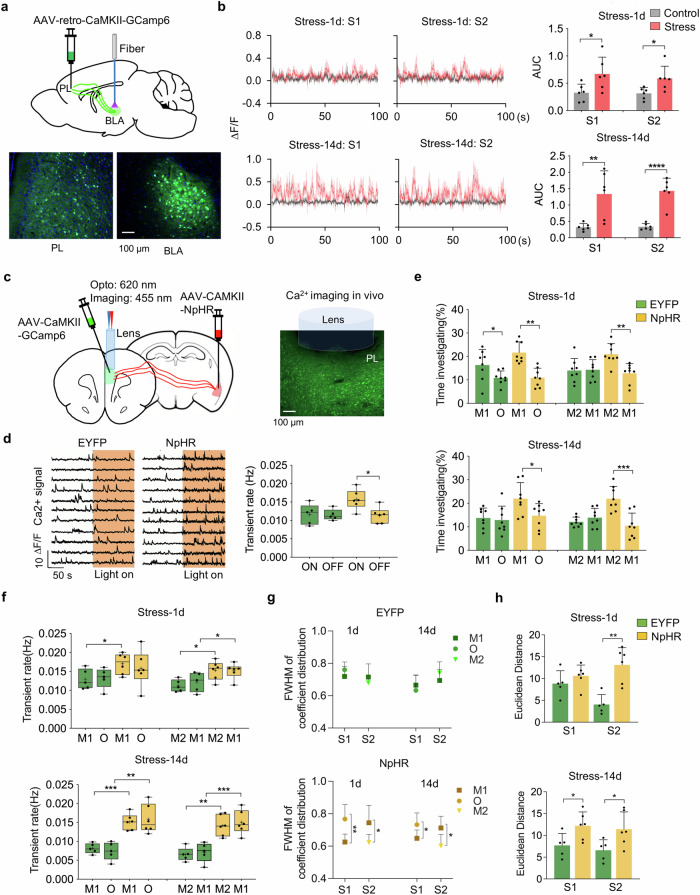
Prelimbic calcium recordings showed reduced event frequency after stress, more strongly after repeated stress, without the same amplitude change. Lower activity also appeared in other exploration contexts, suggesting a broader network-state shift.
Different stimuli normally produced more separable population trajectories; after stress, distances narrowed and related to behavioral measures. Unstressed repeated tests remained relatively stable. Fewer events and less distinct stimulus patterns appeared together.
Excitatory input changes the outcome through local inhibition
After stress, activity-related labeling increased in basolateral amygdala (BLA) and hypothalamic paraventricular nucleus (PVN), both of which project to prefrontal cortex. Excitatory BLA input can recruit local GABAergic cells, linking stronger source activity with lower pyramidal activity through local connections.
Reducing BLA input improved calcium events, stimulus-pattern separation and social outcomes in stressed mice. In normal mice, it did not broadly enhance novelty preference and reduced general social approach. An input can support normal function yet contribute to imbalance after stress.
Source: Zhang Y et al. · Communications biology · CC BY-NC-ND
Original figure and English caption ↗
More specific populations yield different outcomes
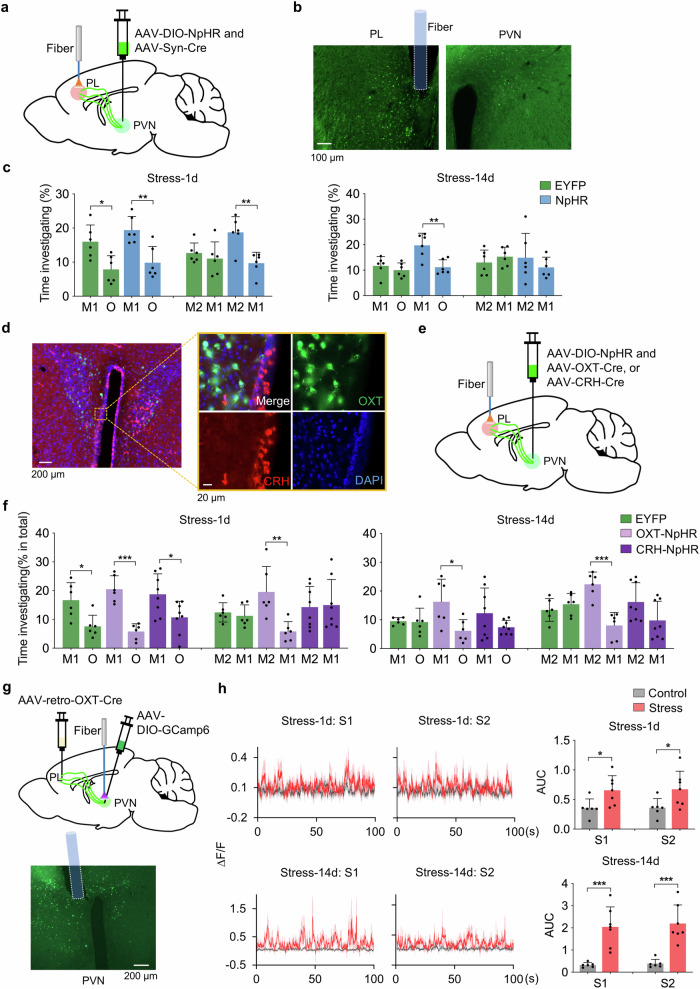
Broad reduction of PVN input improved acute-stress outcomes without clearly restoring novelty preference after repeated stress. Focusing on oxytocin-associated cells improved social and novelty measures, whereas corresponding CRH populations did not. Population identity resolved functions hidden in the regional input.
Prefrontal-projecting PVN oxytocin populations became more active during and after stress. Reducing their terminal activity improved prefrontal activity and pattern separation in stressed animals, without equivalent significant social changes in normal animals.
Source: Zhang Y et al. · Communications biology · CC BY-NC-ND
Original figure and English caption ↗
Peptide signaling and local responses vary with events
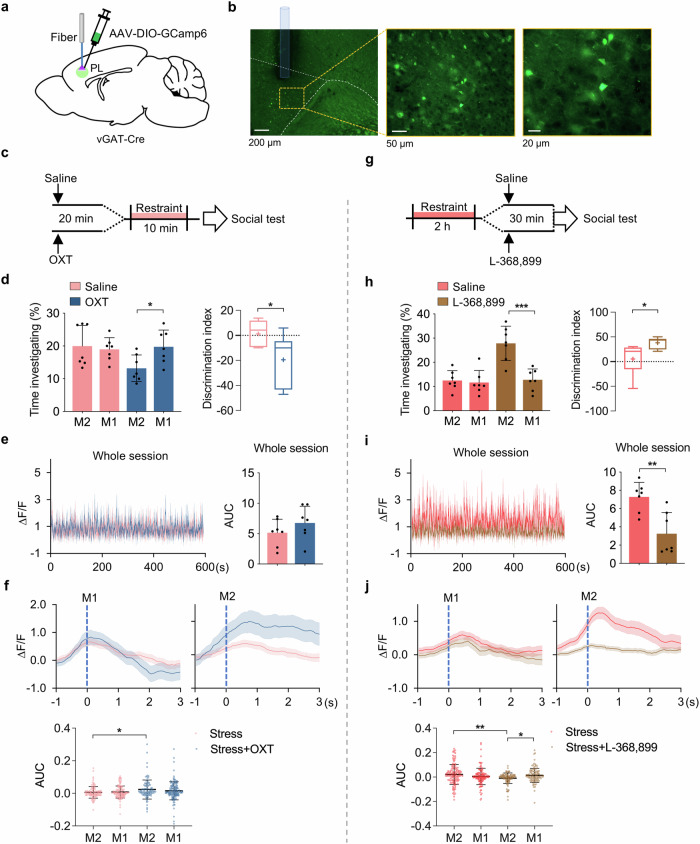
Under milder acute stress, oxytocin-related intervention reduced novelty preference and enhanced local GABA-population responses around newcomer events, without significantly changing average activity across the whole test. Effects concentrated around particular events.
With receptor antagonism, novelty behavior improved and the displayed GABA-response area and newcomer-event responses declined. Peptide signaling, local inhibition and behavior aligned, with whole-session and event-related measures revealing different temporal aspects.
Source: Zhang Y et al. · Communications biology · CC BY-NC-ND
Original figure and English caption ↗
A familiar molecule acts within a specific state
BLA and PVN inputs converge within one prefrontal network, and altering either improves some stress-associated measures. Similar outcomes can arise through different recipients and local connections. More specific populations reveal contributions hidden in regional averages.
Oxytocin is often associated with social behavior, yet its effects here depend on conditions. Peptide cells may also release other transmitters. Identity, receptors and stress state together shape outcomes, giving a familiar name a more specific meaning within a circuit.
Social exploration connects with network dynamics
The study separates general approach, familiarization and novelty choice, then links them with prefrontal activity and upstream inputs. Stress produces different changes across exploration phases and stimulus-related network patterns rather than one uniform reduction of social behavior.
The findings concern a restraint model in male mice. External stress can influence prefrontal dynamics through upstream signals and local inhibition, while the same input may contribute differently in normal and stressed states.