How does kaempferol improve social and cognitive behavior? Clues from basal forebrain cholinergic neurons
A mouse study in an MK-801 model follows basal forebrain cholinergic activity to test how kaempferol restores ChAT expression and behavioral performance.
Schizophrenia encompasses positive symptoms, negative symptoms such as social withdrawal, and cognitive deficits. While current antipsychotics primarily target dopamine and serotonin receptors to control positive symptoms, effective treatments for negative and cognitive impairments remain an unmet clinical need. Recently, a research team led by Prof. Zhong Chen and Associate Prof. Li Cheng at the Key Laboratory of Neuropsychopharmacology of Zhejiang Province, College of Pharmaceutical Sciences, Zhejiang Chinese Medical University (with Minzhu Li, Boshi Wang, Chenshu Gao, and Jingwen Sun as co-first authors) published a research article titled "Kaempferol alleviates schizophrenia-like social and cognitive deficits through cholinergic modulation" in *Phytomedicine*. Across chronic MK-801-treated mice, cholinergic-specific histamine H1 receptor conditional knockout (ChAT-Cre;Hrh1fl/fl) mice, and mice with chemogenetic inhibition of cholinergic neurons in the horizontal limb of the diagonal band of Broca (HDB), the authors demonstrate using immunohistochemistry and in vivo fiber photometry that the natural flavonol kaempferol restores HDB choline acetyltransferase (ChAT) expression and behavior-locked Ca2+ signaling to alleviate sensorimotor gating, social, and cognitive deficits.
Kaempferol (30 mg/kg) consistently rescues prepulse inhibition, social novelty preference, and novel object recognition across pharmacological, genetic, and chemogenetic mouse models of schizophrenia by restoring ChAT protein expression and task-evoked Ca2+ activity in basal forebrain HDB cholinergic neurons.
Contents · 5 sections
Kaempferol Reverses Sensorimotor Gating, Social, and Cognitive Deficits in Chronic MK-801 Mice
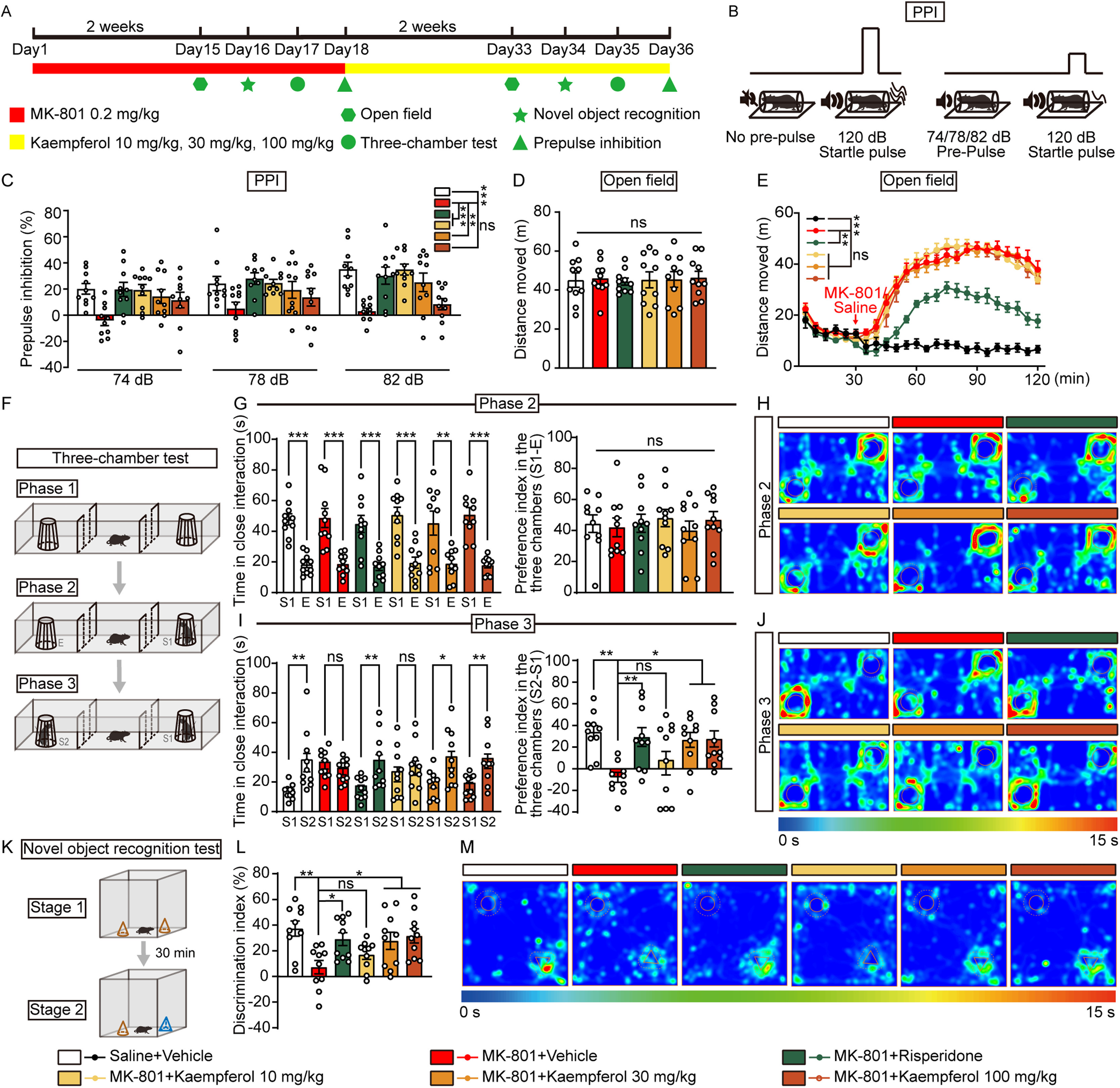
Chronic administration of the non-competitive NMDA receptor antagonist MK-801 is a well-established pharmacological model of schizophrenia-like negative and cognitive symptoms. The authors treated adult male C57BL/6J mice with MK-801 (0.2 mg/kg, daily) for 2 weeks followed by 2 weeks of co-treatment with kaempferol (10, 30, or 100 mg/kg) or the atypical antipsychotic risperidone as a positive control (Figures 1A and 1B). In the prepulse inhibition (PPI) test of sensorimotor gating, chronic MK-801 severely reduced %PPI across 74, 78, and 82 dB prepulse intensities; both 30 and 100 mg/kg kaempferol significantly restored %PPI to levels comparable to risperidone without altering baseline startle amplitude (Figure 1C).
While baseline open-field locomotion was unchanged across groups (Figure 1D), kaempferol—unlike risperidone—did not suppress MK-801-induced hyperlocomotion (Figure 1E). However, in Phase 3 of the three-chamber social interaction test, 30 and 100 mg/kg kaempferol completely rescued the severe deficit in social novelty preference (exploring novel stranger S2 over familiar mouse S1) induced by chronic MK-801 (Figures 1F and 1G). Similarly, 30 and 100 mg/kg kaempferol robustly restored the discrimination index in the novel object recognition (NOR) test (Figures 1H and 1I), establishing 30 mg/kg as an effective dose against schizophrenia-like social and cognitive impairments.
Source: Minzhu Li et al. · Phytomedicine · © Elsevier Inc.
Original figure and English caption ↗
Cross-Model Validation in Genetic and Chemogenetic Models of Cholinergic Hypofunction
Building on the team's prior finding that conditional deletion of the histamine H1 receptor in cholinergic neurons (ChAT-Cre;Hrh1fl/fl mice) causes basal forebrain cholinergic hypofunction and schizophrenia-like negative and cognitive phenotypes, the authors next tested kaempferol (30 mg/kg for 2 weeks) in ChAT-Cre;Hrh1fl/fl mice (Figure 2A). Kaempferol treatment significantly reversed the deficits in %PPI across 74, 78, and 82 dB prepulses (Figure 2B), Phase 3 social novelty preference (S2 minus S1 interaction time; Figure 2E), and NOR discrimination index (Figure 2F) in ChAT-Cre;Hrh1fl/fl mice, matching the efficacy of risperidone.
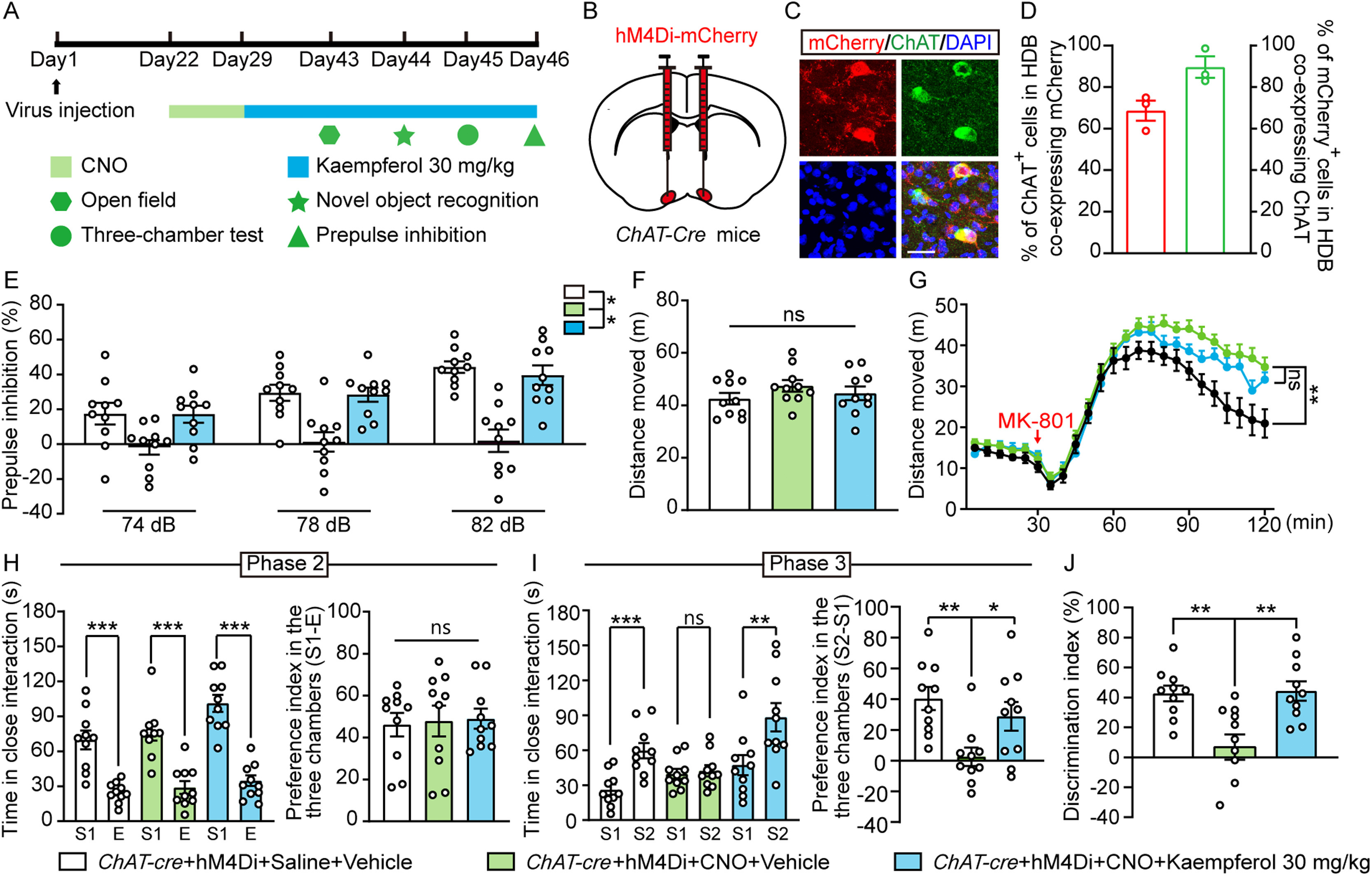
To directly target basal forebrain cholinergic circuitry, the authors bilaterally injected Cre-dependent AAV-CAG-FLEX-hM4Di-mCherry into the horizontal limb of the diagonal band of Broca (HDB) in ChAT-Cre mice (~68% of ChAT+ neurons expressed mCherry, and ~90% of mCherry+ cells were ChAT+; Figures 3A and 3B). Chronic CNO-mediated chemogenetic inhibition of HDB cholinergic neurons sufficed to induce schizophrenia-like deficits in %PPI, Phase 3 social novelty preference, and NOR discrimination (Figures 3C–3H). Co-administration of kaempferol (30 mg/kg) significantly reversed all three behavioral deficits induced by selective HDB cholinergic inhibition (Figures 3C and 3F–3H).
Source: Minzhu Li et al. · Phytomedicine · © Elsevier Inc.
Original figure and English caption ↗
Region-Specific Molecular Restoration of ChAT Expression in the HDB
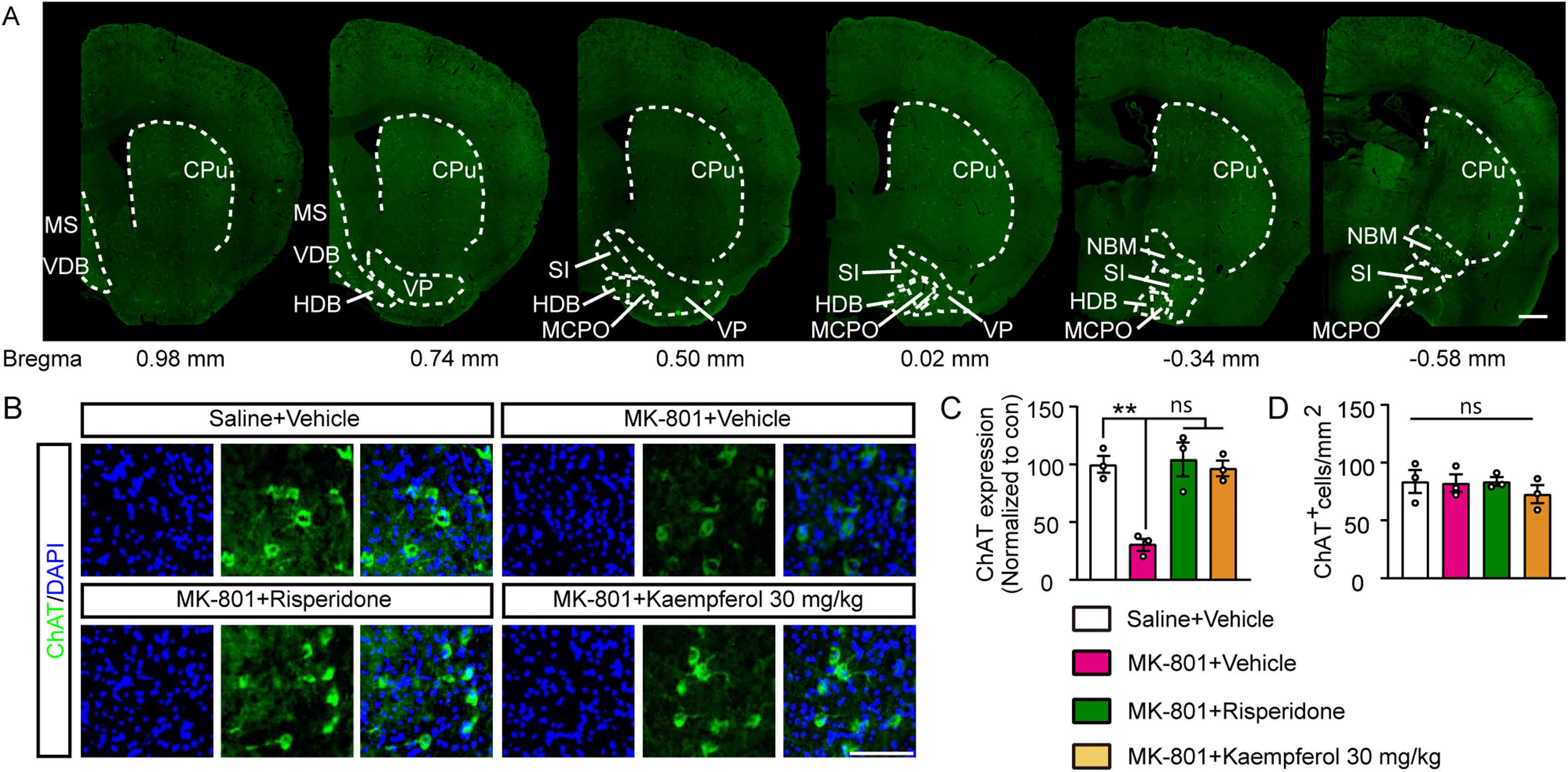
To pinpoint which cholinergic subregions are affected by chronic MK-801 and restored by kaempferol, the authors performed quantitative ChAT immunofluorescence mapping across coronal brain sections spanning Bregma +0.98 mm to -0.58 mm, covering the medial septum (MS), vertical and horizontal limbs of the diagonal band (VDB and HDB), ventral pallidum (VP), substantia innominata (SI), magnocellular preoptic nucleus (MCPO), nucleus basalis of Meynert (NBM), and caudate putamen (CPu) (Figures 4A and 4B).
Quantification revealed that ChAT+ cell density (cells/mm²) remained unchanged across all examined brain regions, ruling out overt cholinergic neuronal loss. However, within the HDB, chronic MK-801 drastically reduced relative ChAT protein expression to ~30% of control levels (p <= 0.01; Figures 4C and 4D). Treatment with either kaempferol (30 mg/kg) or risperidone completely restored HDB ChAT expression to control levels (p <= 0.001; Figures 4C and 4D), identifying HDB ChAT downregulation as a key molecular lesion reversed by kaempferol.
Source: Minzhu Li et al. · Phytomedicine · © Elsevier Inc.
Original figure and English caption ↗
In Vivo Fiber Photometry: Kaempferol Restores Behavior-Locked Ca2+ Dynamics in HDB Cholinergic Neurons
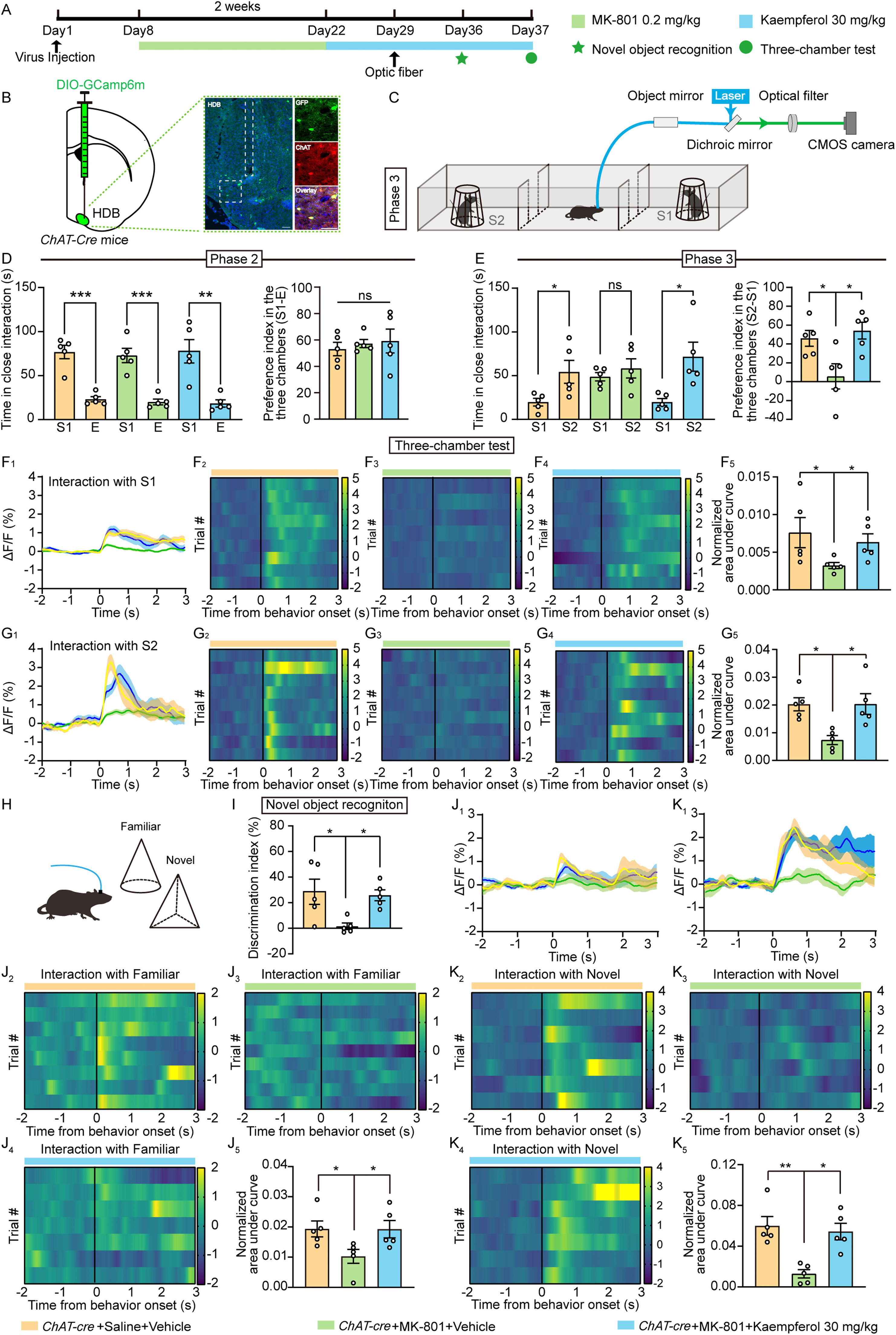
To determine whether molecular restoration of ChAT translates into rescued neuronal activity during behavior, the authors injected Cre-dependent AAV-EF1α-DIO-GCaMP6m into the HDB of ChAT-Cre mice and performed in vivo fiber photometry during social and cognitive tasks (Figures 5A–5C). In control mice, active investigation of either the familiar mouse (S1) or the novel stranger (S2) during the three-chamber test reliably evoked robust time-locked GCaMP6m Ca2+ transients (ΔF/F and normalized area under the curve, AUC) in HDB cholinergic neurons, whereas these responses were severely blunted in chronic MK-801 + Vehicle mice (Figures 5F and 5G). Kaempferol treatment (30 mg/kg) significantly restored behavior-locked Ca2+ transients and normalized AUC during both S1 and S2 social encounters (Figures 5F and 5G).
Consistently, during the novel object recognition (NOR) test, HDB cholinergic neurons in MK-801 + Vehicle mice exhibited markedly attenuated Ca2+ transients upon exploring both familiar and novel objects, whereas kaempferol (30 mg/kg) robustly restored object-exploration-locked Ca2+ dynamics and normalized AUC to near-control levels (Figures 5J and 5K).
Source: Minzhu Li et al. · Phytomedicine · © Elsevier Inc.
Original figure and English caption ↗
Summary and Outlook: A Plant-Derived Lead Targeting Basal Forebrain Cholinergic Circuitry
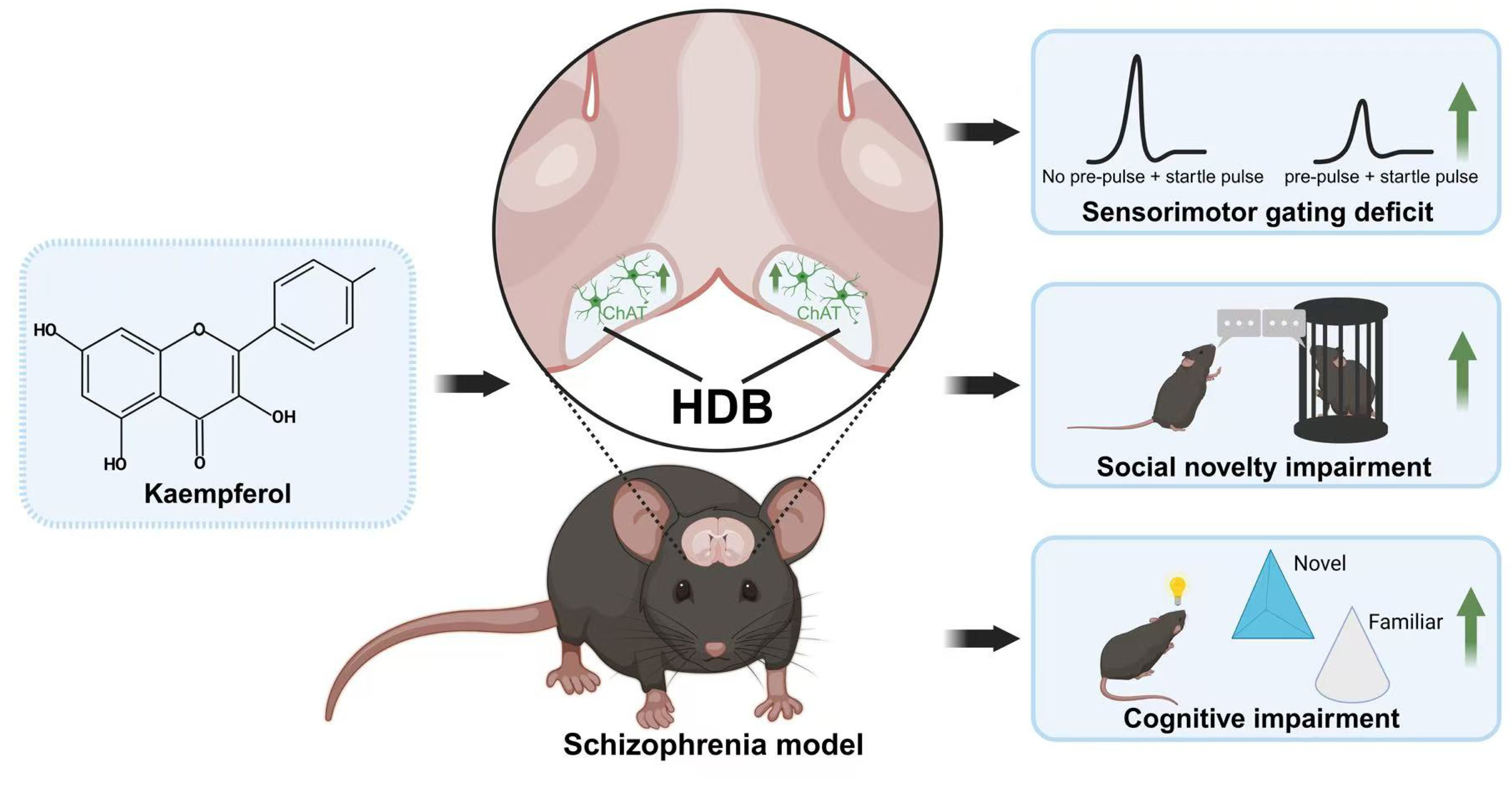
Integrating pharmacological, conditional knockout, chemogenetic, immunohistochemical, and in vivo fiber photometry evidence, this study establishes a cohesive mechanism of action (Figure 6): pathological downregulation of ChAT expression and blunted neuronal activity in basal forebrain HDB cholinergic neurons drive sensorimotor gating, social novelty, and cognitive deficits, whereas the natural dietary flavonol kaempferol restores HDB ChAT expression and task-evoked cholinergic Ca2+ signaling to rescue these core schizophrenia-like phenotypes.
Given the limited efficacy of conventional antipsychotics against negative and cognitive symptoms, these findings highlight basal forebrain HDB cholinergic neurons as a key therapeutic node and support kaempferol as a promising natural lead compound for alleviating social and cognitive impairments in schizophrenia.
Source: Minzhu Li et al. · Phytomedicine · © Elsevier Inc.
Original figure and English caption ↗