How does bright light alter stress-related behavior? Three habenular outputs
In male mice, stress alters burst firing in three lateral habenular output populations. Bright-light effects on sucrose preference and tail-suspension immobility depend on different combinations of these populations.
Reduced sucrose preference and longer immobility after stress may appear to belong to one behavioral pattern. Do the same circuits drive them, and can they be modulated in the same way? A study published in Advanced Science on June 11, 2024 separates lateral habenular outputs into populations projecting to dorsal raphe, ventral tegmental area and median raphe. In male mice, prolonged stress increases the prevalence of burst firing in all three populations, while bright light reduces it. Different behavioral measures, however, depend on different population combinations, revealing parallel specialization and coordination in the light–brain relationship.
DRN-projecting habenular cells have a stronger role in sucrose-preference and anxiety-like changes, while reducing tail-suspension immobility requires broader combined modulation. Individual or combined activation during light treatment differentially attenuates its behavioral benefits.
Contents · 6 sections
One region sends signals to different destinations
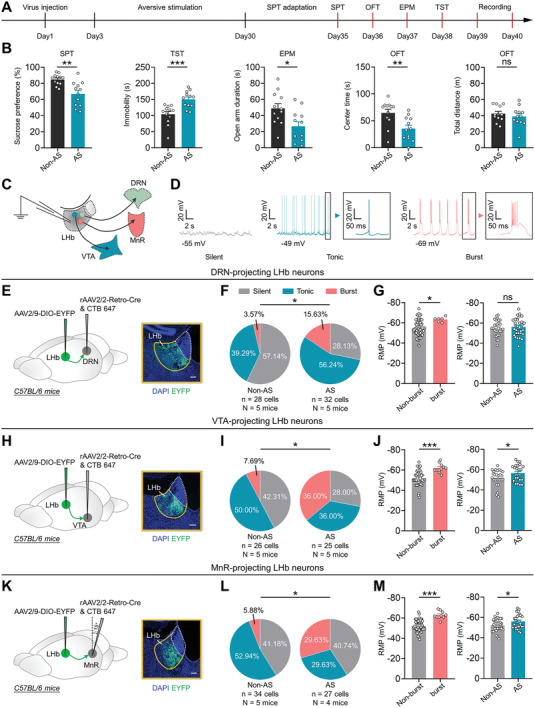
The lateral habenula is associated with negative events, but its outputs do not all share one destination. Tracing showed limited overlap among populations projecting to dorsal raphe, VTA and median raphe. Defining cells by destination allowed the study to examine parallel channels within one region.
After prolonged aversive stimulation, mice showed lower sucrose preference, longer tail-suspension immobility and less exploration of exposed spaces, without a significant change in overall distance traveled. All three output populations contained a higher proportion of bursting cells. These short clusters of spikes indicate changes in the organization of neuronal signaling alongside behavioral changes.
Source: Liu X et al. · Advanced science (Weinheim, Baden-Wurttemberg, Germany) · CC BY
Original figure and English caption ↗
Similar firing patterns produce different behavioral profiles
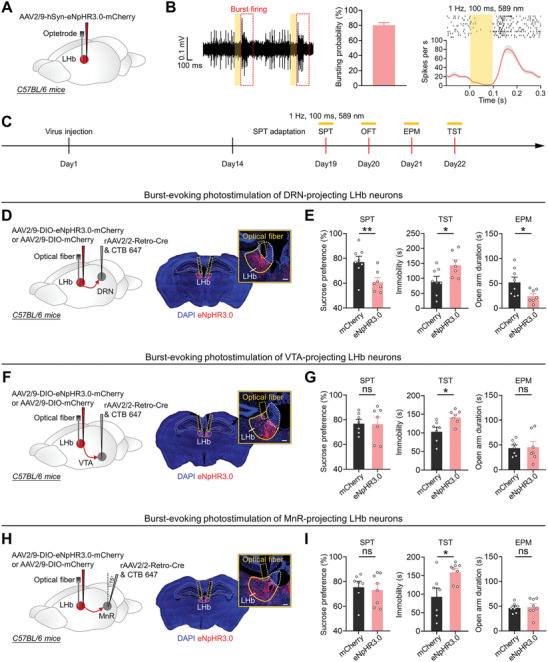
The study used rebound responses after brief inhibition to evoke bursts. Inducing bursts in DRN-projecting cells reduced sucrose preference, increased tail-suspension immobility and reduced exploration of exposed spaces, affecting several behavioral dimensions.
Burst induction in VTA- or median-raphe-projecting cells also increased immobility, but did not significantly alter sucrose preference or the tested anxiety-like measures. A similar firing pattern produced different behavioral profiles depending on output identity, separating components of the broader stress-related phenotype.
Source: Liu X et al. · Advanced science (Weinheim, Baden-Wurttemberg, Germany) · CC BY
Original figure and English caption ↗
The distinction persists with sustained activation
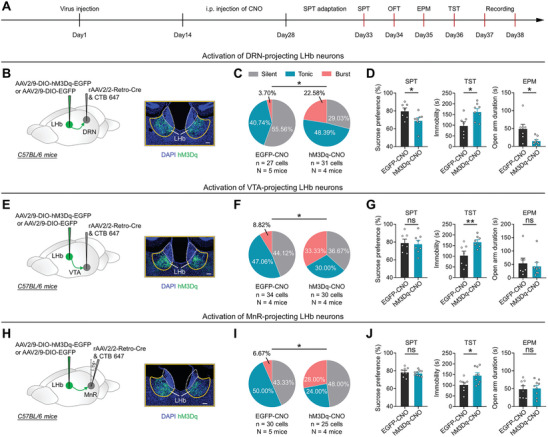
Sustained activation provided a complementary test. Prolonged activation increased bursting prevalence in the output-defined populations and produced a similar division: DRN-projecting cells affected sucrose preference, immobility and exposed-space exploration, while the other populations mainly increased tail-suspension immobility.
Convergent results from different interventions strengthen the link between output identity and behavioral effect. They connect activity changes, bursting and behavior, while leaving the responses of specific downstream recipient cells to be resolved. Further work is needed to connect these outputs to transmitter changes in their targets.
Source: Liu X et al. · Advanced science (Weinheim, Baden-Wurttemberg, Germany) · CC BY
Original figure and English caption ↗
One output does not account for every improvement
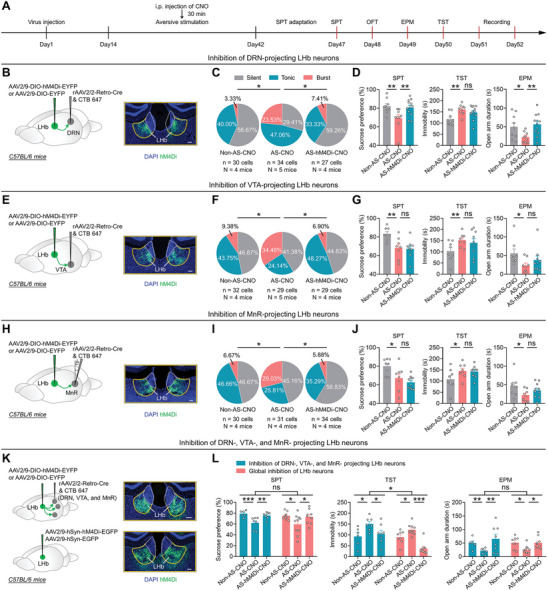
Inhibiting DRN-projecting cells during stress reduced bursting prevalence and improved sucrose preference and tested anxiety-like measures, but did not significantly improve immobility. Inhibiting either of the other populations alone did not significantly improve the tested stress-related behaviors. Effects of increasing activity therefore did not translate into a simple one-population rescue for every measure.
Combined inhibition improved sucrose preference, immobility and anxiety-like measures. Global lateral habenular inhibition reduced immobility more strongly still, suggesting contributions from additional outputs. The comparisons reveal both specialization and coordination: some measures are more closely linked to one population, while others require broader modulation.
Source: Liu X et al. · Advanced science (Weinheim, Baden-Wurttemberg, Germany) · CC BY
Original figure and English caption ↗
Bright light reduces bursting across the three populations
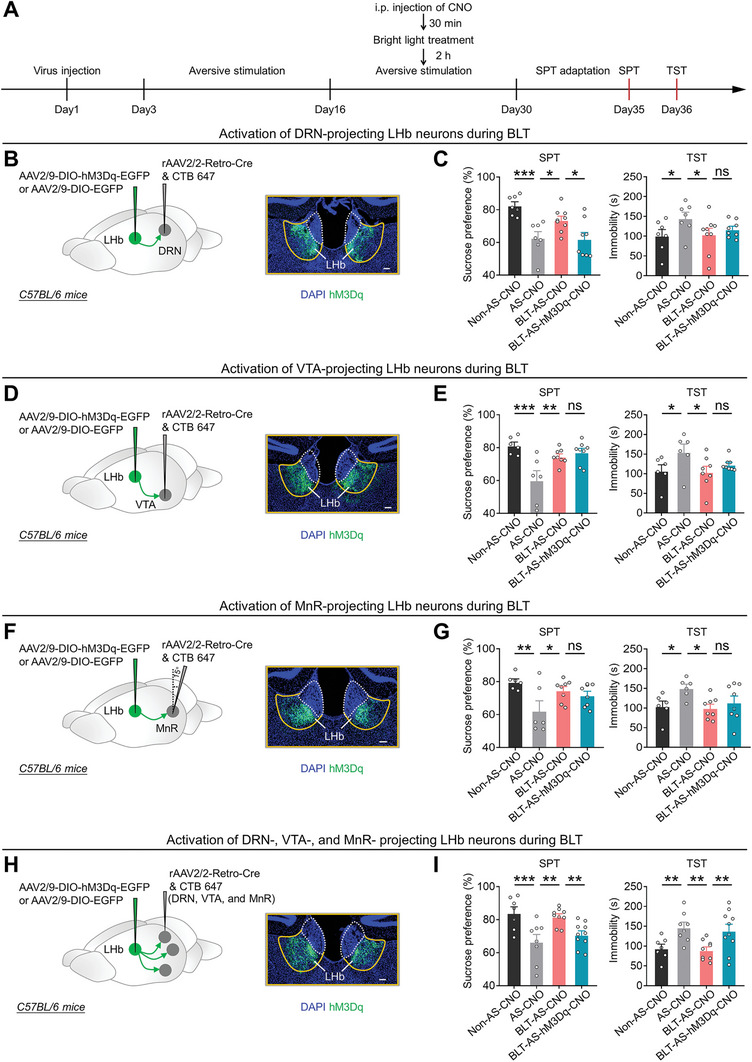
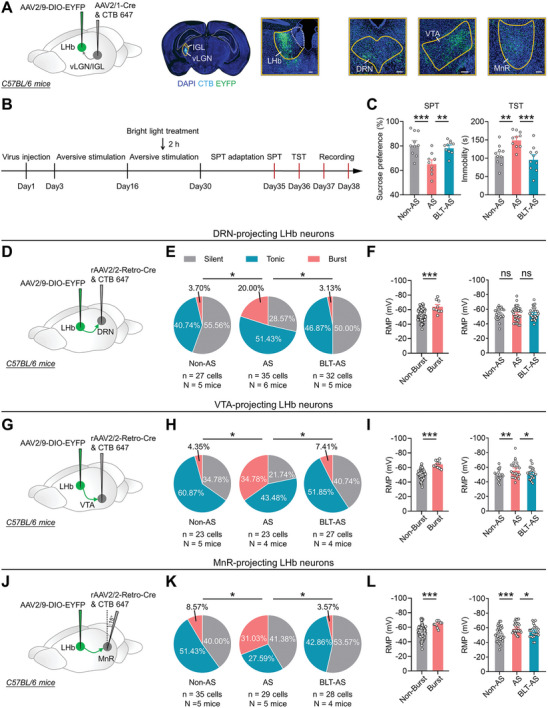
Adding bright light during the latter part of prolonged stress increased sucrose preference and reduced immobility. Bursting prevalence declined in all three output populations. Building on earlier work linking visual thalamic regions with lateral habenula, tracing showed that habenular cells receiving related inputs can send outputs to the three downstream targets.
These findings connect light exposure with changes across the output populations. To examine their contribution to the behavioral effects, the next experiments increased activity again during light treatment, asking which combinations support different improvements.
Source: Liu X et al. · Advanced science (Weinheim, Baden-Wurttemberg, Germany) · CC BY
Original figure and English caption ↗
Different benefits depend on different combinations
During light treatment, activating DRN-projecting cells attenuated the sucrose-preference benefit without significantly reversing the immobility benefit. Activating either of the other populations alone also did not significantly reverse the latter. Combined activation attenuated both benefits, further supporting different population combinations for the two outcomes.
This male-mouse study gives a more detailed circuit account of light-related behavioral changes. Behaviors can be separated, cells can be distinguished by output, and parallel populations can jointly influence one measure. How upstream visual networks change these cells and how each output recruits downstream populations remain open questions, defining a more specific basis for further research.
Source: Liu X et al. · Advanced science (Weinheim, Baden-Wurttemberg, Germany) · CC BY
Original figure and English caption ↗