How does a prefrontal inhibitory population contribute to partner interaction? Clues from CR neurons
In a prenatal VPA mouse model, CR-cell structure, inputs and activity change. Recruiting the remaining population improves social-related behavior.
Inhibitory neurons do more than lower brain activity overall. Different populations use local connections to help organize information and behavior. A 2026 Translational Psychiatry study focuses on calretinin, or CR, interneurons in medial prefrontal cortex, or mPFC, after prenatal valproic acid, or VPA, exposure. Labeling, interaction-related activity, dendrites, synaptic inputs and direct modulation build a multilevel picture: reduced activity accompanies behavioral deficits, while recruiting the remaining population can still improve outcomes.
In the VPA model, mPFC CR activity, structure and synaptic inputs change. Suppressing the population in controls reduces partner preferences, while increasing activity in the model improves related behavior.
Contents · 6 sections
Preferences for partners and novel individuals change
Male offspring after prenatal VPA exposure had reduced mouse-over-object preference and no significant preference between familiar and novel partners in the three-chamber task. Grooming and burying increased, center time decreased, and total locomotor distance remained similar. The model therefore involved changes in partner approach, novelty preference and environmental exploration.
Medial prefrontal cortex organizes several behaviors and contains diverse cell types. The study focused on CR interneurons and compared their features between model and control animals. Examining partner interaction within a defined population gave regional behavioral changes a more specific cellular entry point.
CR labeling and social recruitment weaken together
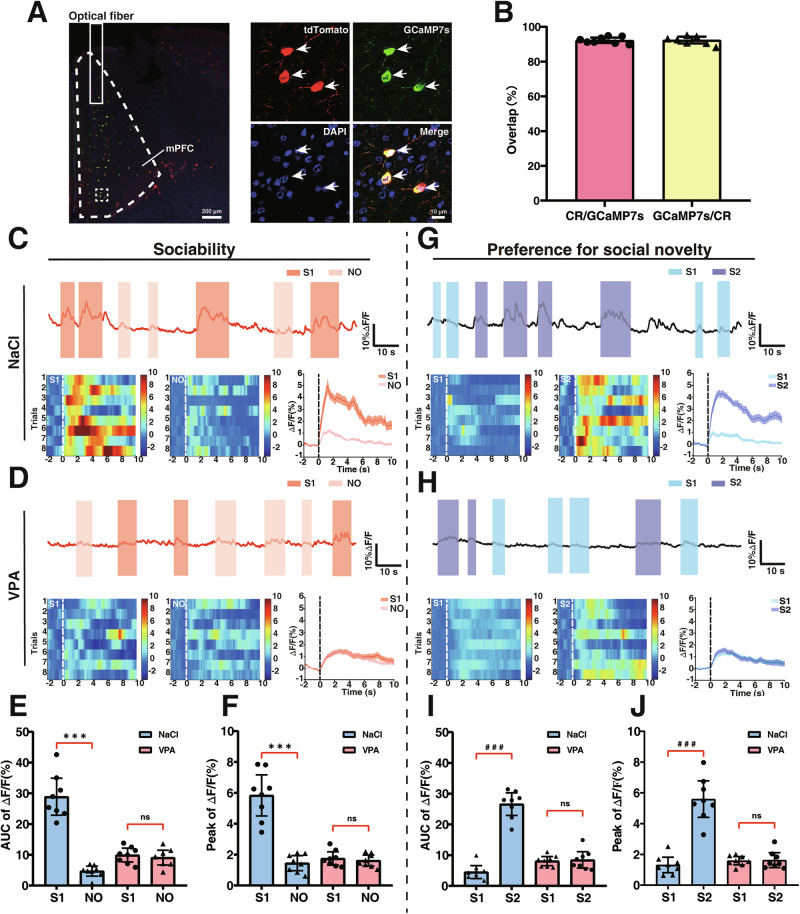
In the model, mPFC CR-labeled density fell by about 46%, and social-task CR/c-Fos labeling decreased. In controls, calcium responses were greater during partner than object investigation and during novel than familiar encounters; these distinctions were not significant in VPA animals. Static labeling and dynamic activity together outlined altered recruitment.
The reduced labeling describes changes in the measured population, with expression and development still to be resolved. Interaction-related activity nevertheless offered a traceable clue: responses that varied with partner conditions in controls were weaker in the model. The study then examined cellular structure and inputs.
Source: Chen M et al. · Translational psychiatry · CC BY-NC-ND
Original figure and English caption ↗
Dendrites, firing and inputs change at several levels
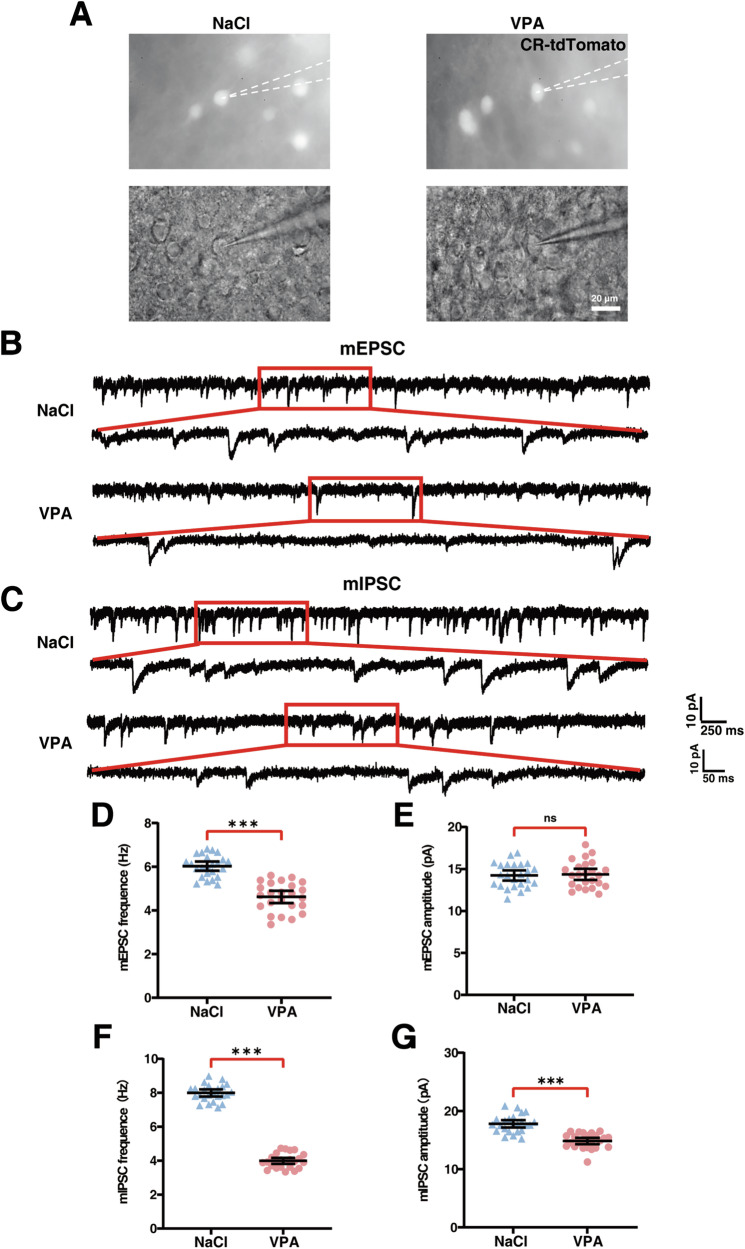
CR-labeled cells had shorter, less complex dendrites, lower spine density and fewer mushroom-like spines, with more thin spines and similar measures for some other spine types. Spontaneous and evoked firing decreased, and firing initiation changed, while resting potential and spike half-width remained similar. Structure and electrical activity provided complementary clues.
Inputs onto these cells also changed: miniature excitatory-current frequency fell with similar amplitude, while inhibitory-current frequency and amplitude decreased. The measures did not all move together but described specific changes in the local network surrounding CR cells. Their combined influence on recruitment during interaction became a question for activity modulation.
Source: Chen M et al. · Translational psychiatry · CC BY-NC-ND
Original figure and English caption ↗
Reducing CR activity changes social behavior and exploration
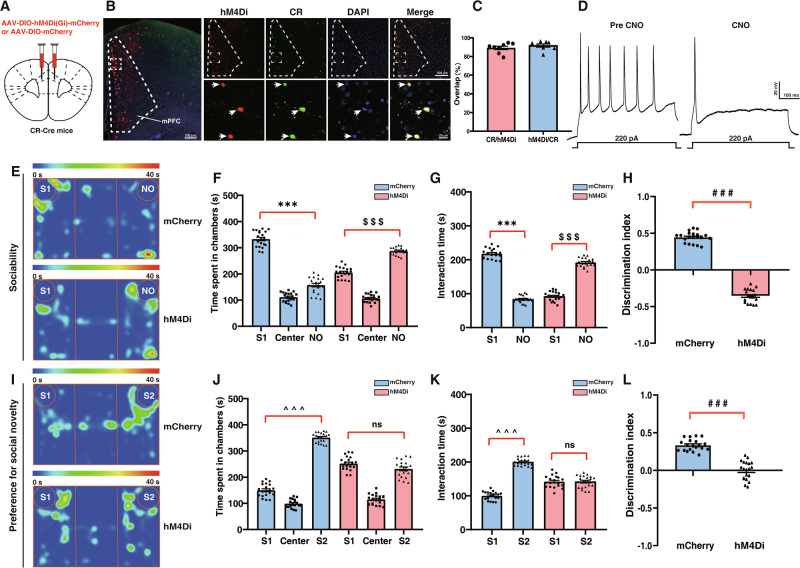
Suppressing mPFC CR cells in controls reduced preferences for partners and novel partners. Overall locomotion remained similar, and open-field center exploration also decreased. Direct population modulation produced changes resembling part of the model phenotype, indicating a contribution to behavioral organization in the normal state.
Joint changes in social approach and environmental exploration added detail to the population’s role. Behavior is not defined by one preference score, and approaching a partner occurs within an environmental context. Multiple readouts revealed relationships between CR activity, interaction and avoidance.
Source: Chen M et al. · Translational psychiatry · CC BY-NC-ND
Original figure and English caption ↗
The remaining population can support improvement
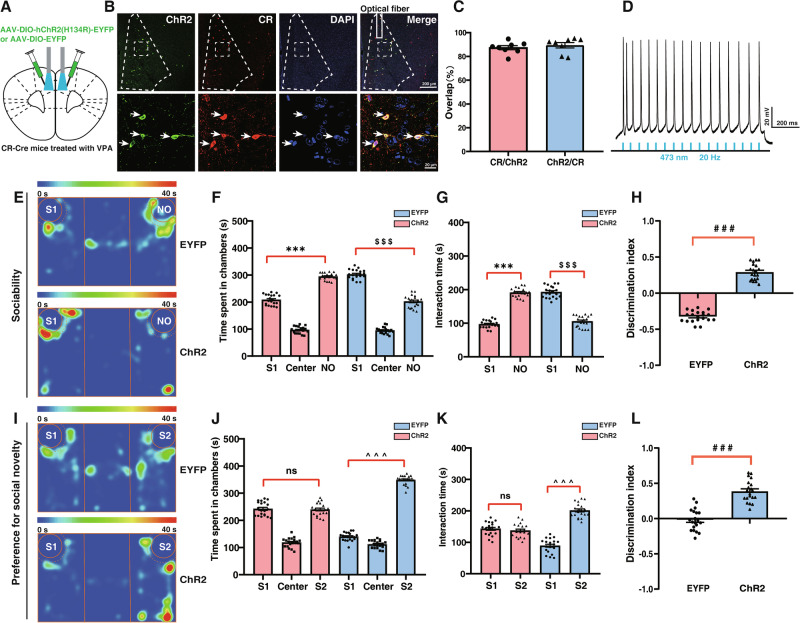
Increasing CR activity in VPA offspring improved partner and novelty preferences and center exploration, with similar overall distance. Despite changes in labeling, structure and inputs, the remaining population retained modulatory capacity. Behavioral outcomes in the model could improve through increased activity.
The result connected cellular activity with behavioral compensation. Inhibitory neurons act on different local targets, and the network response to enhancement still needs to be resolved. Identifying recipient cells and connections will help explain how the CR population organizes partner interaction and how different cellular components support improvement.
Source: Chen M et al. · Translational psychiatry · CC BY-NC-ND
Original figure and English caption ↗
Bringing inhibitory diversity into social-behavior research
The work advances CR interneurons from a population marker to a modifiable behavioral node. Morphology, firing, inputs and interaction-related activity describe the same population from different perspectives, while direct modulation links it with behavior. Diversity within local inhibition thus becomes an important lead for understanding prefrontal social networks.
The findings come from male offspring in a prenatal VPA model. Studies across models, sexes, outputs and developmental timescales will extend the picture. Observing how cells change and investigating the regulatory capacity they retain can together clarify behavioral changes in the model.