How do two amygdala outputs guide approach and avoidance learning?
Fezf2-labeled amygdala neurons include reward- and aversion-responsive cells. Learning links predictive cues to these responses, while distinct projection-defined populations contribute to reward seeking and active avoidance.
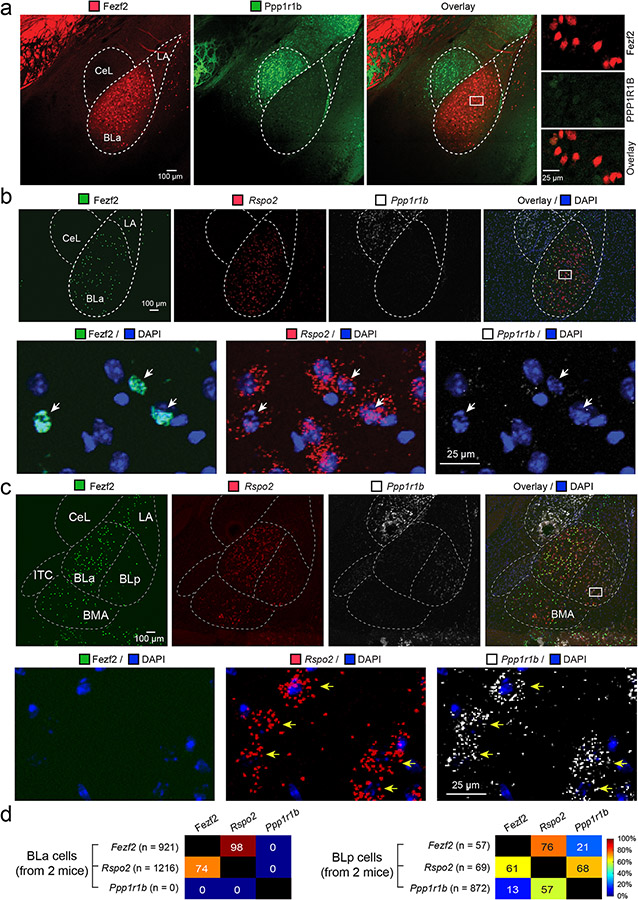
The amygdala is often associated with fear, but it also helps animals pursue desirable outcomes. A study published in Nature Neuroscience on October 18, 2021 examines both directions within one marker-defined population. Fezf2-labeled neurons in anterior basolateral amygdala (BLa) respond to rewarding or aversive events and, with learning, to the cues predicting them. Linking activity, projections and behavior identifies NAc- and olfactory-tubercle-projecting populations involved in avoiding adverse outcomes and seeking rewards, respectively.
Fezf2-labeled neurons contain reward- and aversion-responsive subsets that acquire predictive cue responses. NAc-projecting cells preferentially support aversion and avoidance, whereas OT-projecting cells support reward and approach, within the studied projection and task scope.
Contents · 7 sections
One marker does not mean one valence
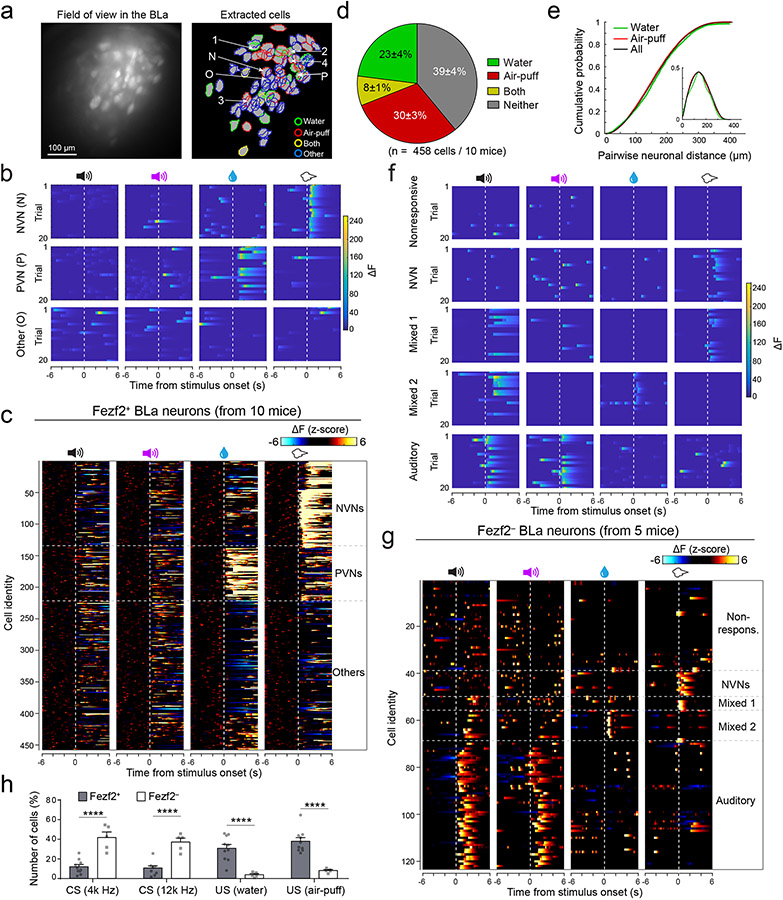
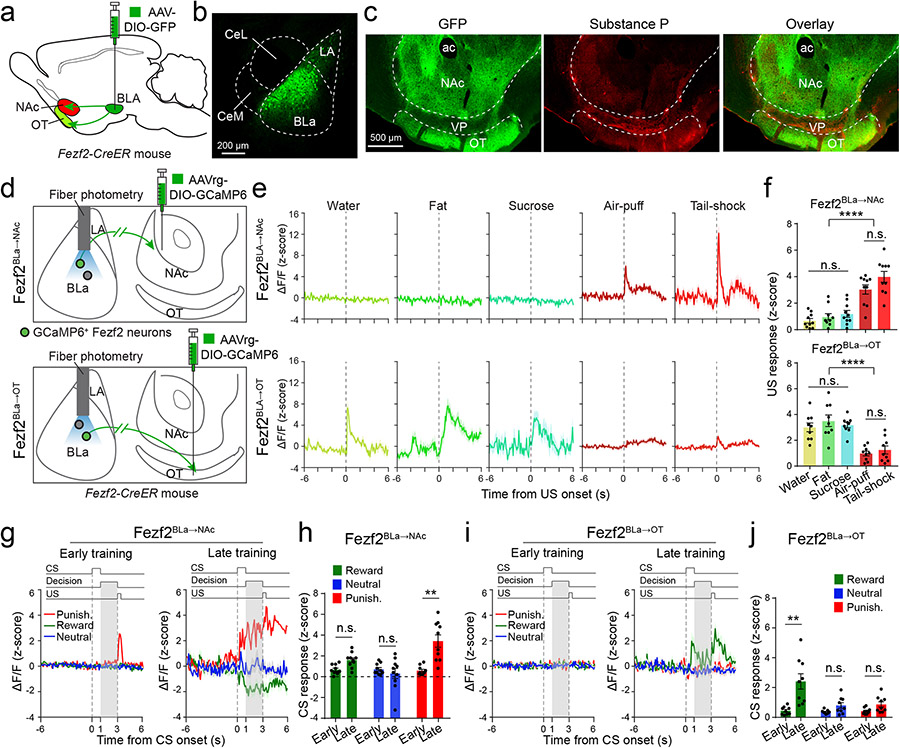
Fezf2 labels a subset of predominantly excitatory BLa neurons. Before predictive-cue learning, some respond to water but not clearly to air puff, others show the reverse, and a smaller subset responds to both. These populations are intermingled rather than occupying neatly separated zones.
The marker provides access to a population rather than assigning it a uniform positive or negative function. By comparison, many Fezf2-negative BLa cells are more responsive to sounds, revealing another functional distinction within the region.
Source: Zhang X et al. · Nature neuroscience · TDM
Original figure and English caption ↗
From responding to outcomes to recognizing their predictors
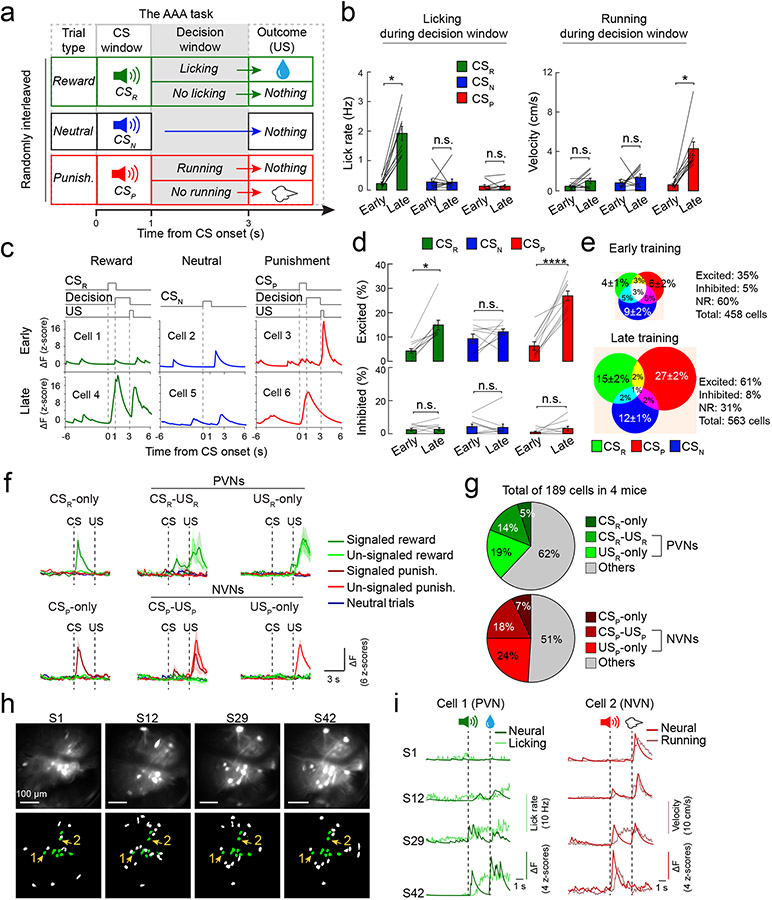
In an active approach-and-avoidance task, different sounds predict reward, an aversive event or a neutral outcome. As performance improves, more Fezf2 neurons respond to reward and aversion predictors without a corresponding increase for the neutral cue. Learned meaning becomes incorporated into cells initially tuned to outcomes.
Longitudinally tracked cells show the transition directly: reward-responsive cells acquire responses to reward cues, while aversion-responsive cells acquire responses to the corresponding predictor. Not every outcome-responsive cell acquires a cue response; learning recruits subsets within these populations.
Source: Zhang X et al. · Nature neuroscience · TDM
Original figure and English caption ↗
Activity can precede action, but correlation is only part of the story
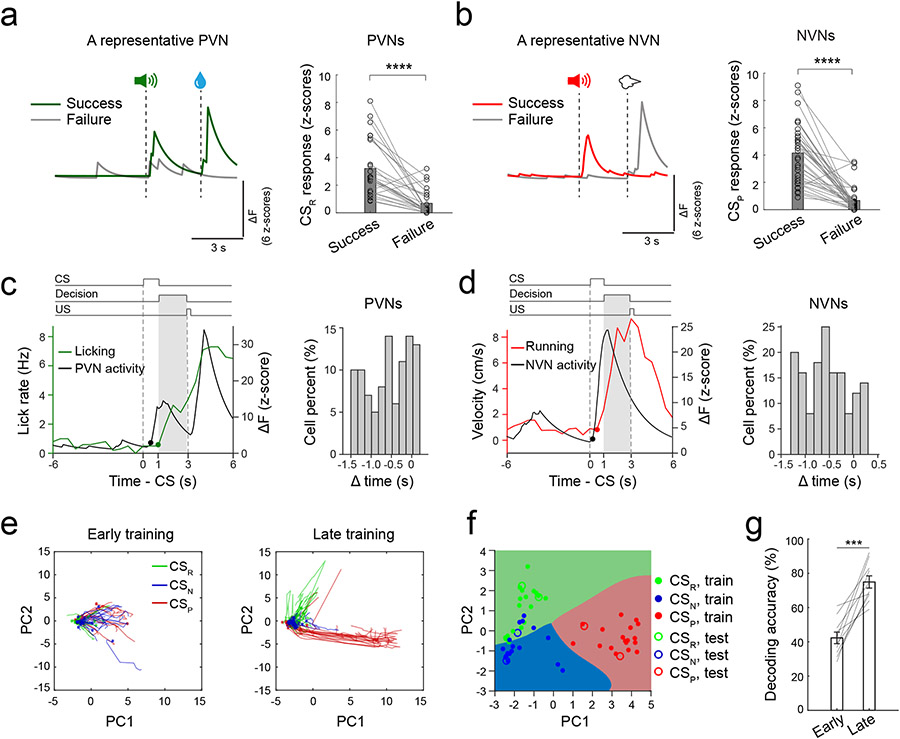
Reward-related cells respond more strongly to cues on trials with successful reward acquisition; aversion-related cells respond more strongly on successful avoidance trials. Many responses precede licking or running rather than merely following completed movements.
After learning, population activity better distinguishes reward, aversion and neutral trials. This shows that the population carries information about predicted outcomes. Whether that information contributes to action requires examining behavior when activity is changed.
Source: Zhang X et al. · Nature neuroscience · TDM
Original figure and English caption ↗
Following outputs separates two functional populations
Fezf2 neurons have several outputs, with prominent projections to NAc and OT. NAc-projecting cells preferentially respond to aversive stimuli, whereas OT-projecting cells respond to rewards. After learning, they likewise respond to aversion- and reward-predictive cues, respectively, with no clear neutral-cue response.
The projection-defined populations largely do not overlap, but some collateral connections remain. Anatomically sparse collaterals can also evoke substantial synaptic responses, supporting preferential wiring rather than complete circuit separation.
Source: Zhang X et al. · Nature neuroscience · TDM
Original figure and English caption ↗
Different input sources offer clues to the functional split
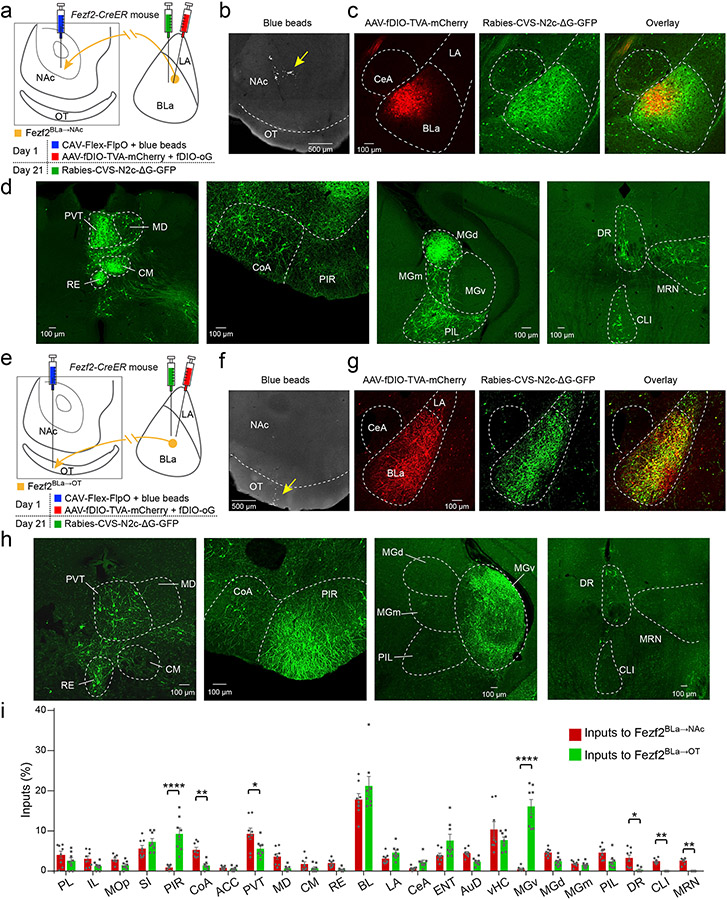
Input tracing finds relatively greater labeling from paraventricular thalamus, cortical amygdala and dorsal raphe onto NAc-projecting cells, while piriform cortex and ventral medial geniculate inputs are more prominent for OT-projecting cells. The populations differ in both input origin and output destination.
These anatomical differences provide structural clues to valence-related routing without individually establishing which input determines each response. How local cells, experience and upstream and downstream connections jointly shape function remains unresolved.
Source: Zhang X et al. · Nature neuroscience · TDM
Original figure and English caption ↗
Suppressing activity affects the action following each predictor
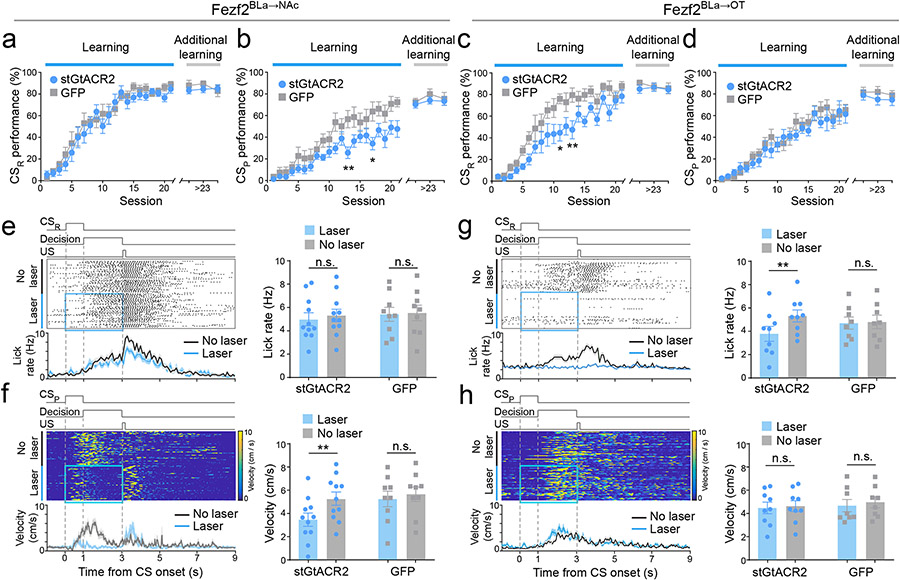
During training, inhibiting NAc-projecting cells reduces aversion-trial performance while sparing reward performance; inhibiting OT-projecting cells reduces reward performance without significantly affecting aversion trials. After learning, inhibition likewise reduces the corresponding anticipatory running or licking while sparing the other response.
In a separate experiment, inhibiting the broader Fezf2 population reduces both anticipatory actions without significantly affecting licking or running triggered by the actual outcomes. The animals can still perform the movements; the affected component is acting in advance on predictive information.
Source: Zhang X et al. · Nature neuroscience · TDM
Original figure and English caption ↗
One output supports approach, another active avoidance
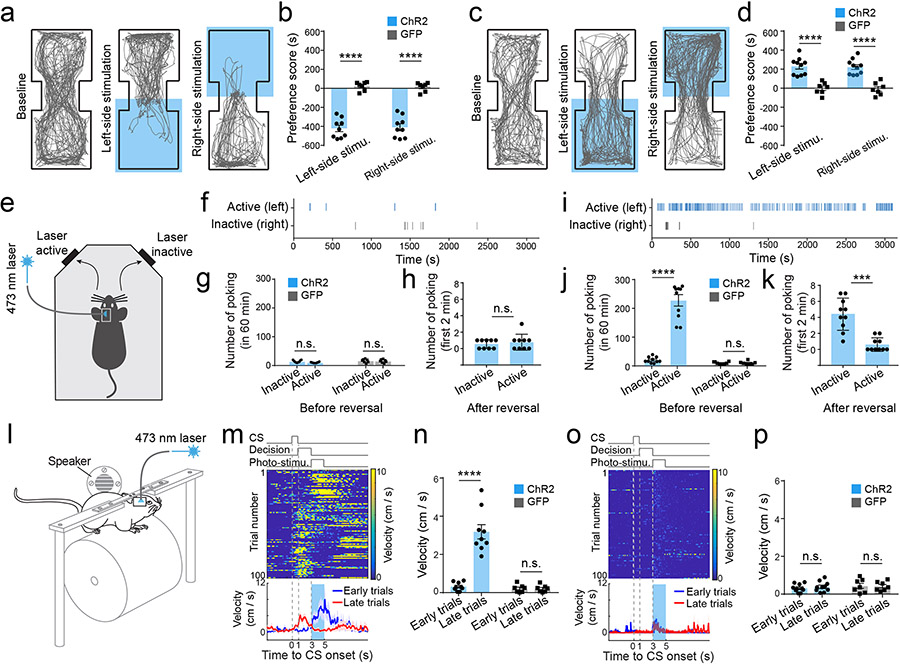
Activating NAc-projecting cells produces place avoidance, whereas activating OT-projecting cells produces preference and supports self-stimulation. NAc-directed activation can also serve as an adverse outcome that animals learn to avoid, while OT-directed activation does not support the same avoidance learning. The populations thus supply differently directed motivational signals.
The findings concern Fezf2-labeled cells; other amygdala-to-NAc neurons may participate in reward. Terminals projecting to prefrontal cortex or lateral septum also lack the same effects in the tested place task. The result is a cellular and circuit account of how outcomes and predictors become linked to action, rather than a fixed valence for an entire brain region.
Source: Zhang X et al. · Nature neuroscience · TDM
Original figure and English caption ↗