How a small active population shifts a stress-related network
A small A2A-receptor-positive population links chronic stress, local inhibition and two downstream outputs. Local receptor blockade improves tested mouse behaviors.

Repeated stress need not make an entire brain region uniformly more or less active. A small population can reshape neighboring cells and distant targets. A study published in Nature Communications on April 5, 2023 focuses on adenosine A2A-receptor-positive neurons in the lateral septum (LS), a midline region linked to emotion, motivation and social behavior and dominated by inhibitory cells. Chronic stress increases septal A2A receptors; enhancing receptor signaling or population activity promotes selected depressive-like behaviors in mice. Unexpectedly, greater activity in this minority accompanies fewer activity-marker-positive cells across the LS.
Receptor, population and projection experiments link LS A2A signaling to stress-related behavior. Downstream disinhibition remains a proposed mechanism.
Contents · 7 sections
Finding the outputs of a small population
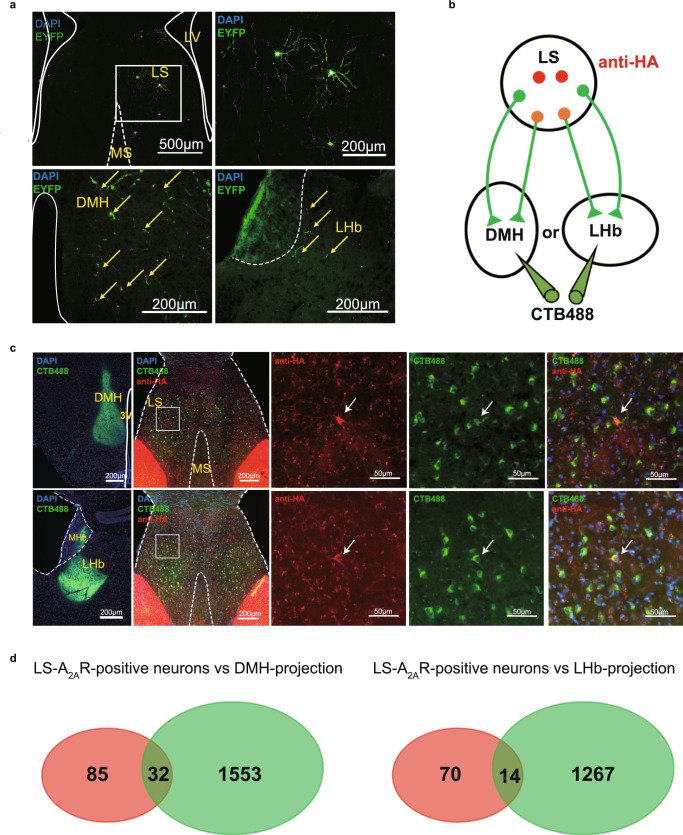
Earlier tagging work estimated that A2A-positive neurons account for about one percent of LS neurons. Their outputs have clear destinations: anterograde tracing identifies labeled terminals in the dorsomedial hypothalamus (DMH) and lateral habenula (LHb), and retrograde tracing from both targets labels receptor-positive LS cells.
These targets participate in stress and mood regulation, suggesting routes by which a local receptor change could reach distant circuitry. The same anterograde observations reveal no corresponding labeling in the periaqueductal gray, ventral tegmental area or raphe. Outputs of distinct LS populations therefore deserve separate attention.
Source: Wang M et al. · Nature communications · CC BY
Original figure and English caption ↗
Exciting a minority increases inhibition nearby
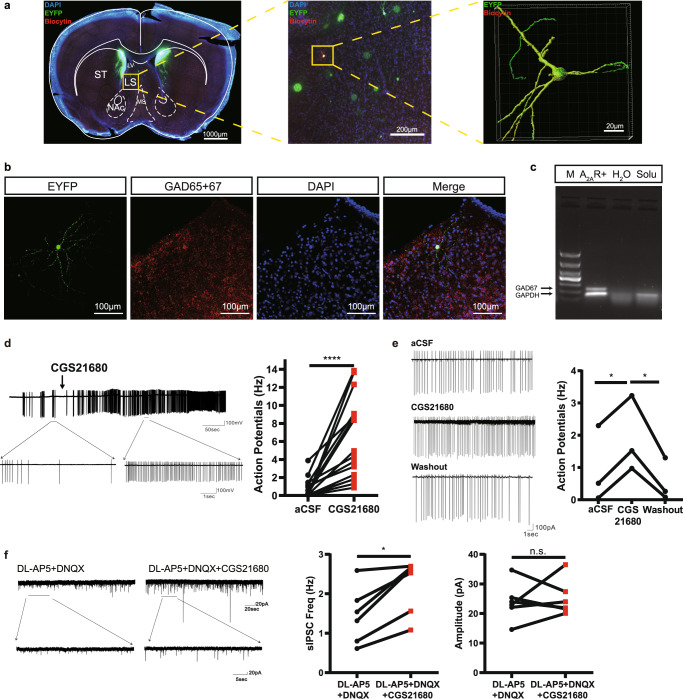
Slice recordings show increased firing in labeled cells after A2A activation, with reversal after agonist washout. Staining and single-cell analysis support their GABAergic identity. Nearby unlabeled cells receive more frequent spontaneous inhibitory postsynaptic currents, with little change in amplitude.
An excited inhibitory minority can quiet its neighbors. Following local receptor activation in vivo, fewer LS cells express c-Fos while more do so in DMH and LHb. As an activity-related marker, c-Fos reveals a striking opposition between local and distant responses.
Source: Wang M et al. · Nature communications · CC BY
Original figure and English caption ↗
Population activity shifts behavior in opposite directions
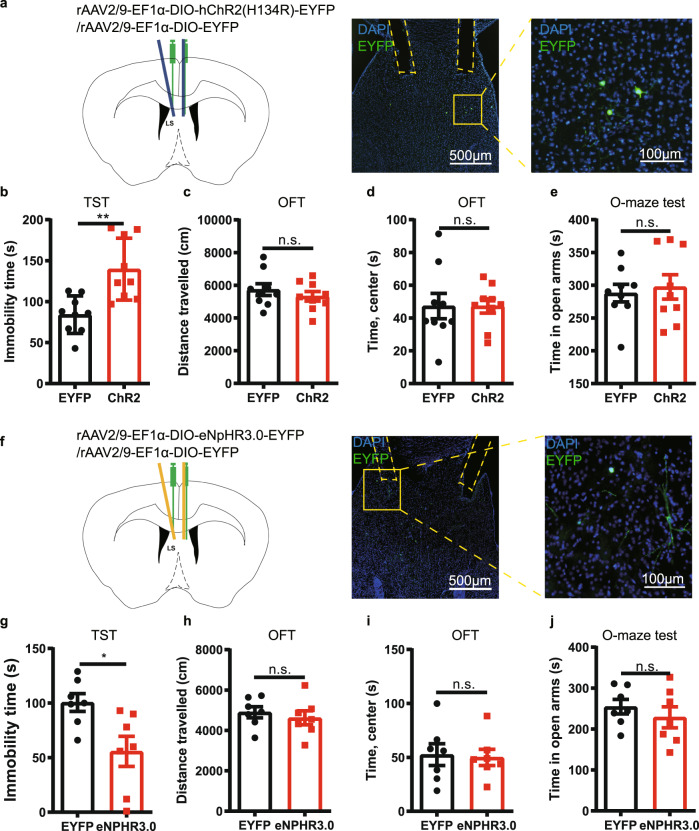
Activating A2A-positive LS cells increases immobility in the tail-suspension test; inhibiting them decreases it. Neither manipulation significantly changes open-field distance, center time or elevated-O-maze open-sector time. The effect concentrates on the tested immobility measure rather than a general reduction in locomotion.
Bidirectional changes explain why a regional average can miss essential detail: one LS population can inhibit another. Most behavioral experiments use males; supplementary experiments also observe a similar activation-associated immobility change in females.
Source: Wang M et al. · Nature communications · CC BY
Original figure and English caption ↗
Both output routes influence immobility
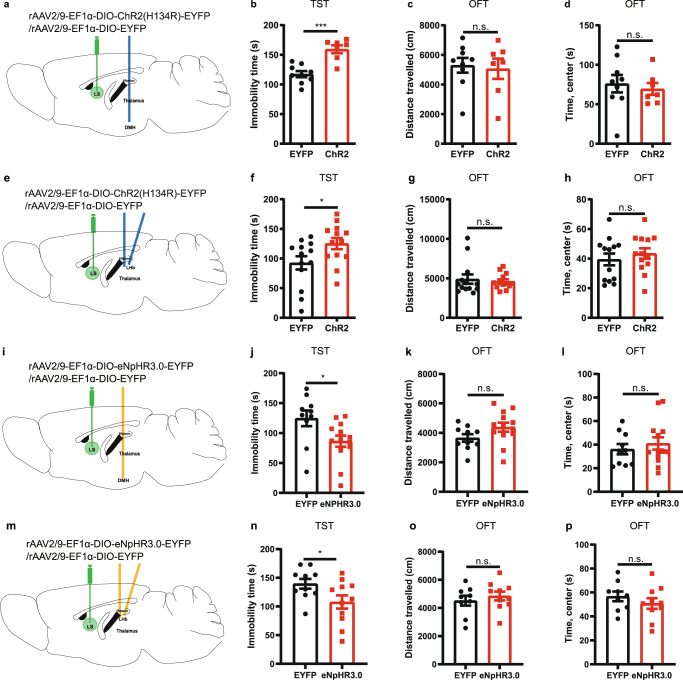
Enhancing labeled LS terminals locally in either DMH or LHb increases tail-suspension immobility. Local terminal inhibition decreases it, while open-field distance and center time remain largely unchanged. The population-level behavioral effect thus extends to specific outputs.
Why does GABAergic input accompany increased downstream activity markers? The authors propose that it may inhibit local inhibitory cells and thereby disinhibit others. Recipient identities and the complete relay remain unresolved, leaving a testable explanation for the counterintuitive result.
Source: Wang M et al. · Nature communications · CC BY
Original figure and English caption ↗
Chronic stress increases receptor abundance
Repeated restraint increases tail-suspension immobility and A2A-receptor protein in the septum containing LS. Tested prefrontal, hippocampal and striatal levels do not rise significantly; open-field distance and the main anxiety-related comparisons also remain nonsignificant. Repeated-swim stress likewise increases septal receptors.
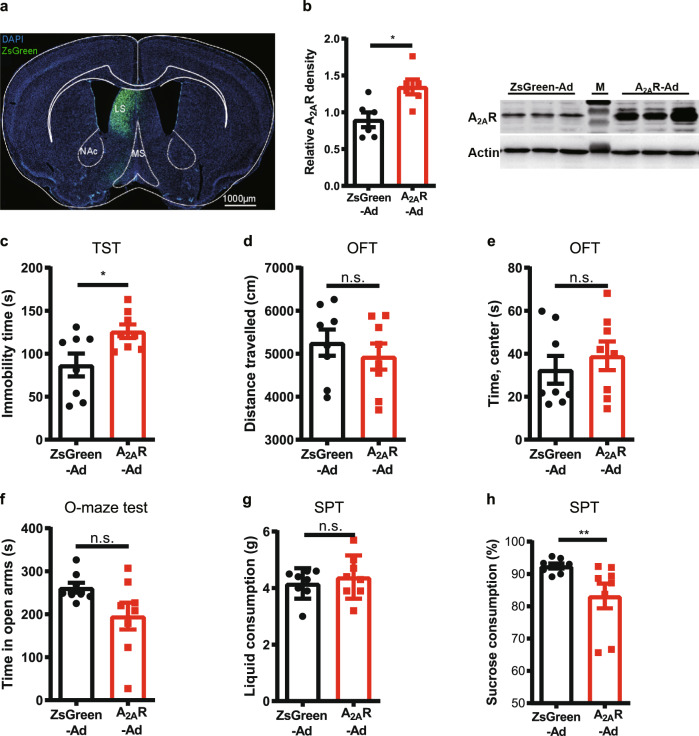
Increasing LS receptor expression in mice not exposed to this chronic-stress regimen also increases immobility and lowers sucrose preference. Total fluid intake, locomotion and tested exploration measures remain similar. Receptor abundance is thus linked to behavioral effects beyond its association with stress.
Source: Wang M et al. · Nature communications · CC BY
Original figure and English caption ↗
Reducing receptors shifts the network another way
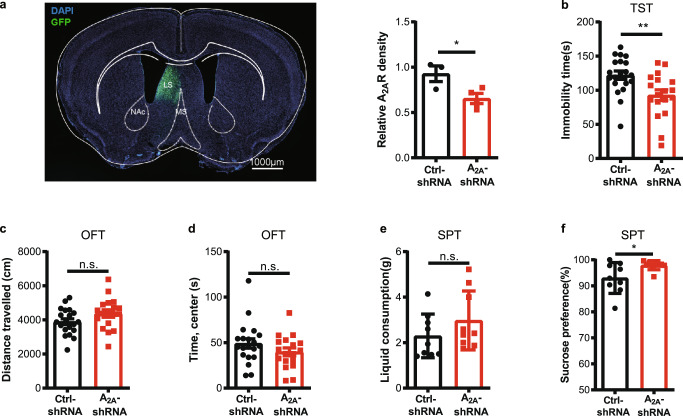
Reducing endogenous LS A2A expression decreases immobility and increases sucrose preference, while total fluid intake and open-field performance remain largely unchanged. Opposing effects of increased and decreased receptor expression echo the earlier bidirectional population experiments.
These findings place adenosine signaling in a specific region, while receptor modulation and population activity remain distinct. One changes responsiveness to signaling; the other directly changes network output. Together they show that this population and its A2A signaling influence the tested behaviors.
Source: Wang M et al. · Nature communications · CC BY
Original figure and English caption ↗
Can receptor blockade help after stress?
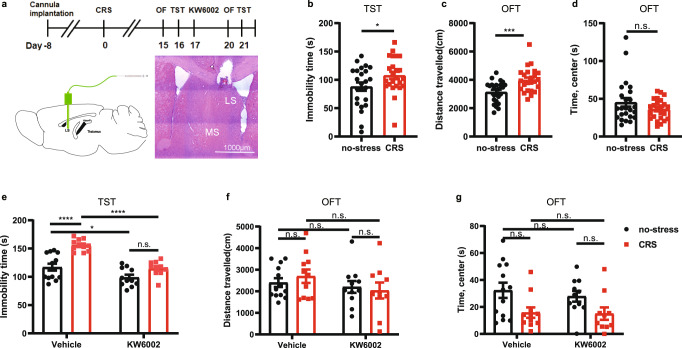
Finally, the team confirms behavioral changes after chronic restraint before applying an A2A antagonist locally in LS. Elevated immobility in stressed mice decreases, without significant changes in open-field distance or center time. This final experiment assesses post-stress immobility improvement without simultaneously testing sucrose-preference recovery.
From receptors in a small population to two distant outputs, the study connects chronic stress with altered local network balance. Findings chiefly come from adult male mice, and immobility and sucrose tests capture particular behavioral dimensions. They identify regional and circuit contributions to stress-related behavior, with local drug observations remaining within animal research.
Source: Wang M et al. · Nature communications · CC BY
Original figure and English caption ↗