How a companion’s pain travels: early experience changes a thalamocortical response
After early maternal separation, mice show weaker social transfer of pain in adulthood. Researchers trace the change to excitatory signaling from the paraventricular thalamus to the prelimbic cortex.
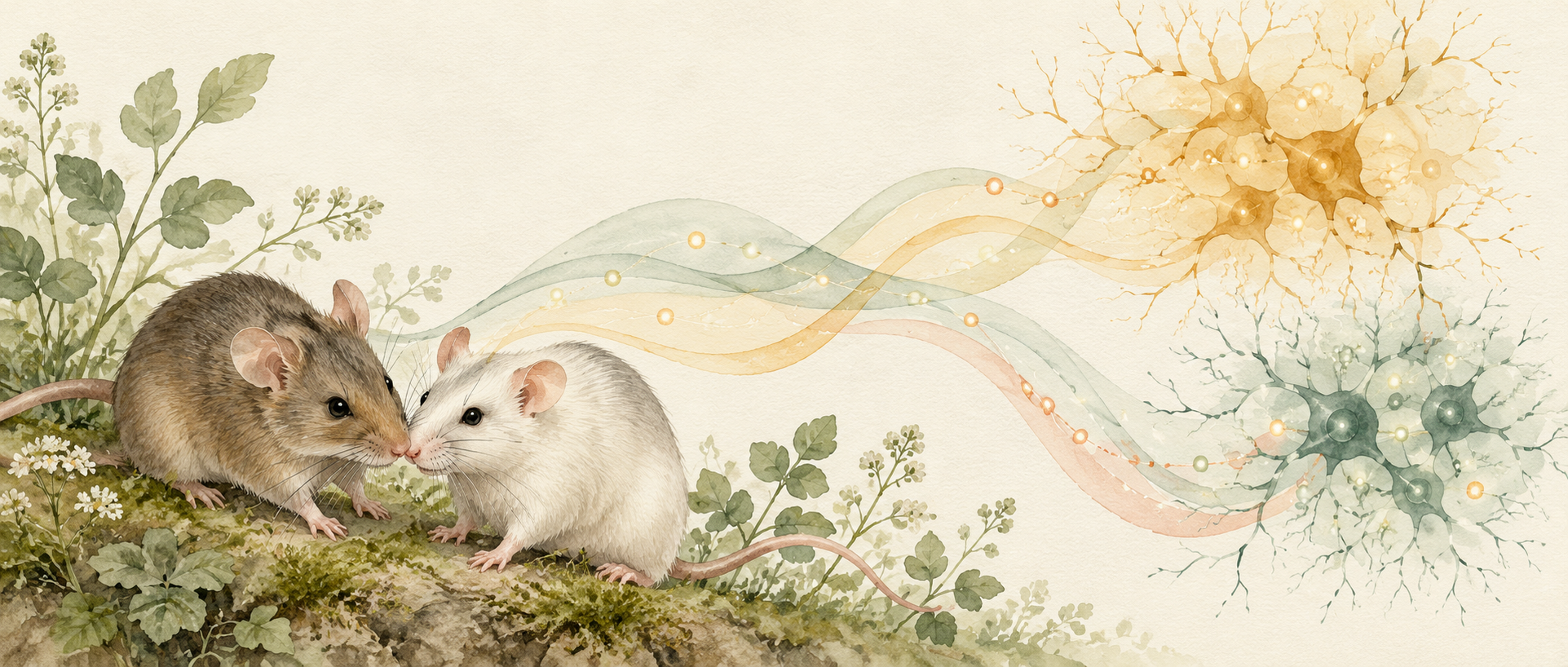
A mouse has not been directly injured, yet becomes more sensitive to touch after spending time with a companion in pain. This social transfer of pain offers a way to ask how information about another animal’s state changes one’s own sensory responses. A study in Science Advances finds that early experience affects this process, with a thalamic–prefrontal connection playing a key role.
Early maternal separation weakens adult mice’s discrimination of a companion’s state and social transfer of pain. Increasing posterior PVT–PrL activity, or providing gentle tactile experience early in life, improves both readouts.
Contents · 6 sections
The pain does not begin in the observer
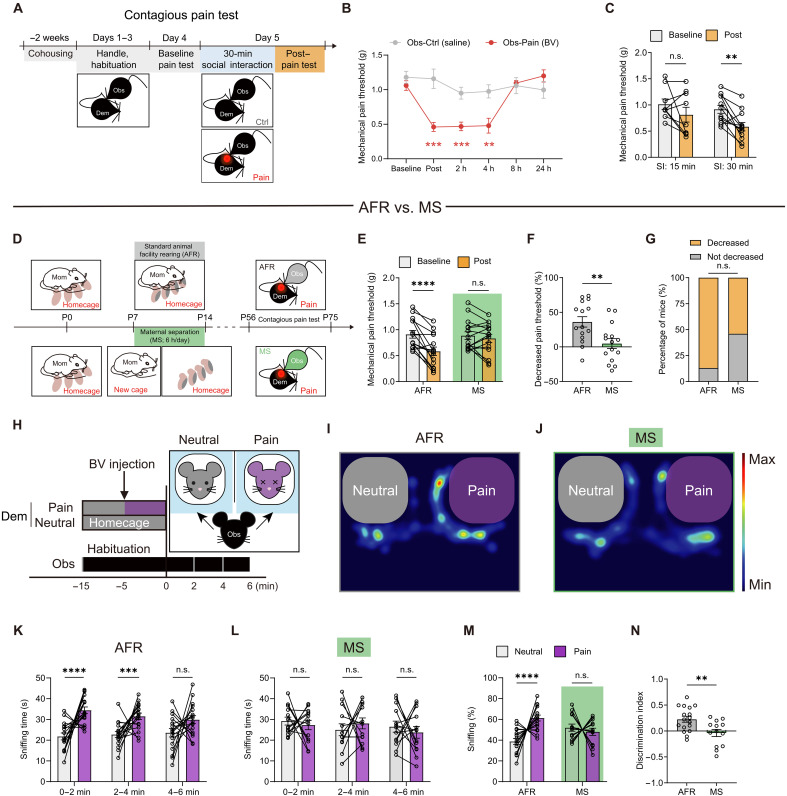
After interacting with a familiar companion in pain, normally reared mice have lower mechanical pain thresholds for several hours. Comparable interaction with a companion without pain does not produce the same change. A social encounter changes the output of the sensory system.
Mice exposed to maternal separation early in life show a markedly weaker response in adulthood. Their baseline mechanical thresholds, heat sensitivity and another nociceptive readout are comparable, without broad reductions in movement or the social behaviors tested. The difference centers on sensitivity changes prompted by a companion’s state.
Source: Zhang Z et al. · Science advances · CC BY
Original figure and English caption ↗
A longer sniff reveals state discrimination
Observers also encounter a painful and a neutral companion. Normally reared mice initially sniff the painful companion more, whereas separated mice lack this preference. This response to differently affected unfamiliar animals complements the pain-transfer task involving familiar partners.
With longer interaction between familiar partners, separated mice can show lower thresholds, but the magnitude and proportion of responders remain below controls. The response is weakened rather than absent under every condition. Supplementary observations in females show similar behavioral differences.
Timing also matters. Separation closer to birth still weakens adult pain transfer, whereas a later separation period has a milder effect and mice retain interaction-associated threshold reductions. Sensitivity to experience changes as this social sensory response develops.
Posterior PVT activity rises around contact
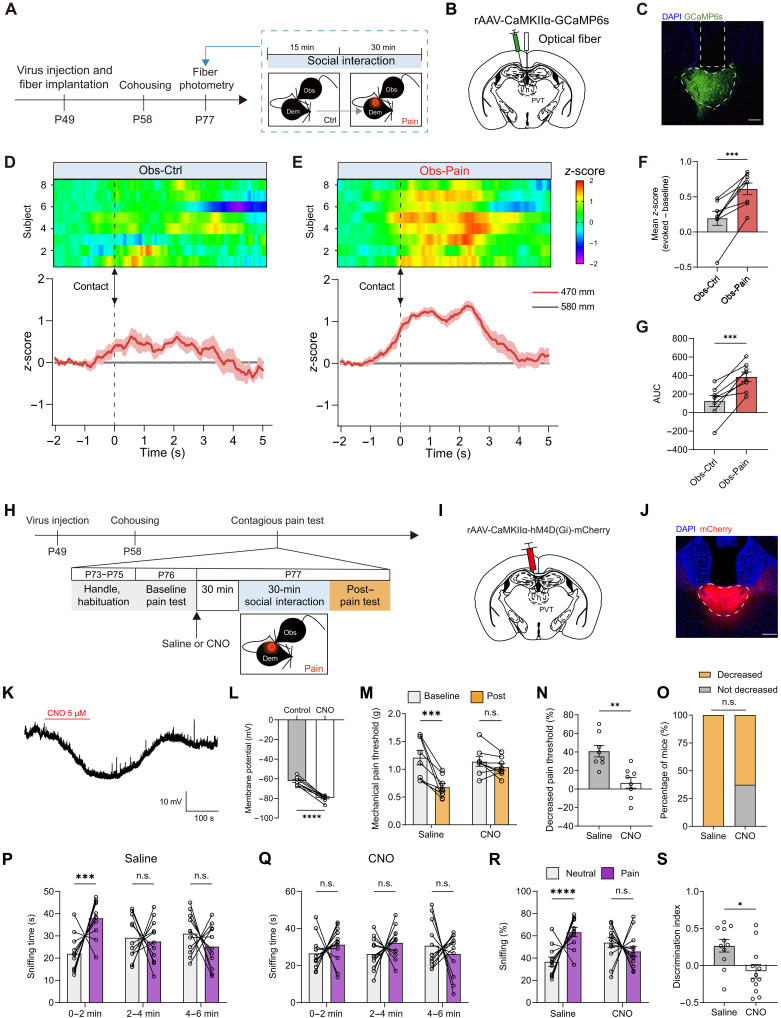
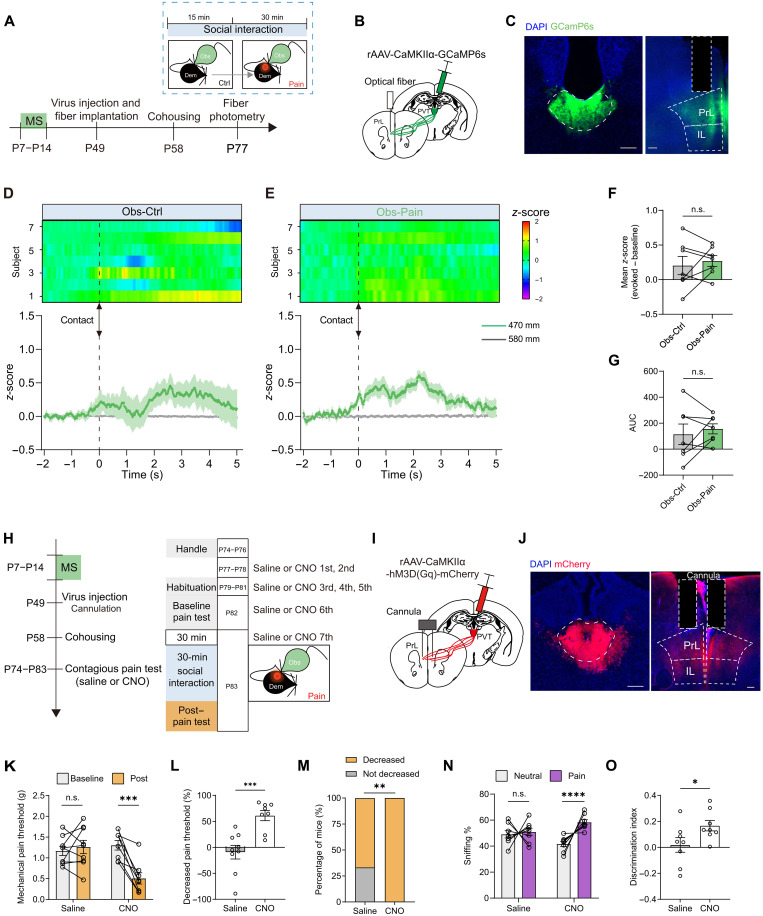
The paraventricular thalamus, or PVT, lies near the brain’s midline and connects with regions involved in motivation, emotion and behavioral significance. Its glutamatergic population shows stronger calcium signals as normally reared observers approach and contact a painful companion. Reducing posterior PVT activity weakens pain transfer and state discrimination; reducing anterior PVT activity does not have the same effect.
The finding goes beyond identifying an active region: neighboring areas differ in their contribution to the same behavior. Pain transfer persists when oxytocin neurons in another candidate region are inhibited, showing that this task does not depend equally on every population associated with social behavior.
Source: Zhang Z et al. · Science advances · CC BY
Original figure and English caption ↗
The cells become less responsive
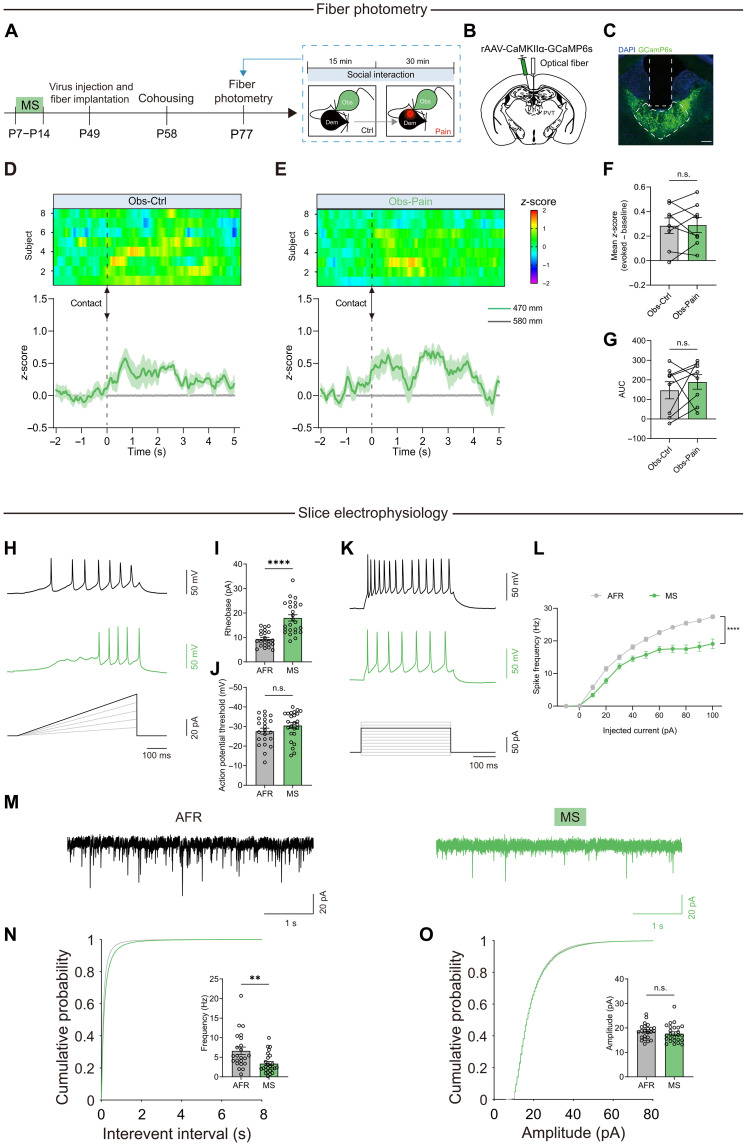
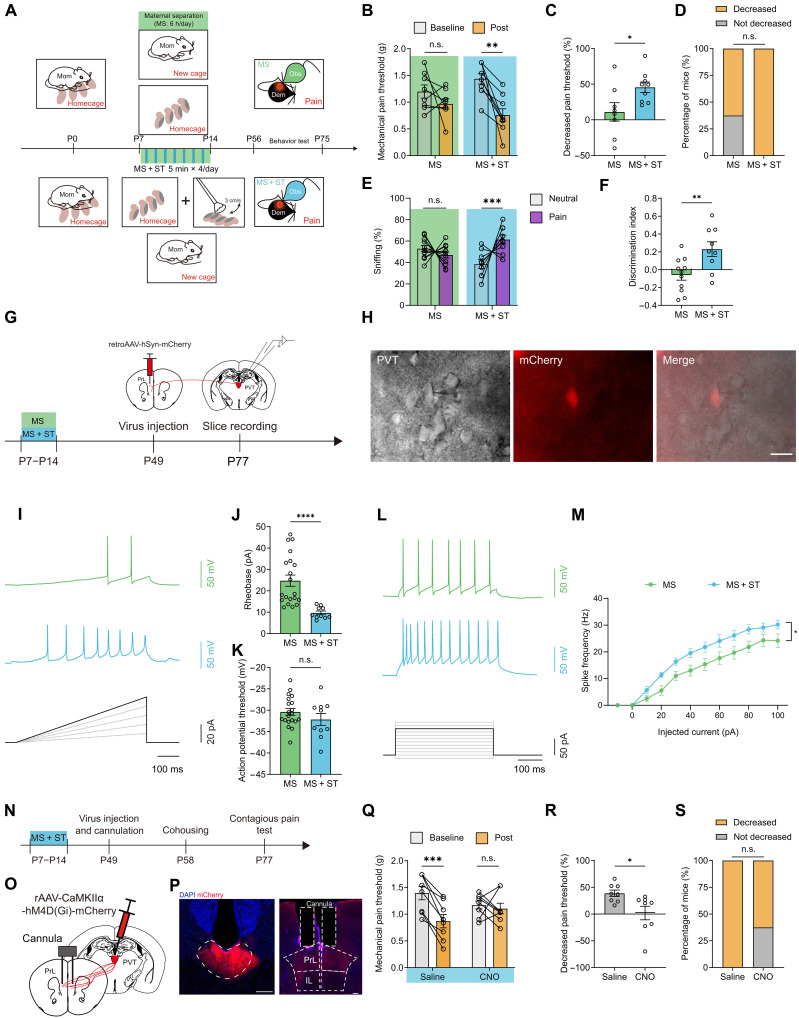
In separated adults, PVT cells lack the additional calcium response seen around contact with painful companions in controls. Electrical recordings show that the cells are harder to excite and receive fewer spontaneous excitatory events, while individual event amplitudes remain comparable. The weaker social response accompanies a changed cellular state.
The same electrical abnormalities are not detected immediately after separation early in life. The adult findings therefore appear to emerge during development rather than simply reproduce an immediate juvenile change. Raising PVT activity in separated adults improves both behavioral readouts.
Source: Zhang Z et al. · Science advances · CC BY
Original figure and English caption ↗
A critical output reaches prelimbic cortex
PVT has multiple outputs. The study identifies the projection to prelimbic cortex: its calcium activity increases during interaction with a painful companion in controls, and reducing its activity weakens pain transfer and state discrimination. Inhibiting projections to nucleus accumbens or infralimbic cortex does not reproduce the pain-transfer effect.
The separated group has weaker social responses in this projection. Increasing its activity restores interaction-associated threshold reductions and state discrimination. The connection links deep thalamic activity with cortical processing of social information.
Source: Zhang Z et al. · Science advances · CC BY
Original figure and English caption ↗
Gentle touch connects with adult circuit responses
The team also examines the effect of gentle tactile experience early in life. Separated mice receiving it later show improved pain transfer and state discrimination, more excitable PrL-projecting PVT cells and stronger interaction-related calcium responses. Reducing projection activity subsequently weakens the restored pain transfer.
Normally reared mice do not develop stronger pain transfer with the same tactile experience. Its effect depends on the starting state and brings physical contact during early care into a specific circuit question. Most experiments use males, with some behavioral findings replicated in females. The study reveals how experience shapes a particular social sensory response in mice.
Source: Zhang Z et al. · Science advances · CC BY
Original figure and English caption ↗