From the natural compound nomilin to inhibitory output in an affective circuit
In male mice, nomilin alters depressive-like behavior in two models. Ventral lateral-septal GABA cells, their BNST output and local GABAA receptors contribute to the effects.
When a natural compound changes animal behavior, the next question is what it recruits in the brain. Nomilin is a bioactive limonoid. A CNS Neuroscience & Therapeutics study observes behavioral effects in inflammation-associated and chronic-stress mouse models, then follows inhibitory GABA output from ventral lateral septum, or LSv, to bed nucleus of stria terminalis, or BNST. The investigation moves from compound to cells, projections and downstream receptors.
Nomilin reduces model immobility and increases sucrose preference. Inhibiting LSv GABA cells or BNST-projecting populations diminishes post-treatment behavioral improvement; BNST GABAA blockade also weakens effects of LSv activation.
Contents · 7 sections
Behavior changes in immune-challenge and chronic-stress models
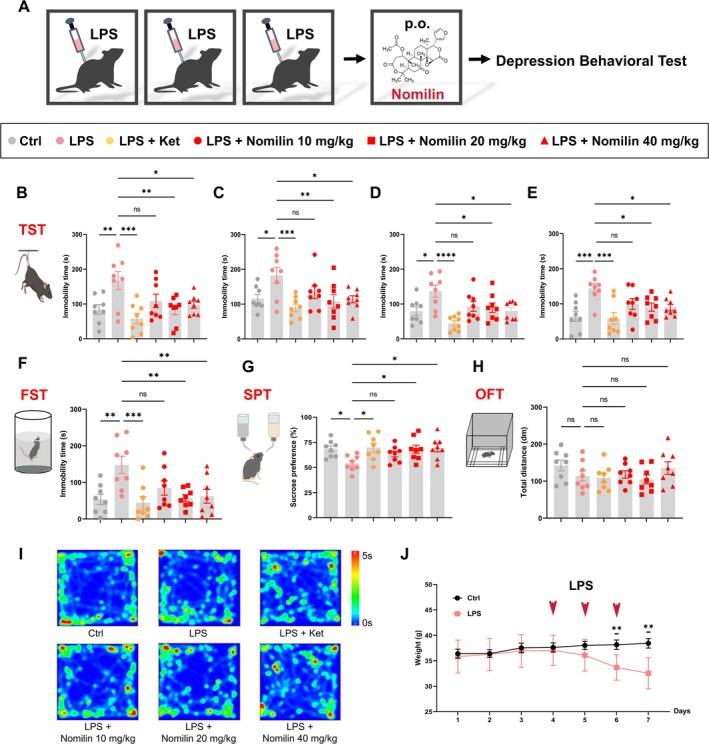
In LPS-treated males, immune activation accompanies increased tail-suspension and forced-swim immobility and reduced sucrose preference. Nomilin decreases immobility and increases preference, without a significant change in open-field total distance.
Tail-suspension changes at effective doses are observed from one to twenty-four hours after a single treatment. Mice exposed to twenty-one days of restraint stress also show reduced immobility and greater sucrose preference after three days of treatment, motivating investigation of shared brain connections.
Source: Chen L et al. · CNS neuroscience & therapeutics · CC BY
Original figure and English caption ↗
Activity markers draw attention to LSv
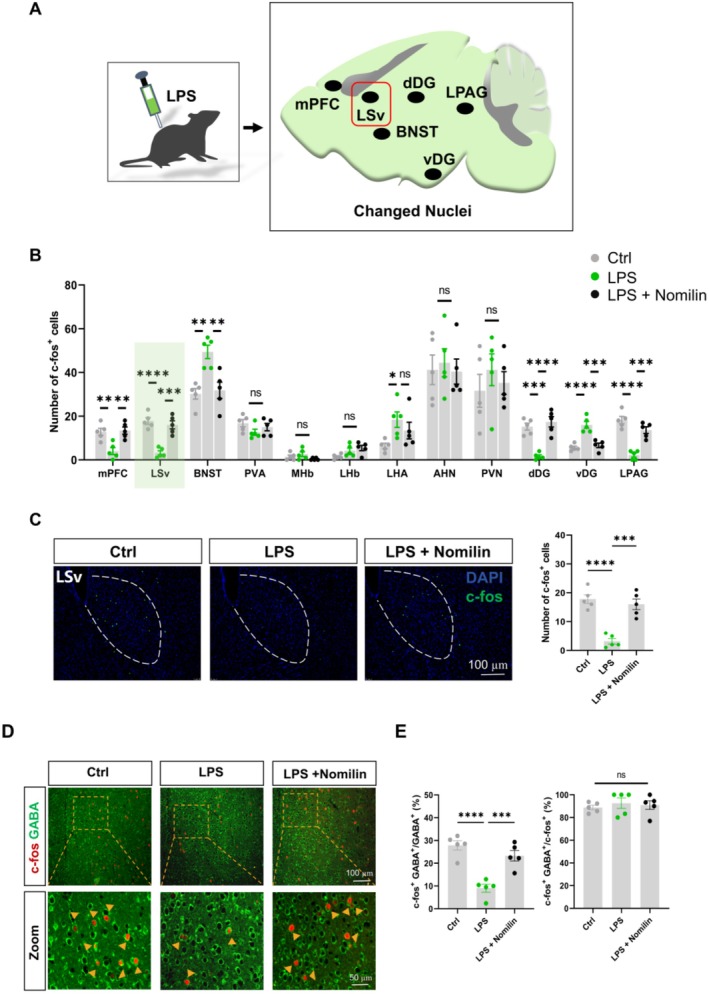
Across surveyed regions, LSv and several other areas have fewer c-Fos activity markers after LPS and more after nomilin. Approximately ninety percent of LSv c-Fos-positive cells carry GABA markers, linking the change chiefly to inhibitory populations.
Nomilin is detectable in brain tissue one hour after administration. Blocking the bile-acid-associated receptor TGR5 in LSv diminishes post-treatment improvement. Measured prefrontal and hippocampal inflammatory factors do not significantly decline relative to LPS alone, directing attention toward neural activity and receptor involvement.
Source: Chen L et al. · CNS neuroscience & therapeutics · CC BY
Original figure and English caption ↗
Direct LSv modulation also changes behavior
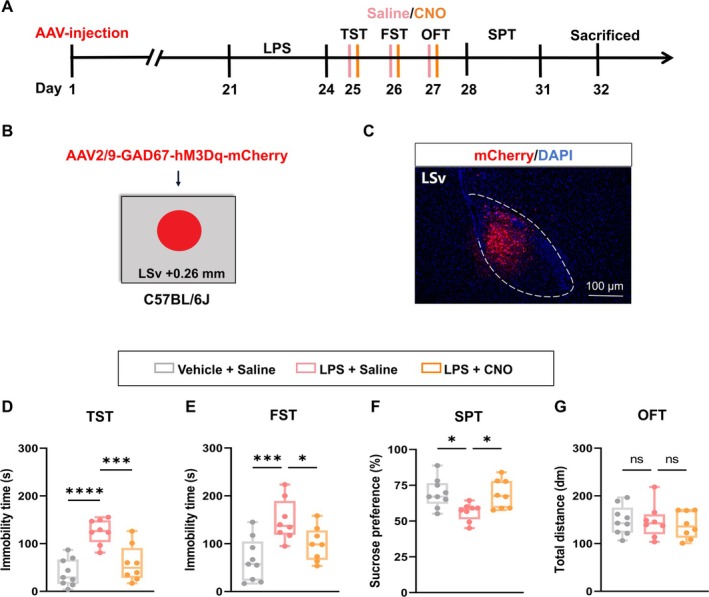
Activity markers locate candidates; intervention tests their contribution. Chemogenetic activation of LSv GABA cells reduces tail-suspension and swimming immobility and increases sucrose preference in LPS mice, without significantly changing open-field distance.
Combining nomilin with cell inhibition increases immobility again and lowers sucrose preference. Activation effects and changes during inhibition under treatment link LSv GABA populations to the measured behaviors from complementary directions.
Source: Chen L et al. · CNS neuroscience & therapeutics · CC BY
Original figure and English caption ↗
Stronger upstream output accompanies lower downstream markers
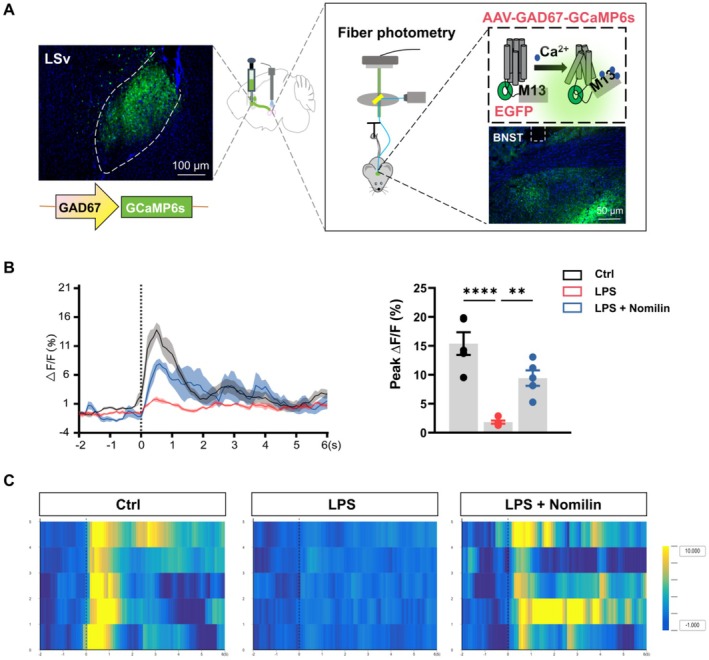
LSv GABA cells project to several regions, including BNST. BNST c-Fos rises in the LPS model and declines after nomilin. Recording LSv-derived GABA projection calcium in BNST examines responses at the onset of tail-suspension struggling.
The projection signal is weaker after LPS and increases after nomilin. An inhibitory projection and the downstream region’s aggregate activity markers can change in different directions. Stronger inhibitory output accompanies a reduction in elevated downstream markers.
Source: Chen L et al. · CNS neuroscience & therapeutics · CC BY
Original figure and English caption ↗
BNST-projecting populations also regulate behavior
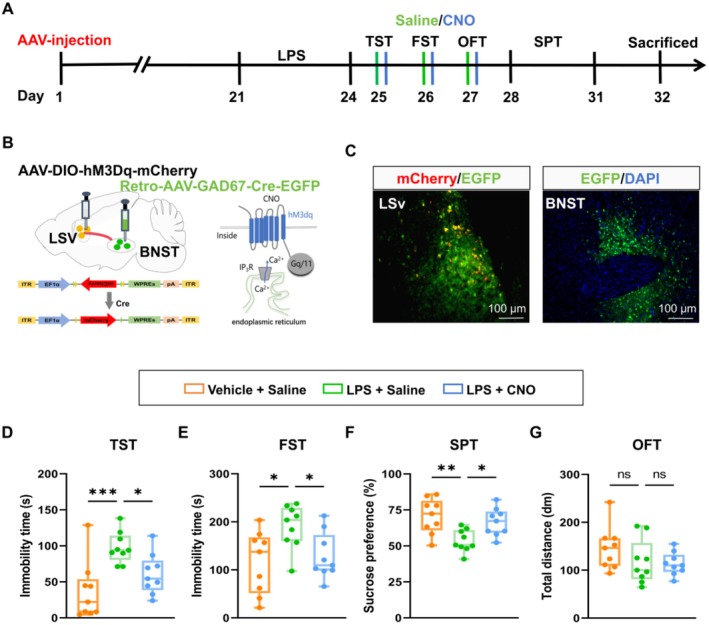
Projection labeling selects BNST-connected LSv GABA cells for chemogenetic modulation. Activation reduces LPS-model immobility and increases sucrose preference, reproducing behavioral changes previously observed with the broader LSv population.
Selecting an output direction links behavioral changes to a more defined population among the region’s diverse projections. The compound’s effects become associated with specific cellular connections rather than a single uniform rise or fall across an affective network.
Source: Chen L et al. · CNS neuroscience & therapeutics · CC BY
Original figure and English caption ↗
Inhibiting the output population diminishes post-treatment improvement
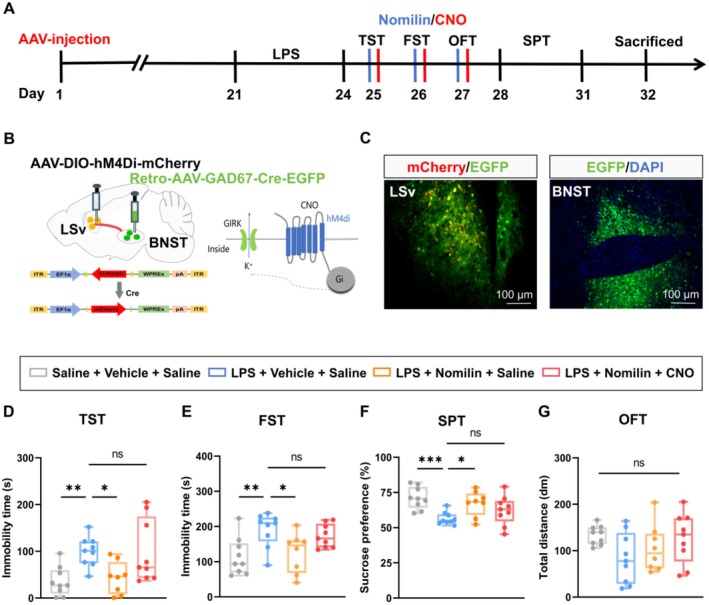
In nomilin-treated LPS mice, inhibiting the projection-associated population increases tail-suspension and swimming immobility and lowers sucrose preference relative to treatment without inhibition. Group comparisons show no significant total-distance change in the open field.
Manipulation links compound, population and behavior more closely: changing this population affects behavior, and reducing its activity during treatment changes post-treatment outcomes. The next question concerns the receptors receiving GABA-related output in BNST.
Source: Chen L et al. · CNS neuroscience & therapeutics · CC BY
Original figure and English caption ↗
BNST GABAA receptors contribute
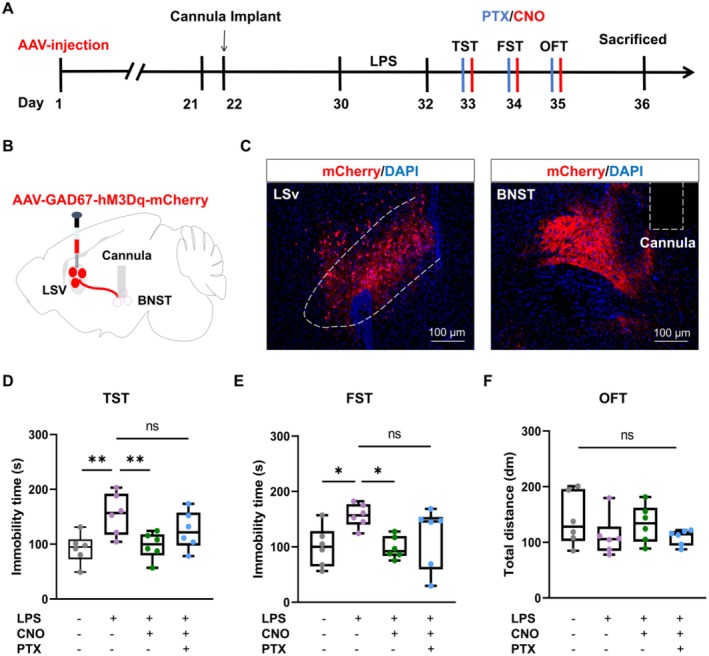
Local BNST GABAA receptor blockade weakens the reduction in tail-suspension and swimming immobility produced by LSv GABA activation. The behavioral effect involves both a defined inhibitory source and downstream receptor participation.
Starting with a natural compound, this male-mouse study reaches LSv inhibitory output and BNST receptors. Stronger upstream projection responses accompany lower downstream activity markers and altered immobility and reward preference, identifying a circuit-level connection for investigating the compound’s effects.
Source: Chen L et al. · CNS neuroscience & therapeutics · CC BY
Original figure and English caption ↗