From avoidance to exploration: distinct roles of amygdala inhibitory cells
A male mouse study reveals different stress and behavioral contributions of BLA PV and CCK-GABA cells. SST cells respond, yet tested interventions do not change behavior.
Do cells in the same amygdala region that release an inhibitory transmitter do the same job? A 2024 Translational Psychiatry study examines GABAergic populations marked by somatostatin (SST), parvalbumin (PV) and cholecystokinin (CCK) in basolateral amygdala (BLA). The same stimulus sometimes activates them together and sometimes produces opposing changes. Manipulating activity affects different combinations of social interaction, sucrose preference and exposed-space exploration. Understanding greater regional inhibition therefore requires resolving particular cells and behaviors.
BLA PV cells regulate several depression-like measures, while CCK-GABA cells more prominently affect exposed-space exploration and some other measures. Effects depend on stress condition and behavioral context.
Contents · 6 sections
A population responds differently across stressors
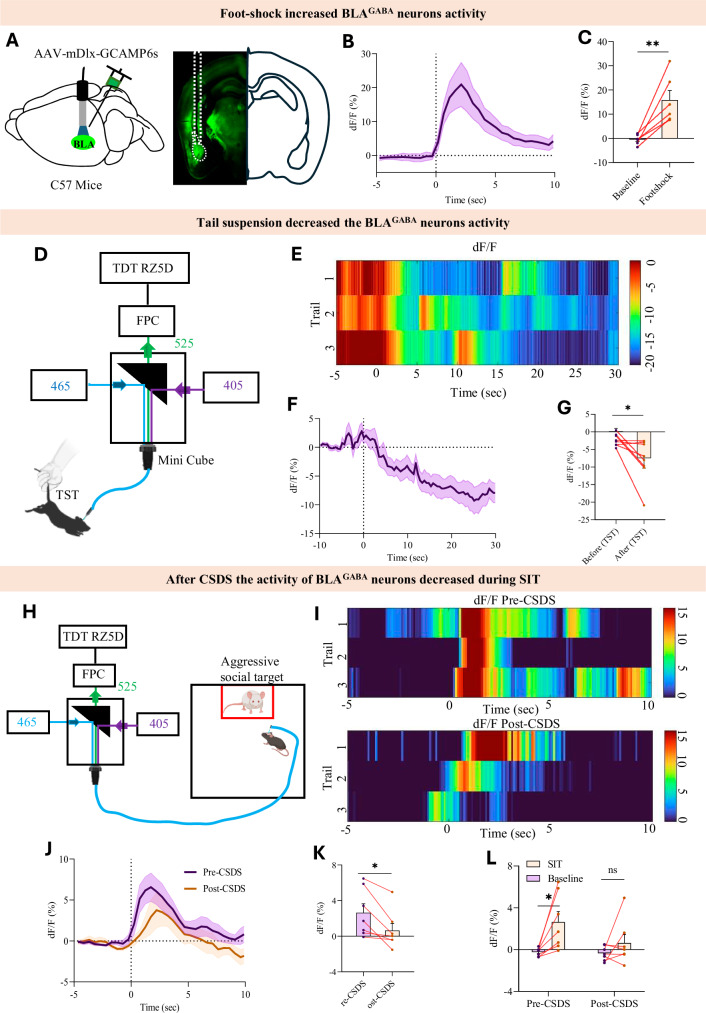
Aversive foot stimulation increases BLA GABAergic population calcium, whereas tail suspension lowers it. After chronic social defeat, the population also responds less strongly during social interaction. Inhibitory cells do not respond to all stress events in the same direction.
Tissue analysis finds more c-Fos-positive GABAergic cells after foot stimulation, with similar total GABAergic-cell labeling. SST, PV and CCK-GABA subtypes also show increased activity labeling, directing attention to recruitment rather than changes in population size.
Brief aversive stimulation, sustained stress and later encounters with another animal are different contexts. The study next tests whether changing population activity affects behavior, rather than inferring function solely from the direction of recorded activity.
Source: Asim M et al. · Translational psychiatry · CC BY-NC-ND
Original figure and English caption ↗
Activation pattern changes the outcome
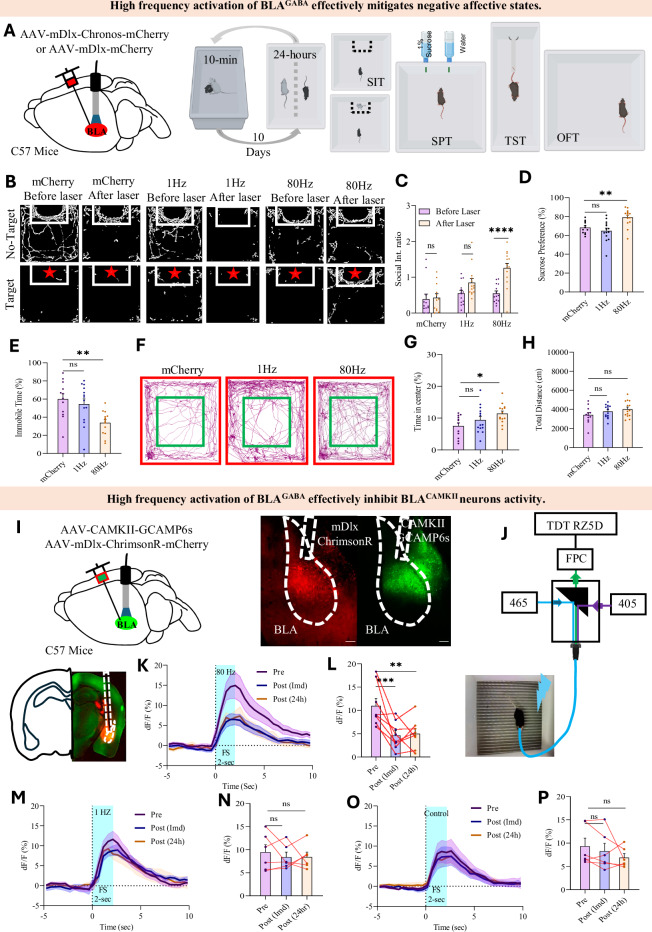
In chronically defeated mice, the higher tested activation frequency increases social interaction, sucrose preference and open-field center time while reducing suspension immobility. The lower frequency does not produce comparable effects, and total distance remains similar without a general movement increase.
After higher-frequency activation, excitatory-cell responses to aversive foot stimulation decrease and remain reduced the next day. Lower-frequency and control conditions lack the same change, linking stronger population inhibition with downstream activity and behavior.
The broad population contains different cell types. Improvements across several measures do not imply that every type independently provides all effects. The study therefore separates three molecularly labeled populations and compares their activity and intervention outcomes.
Source: Asim M et al. · Translational psychiatry · CC BY-NC-ND
Original figure and English caption ↗
SST: responsive without changing tested behaviors
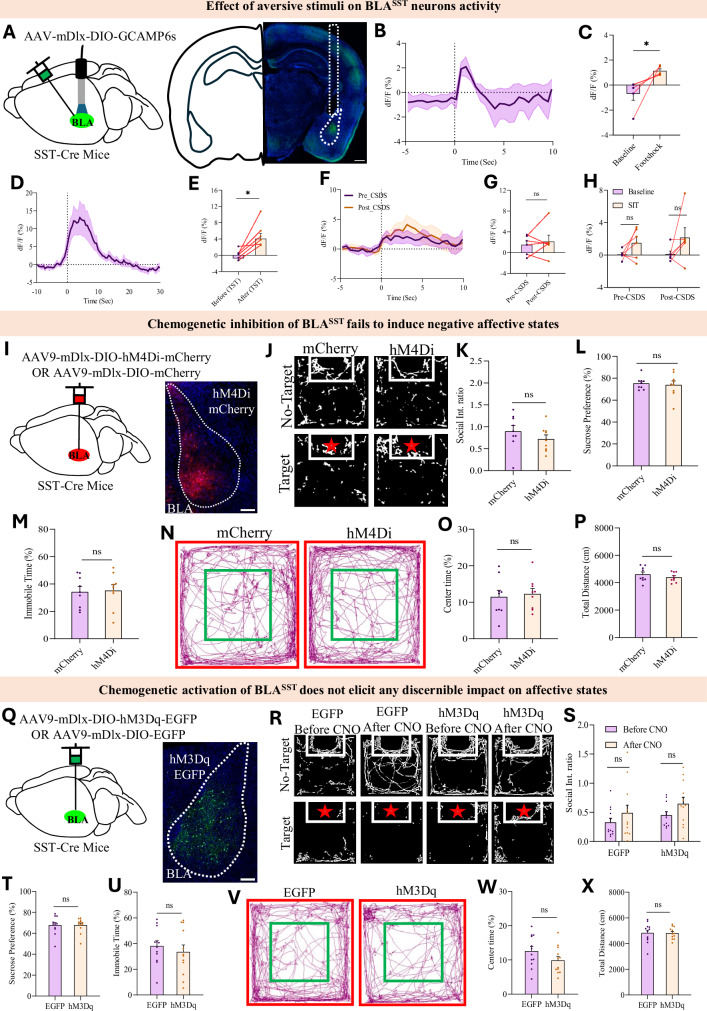
SST cells increase activity during aversive foot stimulation and at suspension onset. Social-interaction responses do not clearly differ before and after chronic defeat. Recruitment by stress events does not automatically confer the same behavioral effect.
Inhibiting SST cells under a milder defeat condition leaves interaction, sucrose preference, immobility and open-field measures largely similar. Activating SST cells under chronic defeat likewise does not clearly improve them. Under the tested conditions, increasing or reducing SST activity does not produce clear behavioral differences.
Source: Asim M et al. · Translational psychiatry · CC BY-NC-ND
Original figure and English caption ↗
PV: changes in interaction and reward choice
PV cells respond to foot stimulation and suspension onset, but their social-interaction responses decline after chronic defeat. Inhibition reduces interaction ratio and sucrose preference without clear changes in suspension immobility, center time or total distance.
Activating PV cells under chronic defeat increases interaction and sucrose preference and reduces immobility, while center time remains similar. Several depression-like measures change with PV activity without a parallel exposed-space exploration benefit, clarifying its contribution.
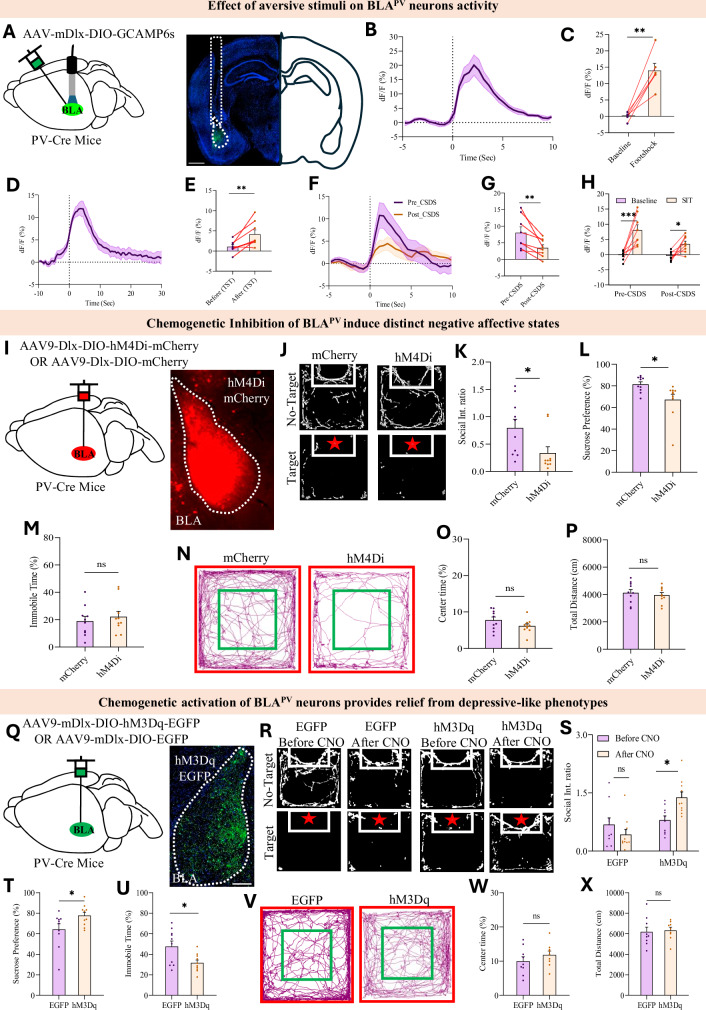
Source: Asim M et al. · Translational psychiatry · CC BY-NC-ND
Original figure and English caption ↗
CCK-GABA: exposed-space choice is more sensitive
CCK-GABA cells activate during foot stimulation but decrease activity during suspension. Social-interaction calcium responses do not clearly differ across chronic defeat. Their activity pattern differs from PV and SST and varies by task.
CCK-GABA inhibition reduces interaction and center time while leaving sucrose preference and immobility similar. Activation increases center time and reduces immobility without clearly improving interaction or sucrose preference. Exposed-space choice and selected coping-related behavior show the clearest changes.
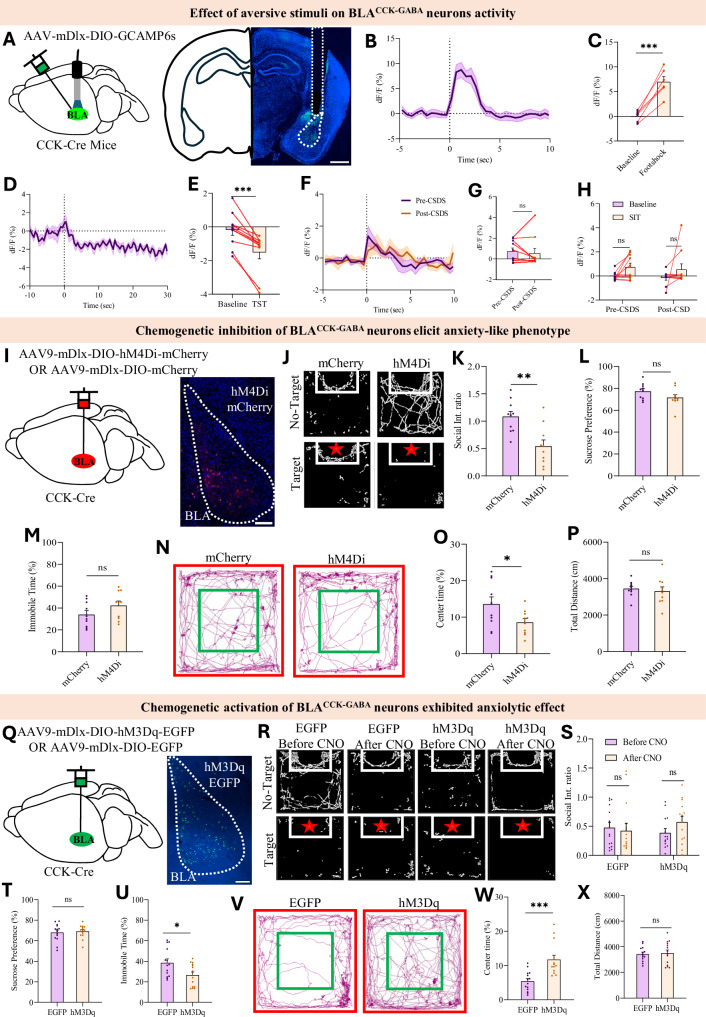
Source: Asim M et al. · Translational psychiatry · CC BY-NC-ND
Original figure and English caption ↗
Resolving regional function into cellular roles
This adult male mouse study resolves inhibitory populations by subtype, stress context and task. Broad activation improves several measures, while subtype interventions have selective effects. Molecular markers identify this division of roles; the molecules’ own contributions require separate testing.
The study distinguishes social contact, sucrose choice and exposed-space exploration as concrete behaviors often grouped under negative states. Local amygdala inhibition emerges as a finer organization in which different cells using one transmitter alter choices and coping in distinct ways.