Astrocyte responses follow different rhythms across challenges
In male mice, prefrontal astrocyte calcium responses to acute challenges differ in amplitude, peak timing and repetition. A strong first response does not guarantee equally strong later responses.

Does the brain respond identically to a sudden stimulus and to approaching an unfamiliar environment? Astrocytes support the neural environment and participate in information processing through calcium signals. A 2024 Neurobiology of Stress study observes medial prefrontal, mPFC, astrocyte responses in male mice during restraint, foot shock, exploration at height, odors and social encounters. Instead of one uniform rising curve, different contexts produce distinct dynamics, and repetition alters some responses.
Prefrontal astrocyte populations show calcium responses to several acute challenges. Initial elevated-platform responses are stronger, and foot-shock peaks arrive faster. Some later open-arm and platform responses weaken, whereas repeated restraint and foot-shock peaks change nonsignificantly.
Contents · 7 sections
Following the collective rise and fall
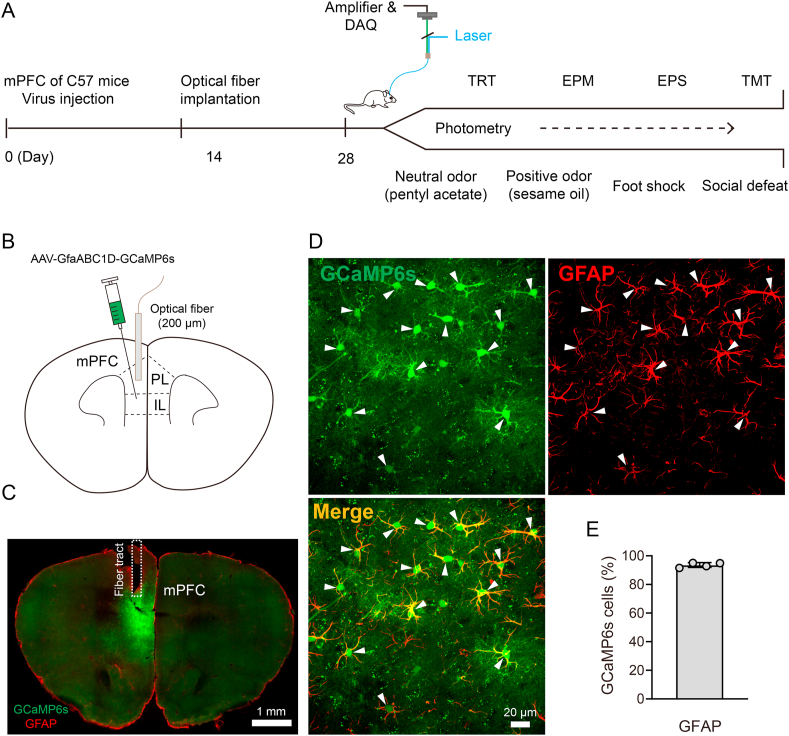
Calcium-indicator expression in mPFC allows fluorescence changes to be followed in freely behaving mice. Histology shows that most indicator-expressing cells overlap the astrocytic marker GFAP. Recordings can therefore track population dynamics during behavior rather than examining tissue only afterward. Because prefrontal cortex participates in coordinating behavior with context, concurrent observations align cellular changes with specific actions.
The signal integrates activity within the recording region. Similar peaks may involve different numbers or locations of recruited cells. It describes how population activity varies with context without resolving each individual astrocyte’s response.
Source: Wu AM et al. · Neurobiology of stress · CC BY-NC-ND
Original figure and English caption ↗
Rapid rises with similar repeated peaks
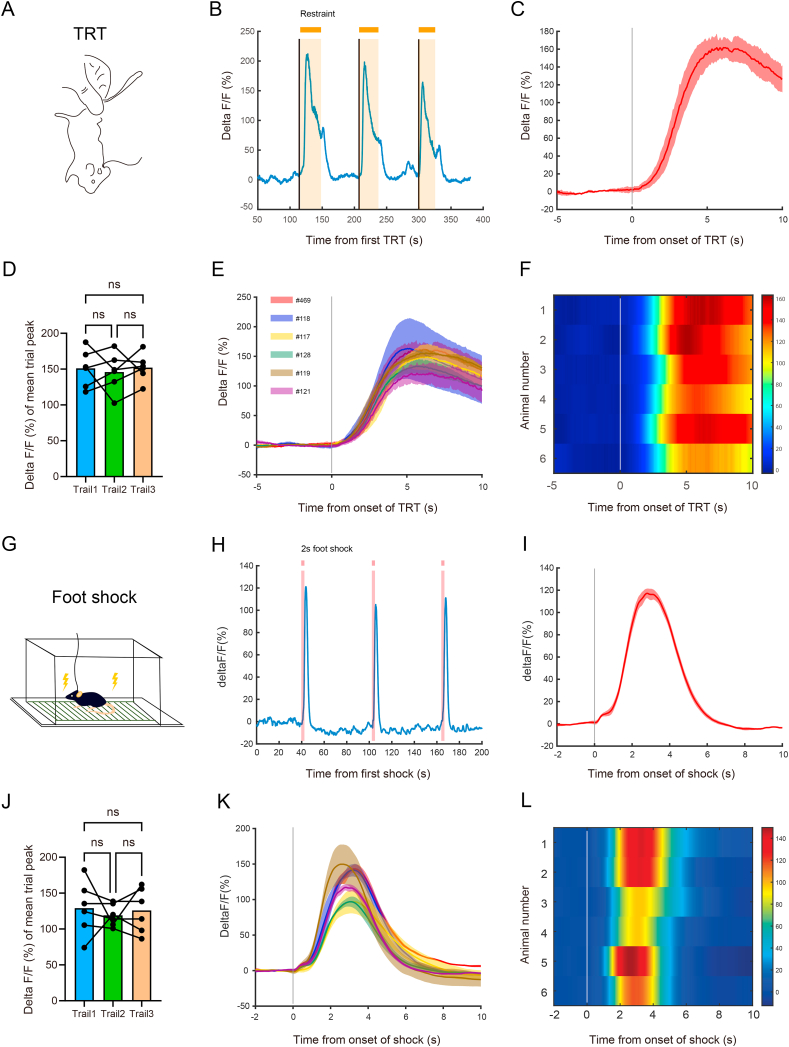
Astrocyte calcium rises rapidly after restraint begins and then declines. Foot shock also evokes a brief response, with a faster peak and faster return. Both experiences recruit the population but produce different temporal profiles.
Across three repetitions, average peak amplitudes for restraint and foot shock change nonsignificantly. Individual traces differ, while the group results show neither a sustained increase nor a sustained decrease with repetition.
Source: Wu AM et al. · Neurobiology of stress · CC BY-NC-ND
Original figure and English caption ↗
Responses begin before open-arm entry
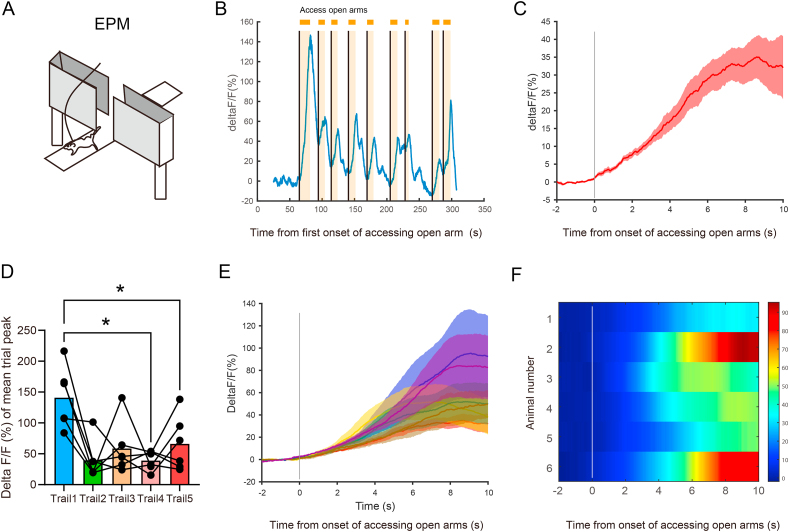
In the elevated plus maze, signals begin to rise as mice approach an open arm from an enclosed arm, reach higher levels after entry and fall upon return to enclosed space. Activity accompanies the unfolding exploration rather than only the instant of crossing a boundary.
Compared with sudden bodily challenges, the rise is slower and peak timing varies with exploration duration. The initial exploration usually has a higher peak, with significant reductions in some later explorations. First and subsequent visits to open space produce different population responses.
Source: Wu AM et al. · Neurobiology of stress · CC BY-NC-ND
Original figure and English caption ↗
A large first response followed by smaller peaks
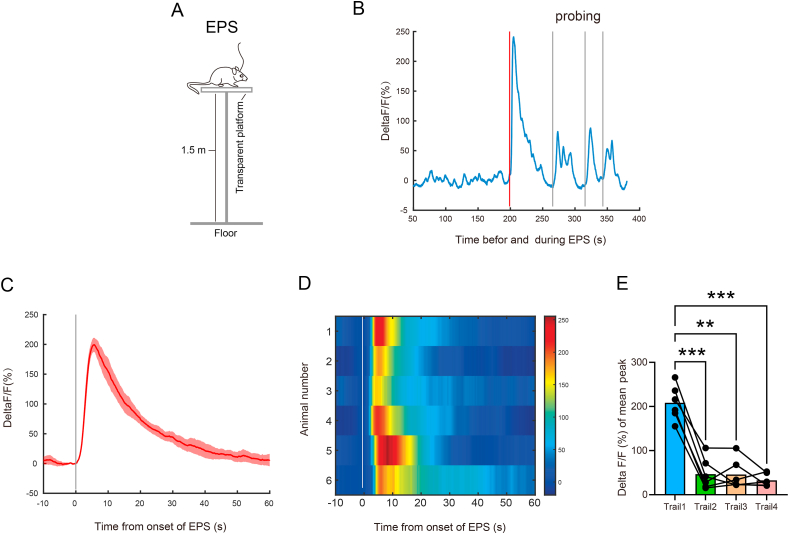
Placement on an elevated platform produces a pronounced calcium increase that gradually returns toward the previous level. Signals do not remain at the initial high peak even while mice remain at height. A continuing environment does not necessarily sustain a high-amplitude response.
Later probing over the platform edge can accompany smaller peaks. Initial and subsequent peak amplitudes differ significantly. This resembles open-arm exploration but contrasts with the comparatively stable peaks during repeated restraint and foot shock.
Source: Wu AM et al. · Neurobiology of stress · CC BY-NC-ND
Original figure and English caption ↗
Threat-related odor evokes more than ordinary sniffing
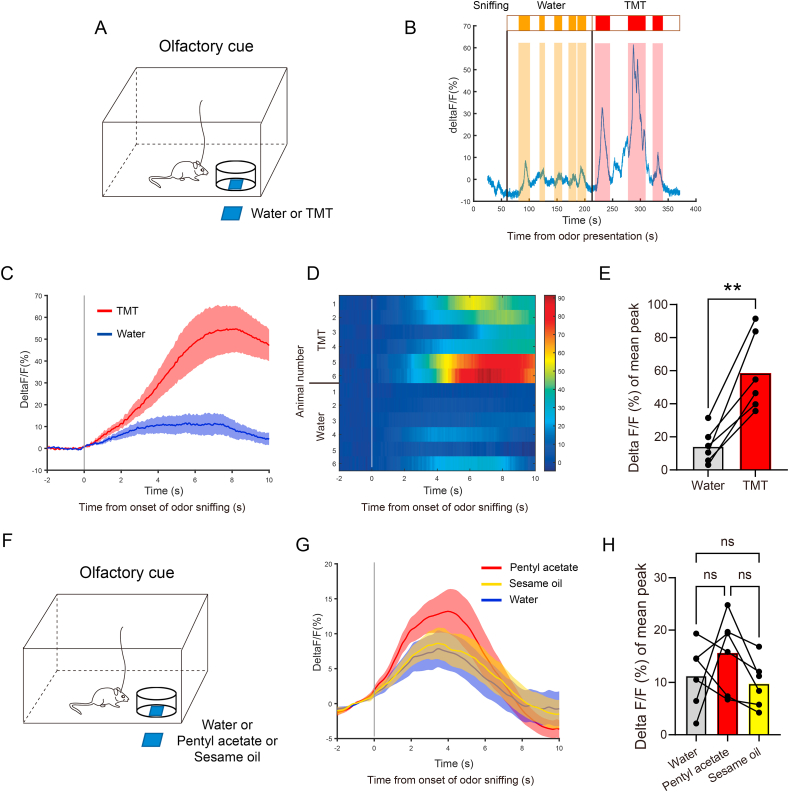
During sniffing of the threat-related odor TMT, calcium peaks exceed the water control. The finding links odor context to population activity, yet responses are not exclusive to aversive stimuli: sniffing water also accompanies smaller changes.
Water, a neutral odor and sesame-oil odor produce nonsignificant differences in average peaks. Astrocytic responses may accompany sniffing, attention and exploration while increasing in a particular odor context; a single peak cannot summarize an entire emotional experience.
Source: Wu AM et al. · Neurobiology of stress · CC BY-NC-ND
Original figure and English caption ↗
Responses vary across moments of an encounter
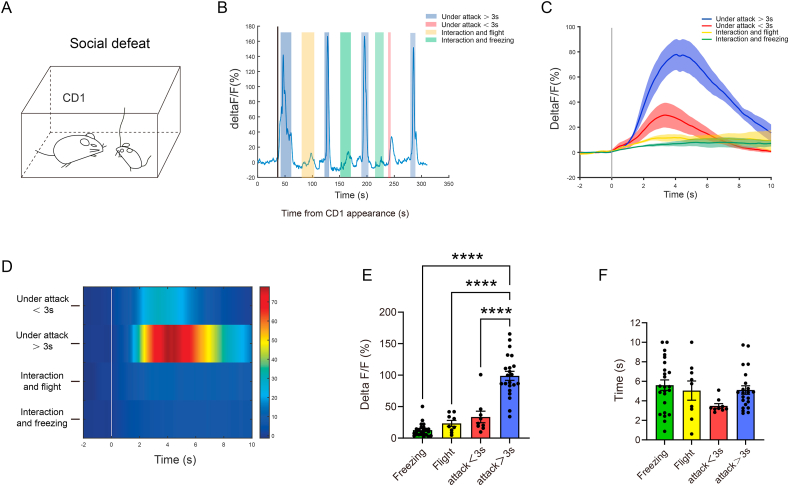
During encounters with an aggressive mouse, test mice may flee, freeze or undergo attack. Longer attacks accompany stronger calcium peaks, while shorter attacks, flight and freezing have smaller responses. A single social context contains several distinct activity changes.
Average peak latencies differ nonsignificantly among these behavioral events. Amplitude differences are more pronounced, whereas time to peak does not show equally clear separation. These recordings include multiple events from the same mice.
Source: Wu AM et al. · Neurobiology of stress · CC BY-NC-ND
Original figure and English caption ↗
First-event and repeated-event comparisons differ
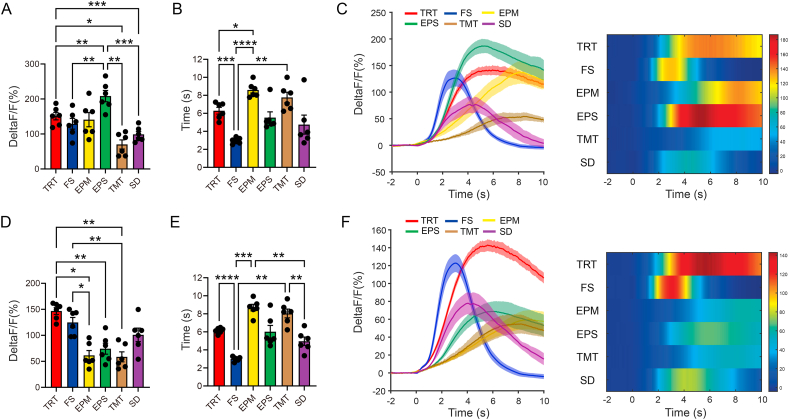
Across challenges, the first elevated-platform response is stronger and foot-shock peaks arrive faster. Pooling repeated events instead highlights restraint peaks, while platform responses no longer retain their initial high amplitude. Initial encounters and subsequent coping generate different signal patterns.
This study of six male mice documents contextual differences in prefrontal astrocyte responses. Because the same animals encounter multiple challenges, earlier experience may affect later responses. Its central insight is that population activity during acute challenges varies in amplitude, timing and repetition; measuring only how much it rises misses part of the change.
Source: Wu AM et al. · Neurobiology of stress · CC BY-NC-ND
Original figure and English caption ↗