DNA methylation contributes to fear-response extinction in mice
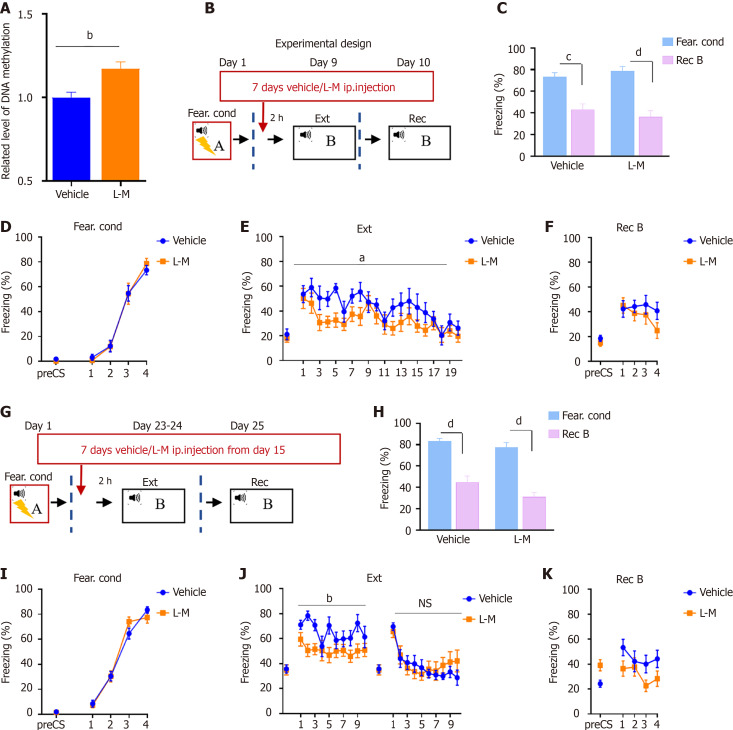
After lowering methylation-associated measures, mice show stronger responses at post-extinction recall. Increasing the measures speeds response reduction during training, without a significant difference at later recall.
When a cue that once predicted danger is no longer followed by danger, an animal can gradually reduce its fear response. This extinction brings new experience into contact with an existing association. A study in World Journal of Psychiatry examines adult male mice and links hippocampal DNA methylation changes with extinction-related behavior, neuronal activity and cellular structure, while distinguishing training responses from later recall.
RG108 lowers overall hippocampal methylation and accompanies higher later-recall freezing and lower dentate-gyrus spine density. Methionine-associated intervention raises methylation and speeds freezing reduction during extinction training, without significantly changing subsequent recall.
Contents · 6 sections
Learning a changed relationship involves cellular processes
Freezing is a common fear-related behavioral readout in mice. During extinction, the cue is no longer followed by the original aversive event, and freezing typically decreases. Researchers can examine how established learning changes with new experience and compare responses during training with those on later cue exposure.
DNA methylation can regulate gene use without changing the DNA sequence. Enzymes that add methyl marks relate to neuronal plasticity and memory processes. The team therefore examines hippocampal methylation measures and their relationship to dentate-gyrus cellular responses.
The dentate gyrus is commonly associated with contextual memory, while this study examines responses to auditory cues. The question involves not only whether an animal still responds to a sound but how cellular states accompany later learning after an association has formed. Extinction provides a window connecting behavioral time courses with cellular regulation.
Similar training responses, different later recall
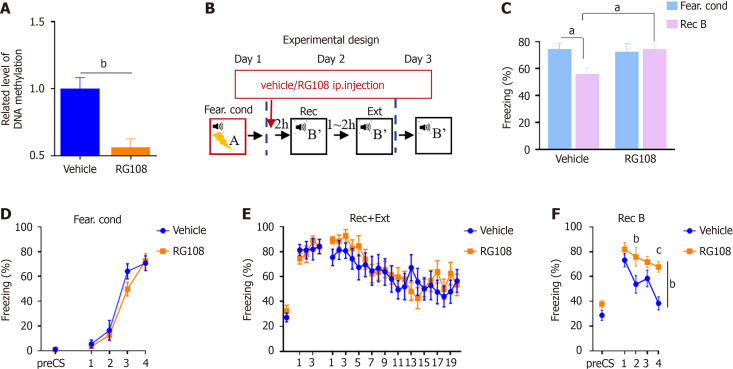
Mice receiving RG108 have lower overall hippocampal DNA methylation. In the retrieval-followed-by-extinction condition, their initial conditioned responses are comparable to controls, as is the decline in freezing during extinction training. At next-day recall, however, the RG108 group freezes more.
Despite similar training responses, later behavior differs. The result links methylation-associated changes with post-extinction performance. Watching freezing decline during training does not necessarily reveal how the animal will respond later; different time points provide different information about the memory process.
Source: Jiang L et al. · World journal of psychiatry · CC BY-NC
Original figure and English caption ↗
Dentate-gyrus spine density is lower
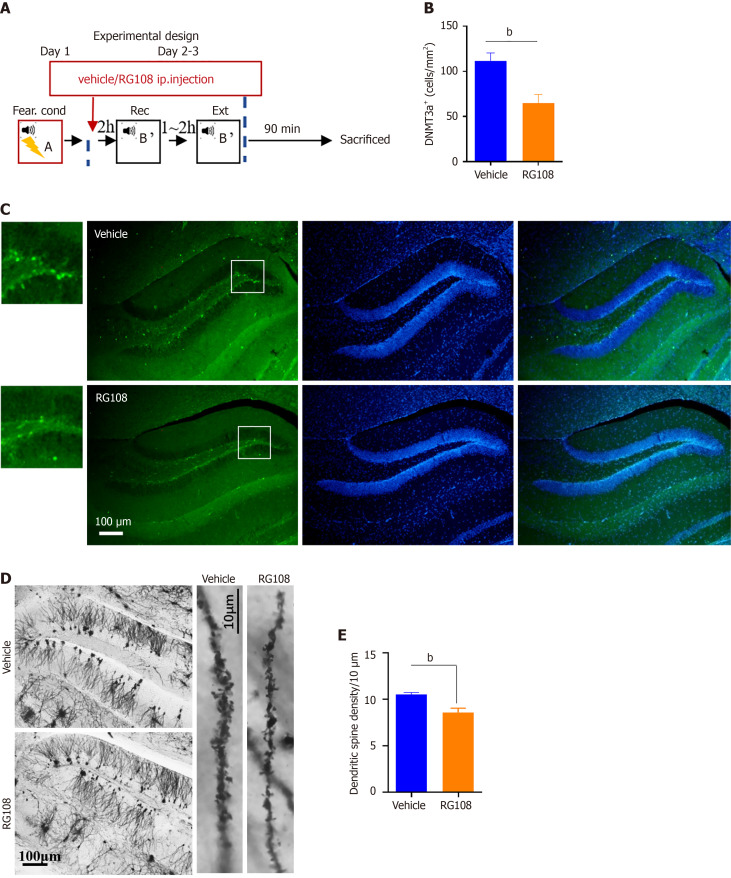
In a separate post-training tissue cohort, RG108-treated mice have lower density of Dnmt3a-positive dentate-gyrus cells and fewer dendritic spines. Dnmt3a is a DNA methyltransferase, while spines are important structures receiving synaptic inputs. These readouts bring molecular state and neuronal structure into the same research question.
The structural difference leads to a dynamic question: do associated cells respond differently in the same learning condition? The study moves from post-training images to calcium signals recorded around cue presentation.
Source: Jiang L et al. · World journal of psychiatry · CC BY-NC
Original figure and English caption ↗
A calcium difference in the latter cue period
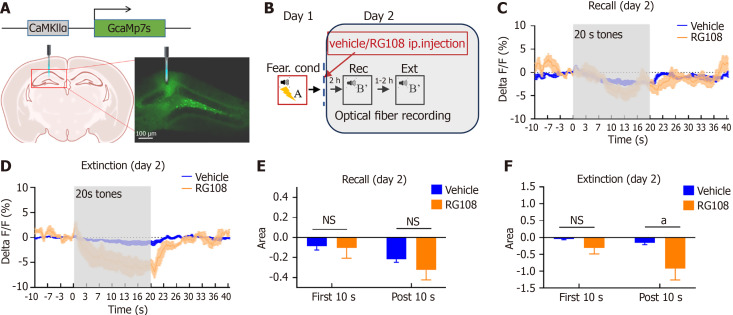
Dorsal dentate-gyrus recordings show no significant between-group calcium difference during retrieval. During extinction, responses are lower in the latter part of the cue period after RG108 and recover after the cue ends. The early-period comparison and overall phase-level group effect are not significant; time-resolved analysis reveals a more localized difference.
The finding makes the activity change specific: it does not span every phase or moment but appears during a particular learning segment. Together with post-training structural measures, it describes several aspects of cellular state under the methylation-associated intervention.
Source: Jiang L et al. · World journal of psychiatry · CC BY-NC
Original figure and English caption ↗
Faster decline in freezing, comparable recall
The team next examines a methionine-associated intervention. With higher overall hippocampal methylation measures, freezing declines faster during conventional extinction training. Later recall does not differ significantly. The intervention changes the rate of decline during learning without producing a clearly lower final recall response.
This training condition differs from the retrieval-followed-by-extinction condition used with RG108. The findings describe methylation-associated effects in their respective contexts: one shows a next-day recall difference, while the other mainly changes the course of training.
Controls also show declining freezing during these training conditions. Increasing methylation-associated measures changes the rate of an ongoing extinction process; at subsequent recall, both groups show lower cue-related responses.
Source: Jiang L et al. · World journal of psychiatry · CC BY-NC
Original figure and English caption ↗
Older memories also show a process change
For older fear memories, increasing methylation-associated measures accelerates extinction on the first day. Differences are no longer significant on the second day or at subsequent recall. Both recent and older memories can show training changes, with effects confined to particular periods.
The study uses adult male mice, systemic interventions and overall hippocampal methylation measurements. It connects molecular modulation, neuronal responses and declining fear behavior, while showing that faster change during learning and a lower later response are distinct outcomes.