A brief locus-coeruleus window links threat memory to freezing
In male mice, prefrontal response populations and the LC–NE system allow brief memory-linked input plus later sound to sustain freezing, temporarily extending responses to unpaired cues.
Mice freeze to sounds previously linked with threat. What converts a retrieved memory into present behavior? A PLOS Biology study follows two dorsomedial prefrontal, or dmPFC, response patterns to locus coeruleus, or LC, and norepinephrine, or NE, modulation. Brief memory-related activity opens a window in which ongoing sound can sustain responses, bringing memory, sensory cues and brain state together.
Transient and sustained dmPFC populations have different connections. LC–NE modulation supports sustained responses and freezing. Unpaired sounds can temporarily evoke freezing before NE signals subside; slower reuptake extends this window.
Contents · 8 sections
One threat cue evokes two prefrontal response patterns
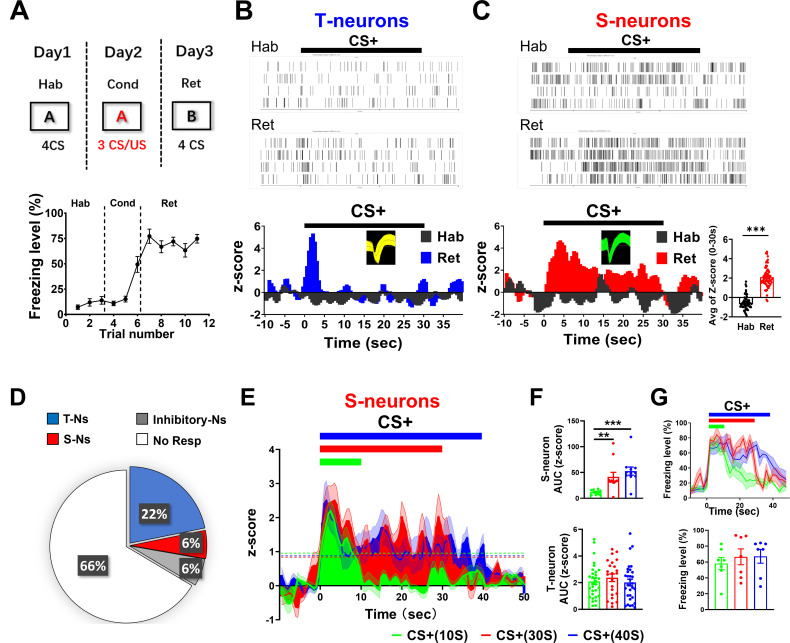
After sound–shock pairing, dmPFC spiking and freezing are recorded in males. Some excitatory cells respond briefly at onset, termed T cells; others sustain responses, termed S cells, with duration resembling sound and freezing duration.
Changing threat-cue duration changes S-cell response duration while T cells retain a brief onset pattern. Unpaired sounds do not evoke similarly clear responses, distinguishing onset-related and sustained activity.
Source: Duan H et al. · PLoS biology · CC BY
Original figure and English caption ↗
Amygdala-recipient and amygdala-projecting populations differ
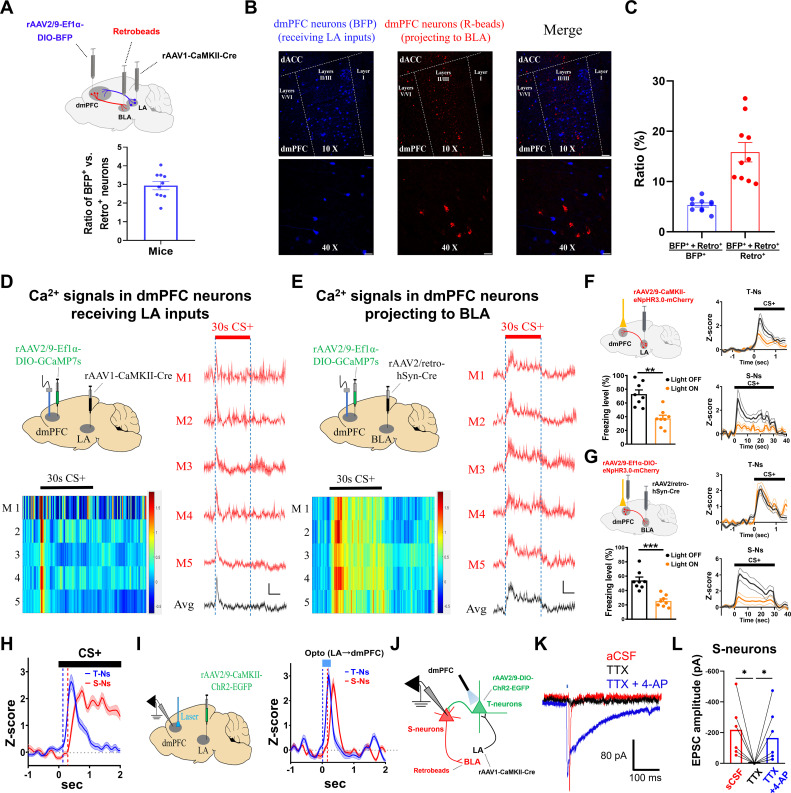
LA-recipient dmPFC populations favor transient responses, while BLA-projecting populations favor sustained responses, with limited labeling overlap. Inhibiting BLA-projecting cells reduces sustained firing and freezing without an obvious transient-firing reduction.
Slice recordings support direct T-associated input to S-associated populations. Brief upstream activation alone evokes only transient S responses, motivating examination of sensory input and neuromodulation for sustained activity.
Source: Duan H et al. · PLoS biology · CC BY
Original figure and English caption ↗
The populations differ in their readiness for modulation
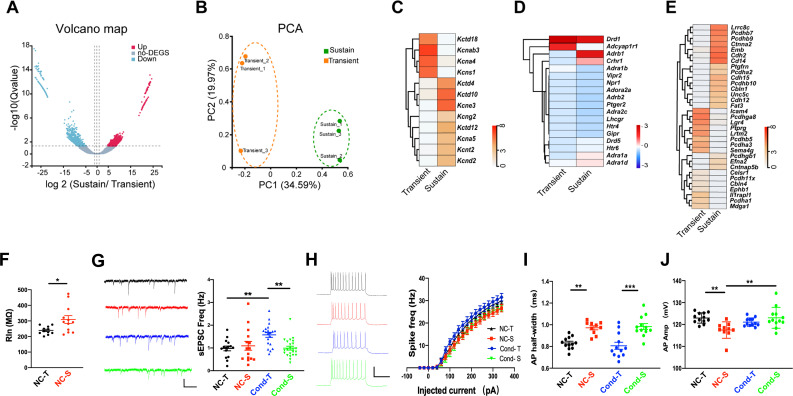
RNA profiles differ in ion-channel, adhesion-molecule and NE-related receptor genes, with higher beta-1 adrenergic receptor expression in S populations. S cells also have higher input resistance, wider spikes and smaller spike amplitudes.
Baseline intrinsic excitability does not significantly differ. Population distinctions involve properties, inputs and modulation-related receptors rather than uniform firing propensity, directing attention to NE.
Source: Duan H et al. · PLoS biology · CC BY
Original figure and English caption ↗
Beta-receptor modulation supports sustained responses
Sound-associated TeA input strongly recruits S cells. Ventricular beta-adrenergic blockade reduces freezing and sustained S firing without significantly changing transient T firing, separating sensitivity to modulation.
In slices, beta-receptor agonism raises excitatory-event frequency, lowers inhibitory-event frequency and changes S-cell membrane potential and intrinsic excitability, without significant event-amplitude changes. Modulation increases responsiveness to ongoing input.
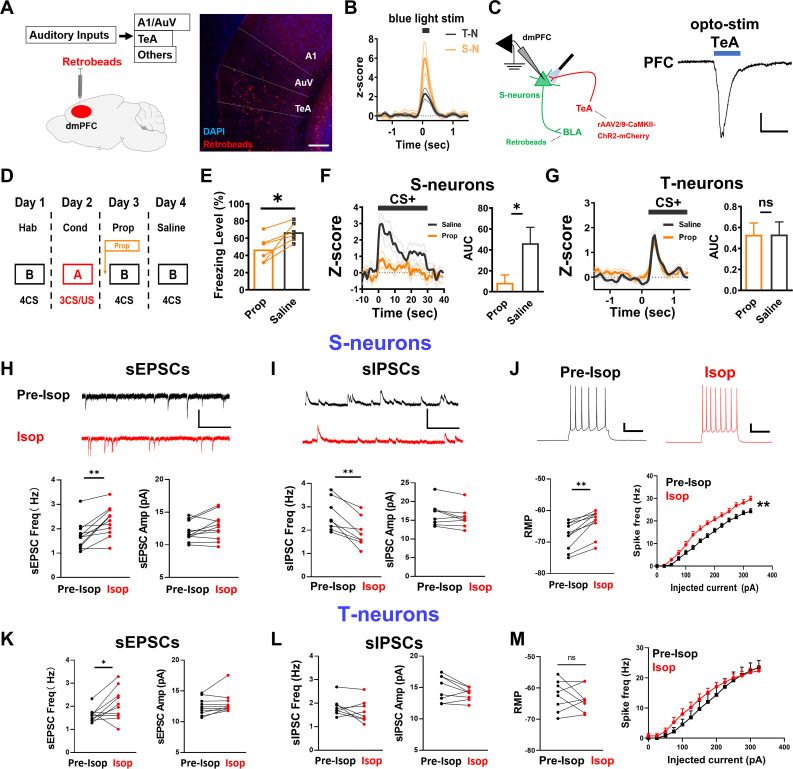
Source: Duan H et al. · PLoS biology · CC BY
Original figure and English caption ↗
Threat cues recruit LC and elevate prefrontal NE signals
NE sensor signals rise rapidly to paired sounds and decline slowly afterward, without a clear rise to unpaired sounds. LC and TH-labeled populations respond to paired cues; inhibiting dmPFC-projecting LC cells reduces freezing.
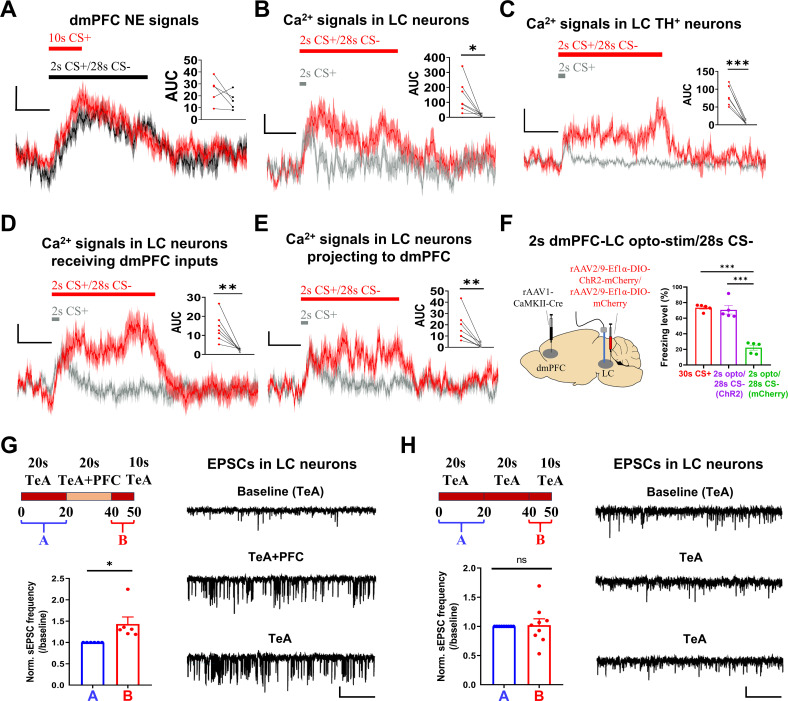
LC receives TeA and dmPFC input. T-associated input drives recorded LC cells, whereas S-associated input evokes no corresponding responses. Some LC cells receive prefrontal input and project back, linking brief memory-associated activity with NE modulation.
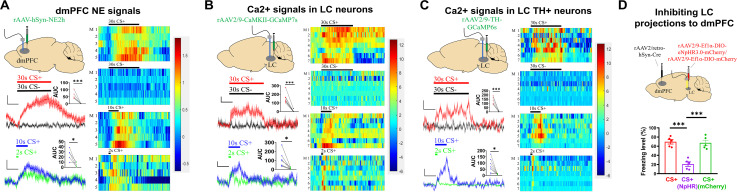
Source: Duan H et al. · PLoS biology · CC BY
Original figure and English caption ↗
Prefrontal onset input and sound converge in LC
In LC slices, TeA inputs evoke clear responses and T-population inputs evoke synaptic currents. Most recorded dmPFC-projecting LC cells respond to prefrontal input, bringing memory-linked onset activity and sensory input to one modulatory node.
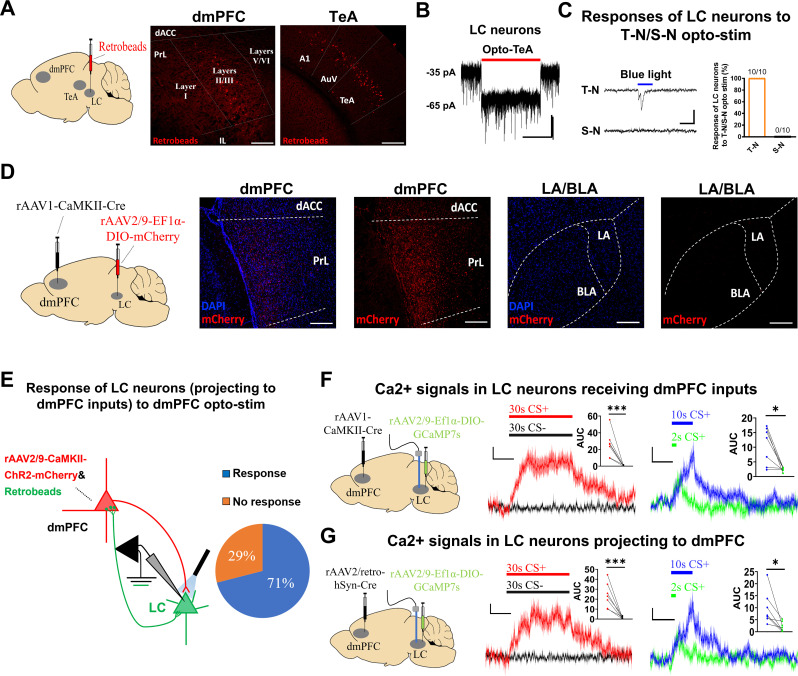
Source: Duan H et al. · PLoS biology · CC BY
Original figure and English caption ↗
Another sound can evoke freezing before NE signals subside
After a ten-second threat cue, NE signals persist while freezing usually ends with the sound. An unpaired cue evokes freezing after a ten-second gap but not a thirty-second gap; slowing NE reuptake allows the later cue to evoke a response.
A two-second threat cue followed by twenty-eight seconds of unpaired sound sustains responses and freezing. Brief initiation plus subsequent sensory input supports a longer response within the neuromodulatory window.
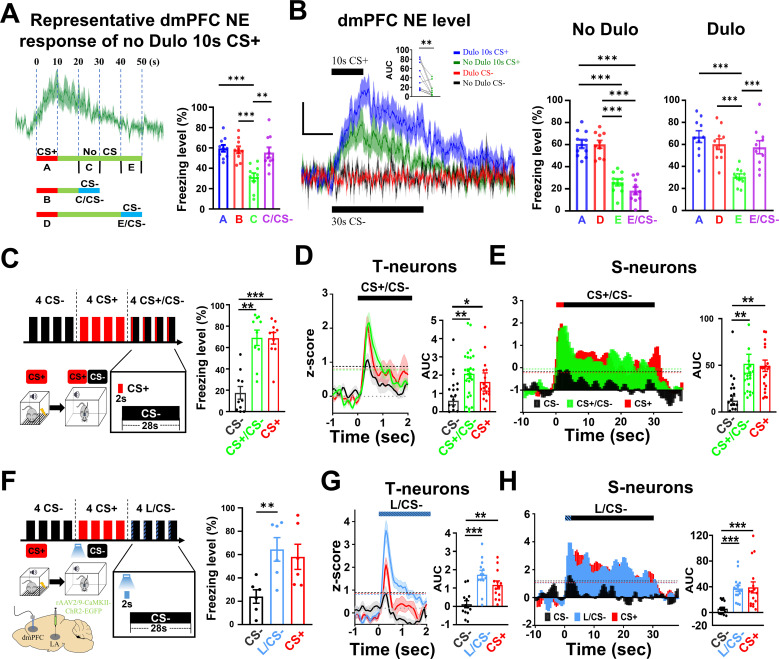
Source: Duan H et al. · PLoS biology · CC BY
Original figure and English caption ↗
Behavior from one memory depends on subsequent input
Hybrid cues sustain LC and prefrontal NE signals. Brief activation of selected LC populations followed by unpaired sound also evokes freezing. Combined prefrontal/TeA stimulation transiently enhances LC responses to TeA input; TeA stimulation alone does not.
This adult male-mouse study identifies a state-modulated transition between retrieval and behavioral expression. Brief memory-linked input initiates recruitment, later sound sustains activity and NE changes the opportunity for cues to affect behavior.
Source: Duan H et al. · PLoS biology · CC BY
Original figure and English caption ↗