Chronic stress changes endogenous signaling in the bed nucleus
Acute stress increases ovBNST activity and local endocannabinoid signals. In a chronic-stress model, associated receptor expression falls, and behavioral readouts respond differently to intervention.
Stress recruits vigilance networks alongside endogenous signals that regulate their responses. Endocannabinoids are lipid molecules produced by the body that participate in communication between neural cells. A study in Frontiers in Neuroscience focuses on the oval bed nucleus of the stria terminalis, finding different links between acute stress, longer-term experience and this signaling system, with behavioral readouts changing unevenly.
Associated receptor expression falls in the chronic-stress group. Reducing local endocannabinoid degradation clearly improves immobility in the swim task, without significant improvement in sucrose preference or the other immobility measure.
Contents · 6 sections
Behavioral changes form a particular pattern
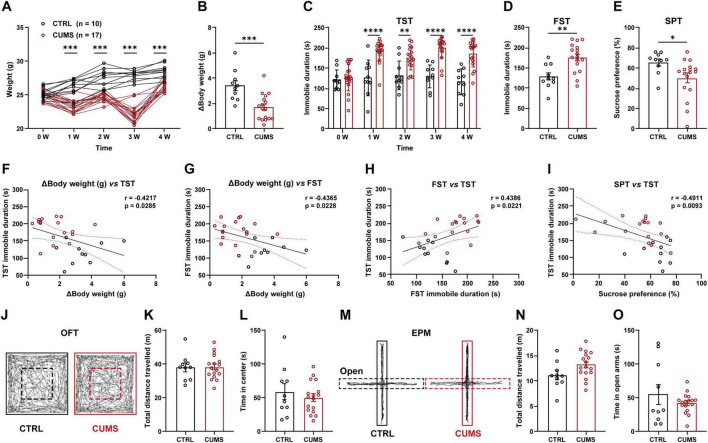
In the chronic unpredictable mild stress model, mice gain less weight, show lower sucrose preference and have longer immobility in two commonly used passive-coping-related tasks. Weight and some behavioral measures correlate, indicating concurrent changes in bodily state and the measured behaviors during prolonged stress.
Movement distance, open-field center time and elevated-maze open-arm time do not change clearly. The pattern combines altered reward-related and passive-coping measures with comparable anxiety-like measures tested here. Stress does not change every behavior in the same way.
Source: Zhu R et al. · Frontiers in neuroscience · CC BY
Original figure and English caption ↗
The oval subnucleus responds more strongly
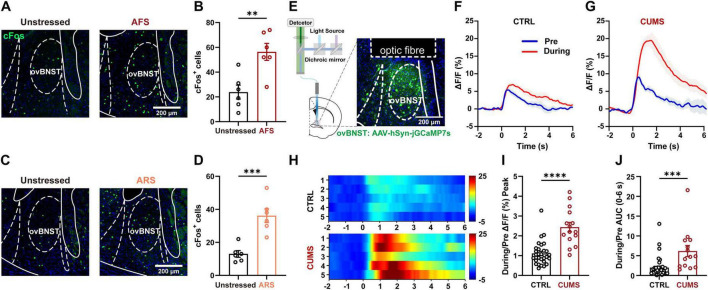
The bed nucleus sits within networks linking stress and affect and contains subregions with different functions. Acute stress increases neuronal activity markers in its oval subnucleus. Population calcium responses also rise rapidly around swim stress, revealing dynamic responses in this deep region.
Mice with a chronic-stress history show larger calcium peaks and integrated responses when encountering the same acute condition. Past experience relates to the present neural response: the same event can elicit different activity levels in networks with different prior states.
Source: Zhu R et al. · Frontiers in neuroscience · CC BY
Original figure and English caption ↗
Endogenous signals rise alongside neuronal activity
The system comprises lipid signals, their receptors and enzymes controlling production and degradation. Common endogenous molecules include anandamide and 2-arachidonoylglycerol, or AEA and 2-AG. Signal appearance, reception and removal involve different components, so altering different parts can change local communication in distinct ways.
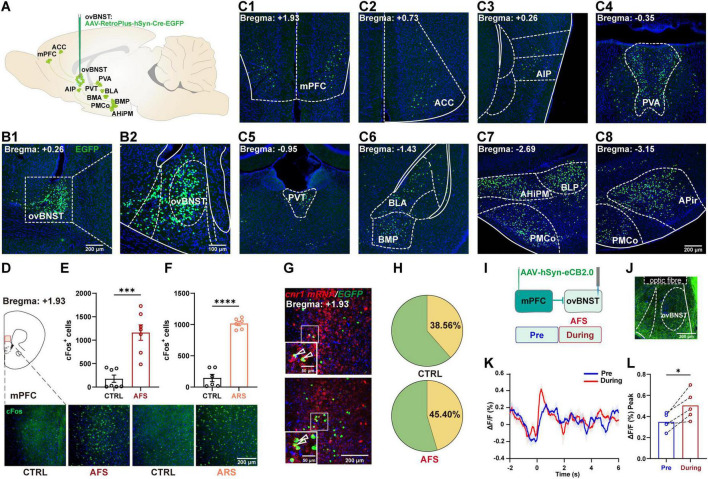
The oval BNST receives inputs from cortex, thalamus and amygdala, among other regions. The team examines medial prefrontal cortex, where some cells projecting to ovBNST carry molecular markers associated with CB1 receptors. This input may participate in an endocannabinoid-modulated network.
A local endocannabinoid sensor recorded around prefrontal inputs shows a stronger signal during acute stress in otherwise unstressed mice. The sensor detects more than one endocannabinoid, so the measurement reflects changes in local signaling. Alongside neuronal activity, it describes the molecular environment of the stress response.
Source: Zhu R et al. · Frontiers in neuroscience · CC BY
Original figure and English caption ↗
Behavior changes in the otherwise unstressed state
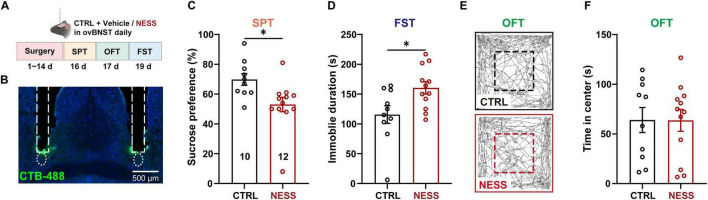
What happens when local receptor signaling is reduced? In mice without chronic stress, local CB1 receptor blockade lowers sucrose preference and increases immobility in the swim task, while movement distance and center time remain comparable.
Another receptor-blocking intervention with different pharmacological properties also increases immobility, but its sucrose-preference change is not significant. Receptor signaling relates to behavior, yet different interventions need not change every readout equally.
Source: Zhu R et al. · Frontiers in neuroscience · CC BY
Original figure and English caption ↗
One improvement does not extend to every measure
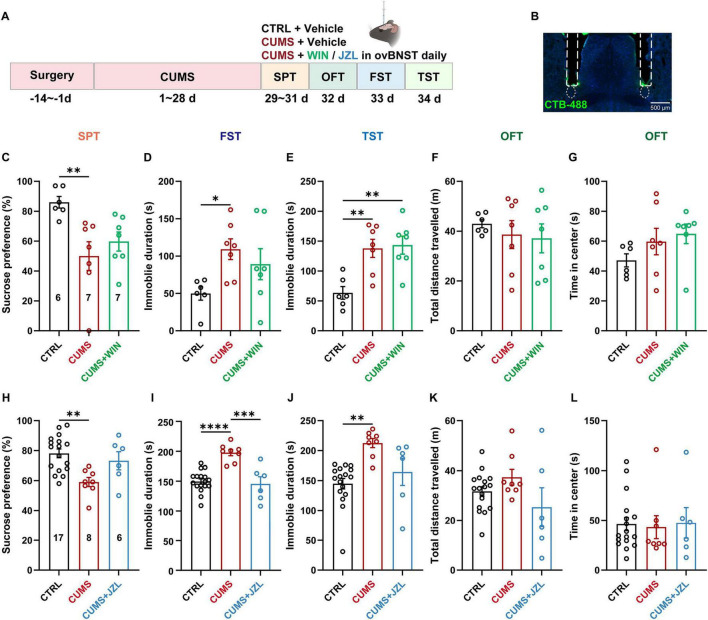
In chronically stressed mice, the receptor agonist WIN does not clearly improve the measured behaviors. Another approach reduces the action of the enzyme that degrades the endogenous molecule 2-AG. After JZL-184, swim-task immobility decreases significantly, while sucrose preference and the other immobility measure show only nonsignificant trends.
The two approaches act at different points in the same signaling system yet produce different results. Reward preference and passive-coping readouts also change unevenly. Molecular modulation and behavior are not linked one-to-one; the clearest improvement here is confined to one task.
Source: Zhu R et al. · Frontiers in neuroscience · CC BY
Original figure and English caption ↗
The receiving side changes too
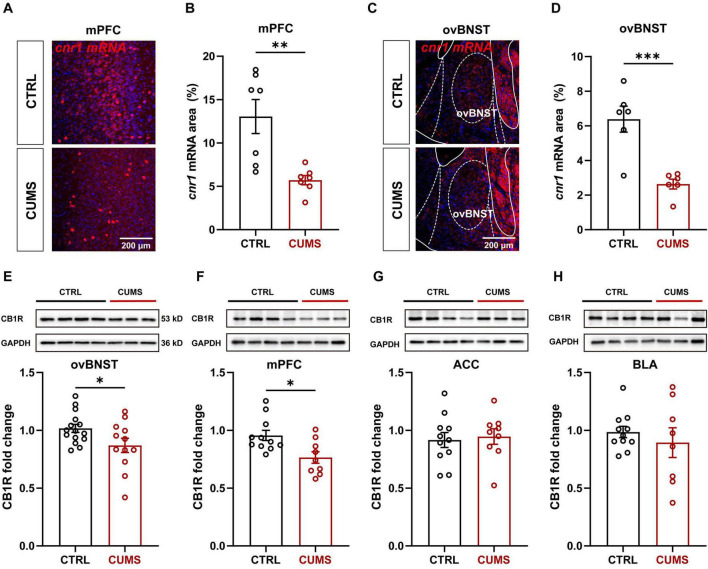
Expression of the gene encoding CB1 receptors is lower in prefrontal cortex and ovBNST after chronic stress, along with lower receptor protein measurements. Protein measurements in anterior cingulate cortex and basolateral amygdala do not change significantly. The signaling changes differ across regions rather than declining uniformly throughout the brain.
These molecular changes accompany the anatomical prefrontal input, suggesting it may contribute to local receptor changes. In adult male mice, the study reveals distinct levels of stress regulation: stress engages local lipid signals, while prolonged experience relates to receptor state and neural responses upon renewed stress, alongside task-specific behavioral differences.
Source: Zhu R et al. · Frontiers in neuroscience · CC BY
Original figure and English caption ↗