As avoidance rises, an internal neural brake is also engaged
A male-mouse study finds a transient rise in endocannabinoids alongside increased amygdala-to-ventral-hippocampus activity, implicating feedback signaling in buffering anxiety-related avoidance.
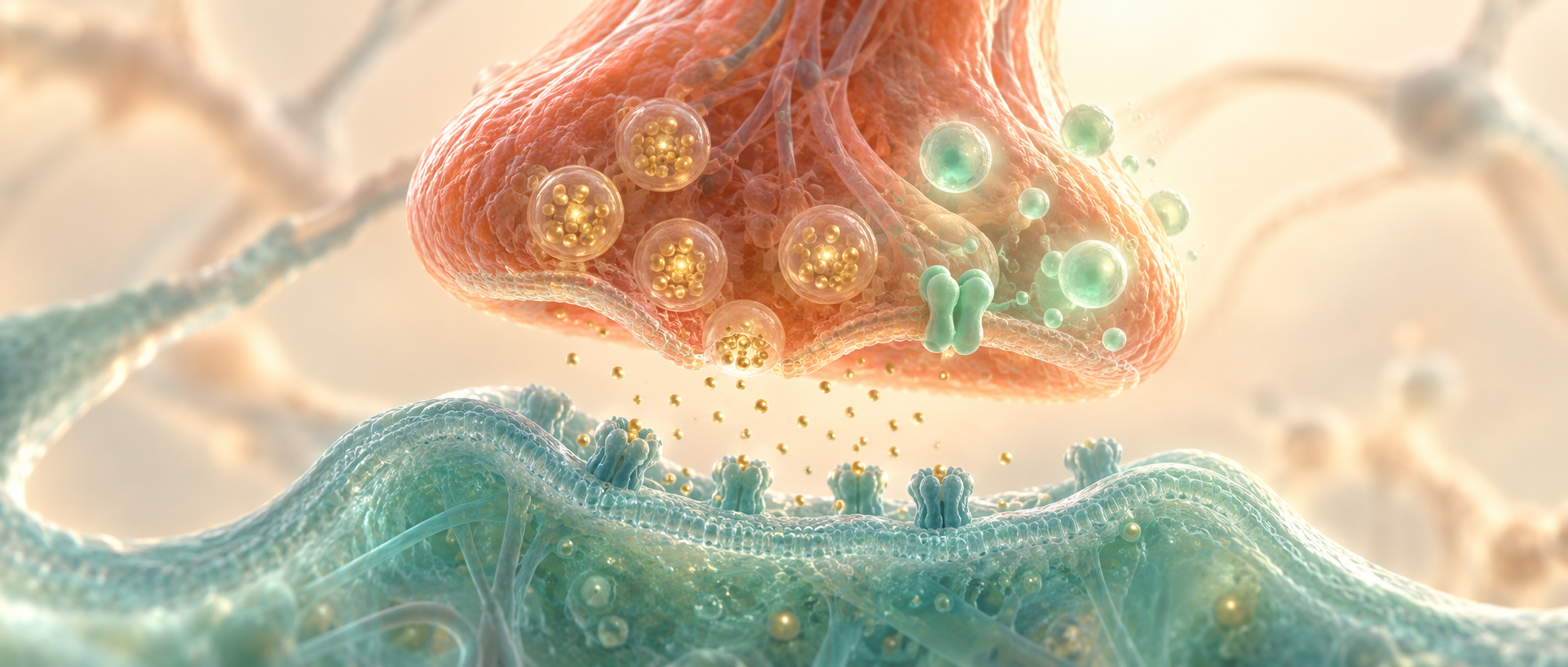
The open arms of an elevated maze have no side walls. When a mouse steps into one, an amygdala-to-hippocampus pathway becomes active. Intriguingly, an endogenous signal capable of suppressing that pathway also appears. A study published on June 16, 2025 in Advanced Science follows connections from the anterior basolateral amygdala (aBLA) to the ventral hippocampus (vHPC), implicating endocannabinoids in the regulation of neural transmission and avoidance. These lipids are produced within the brain and can provide feedback through CB1 receptors; their behavioral effects depend on the particular circuit.
Enhancing CB1-receptor signaling in this pathway reduces avoidance. Reducing the 2-AG synthesis enzyme in hippocampal cells receiving its input weakens local endocannabinoid responses and increases avoidance.
Contents · 7 sections
Feedback appears as the pathway becomes active
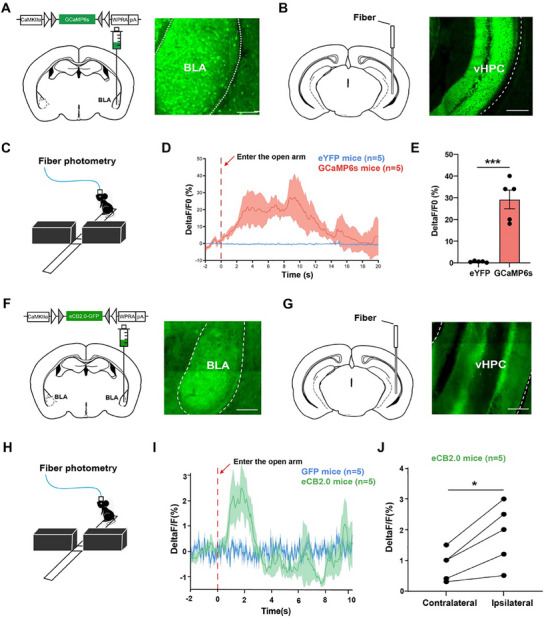
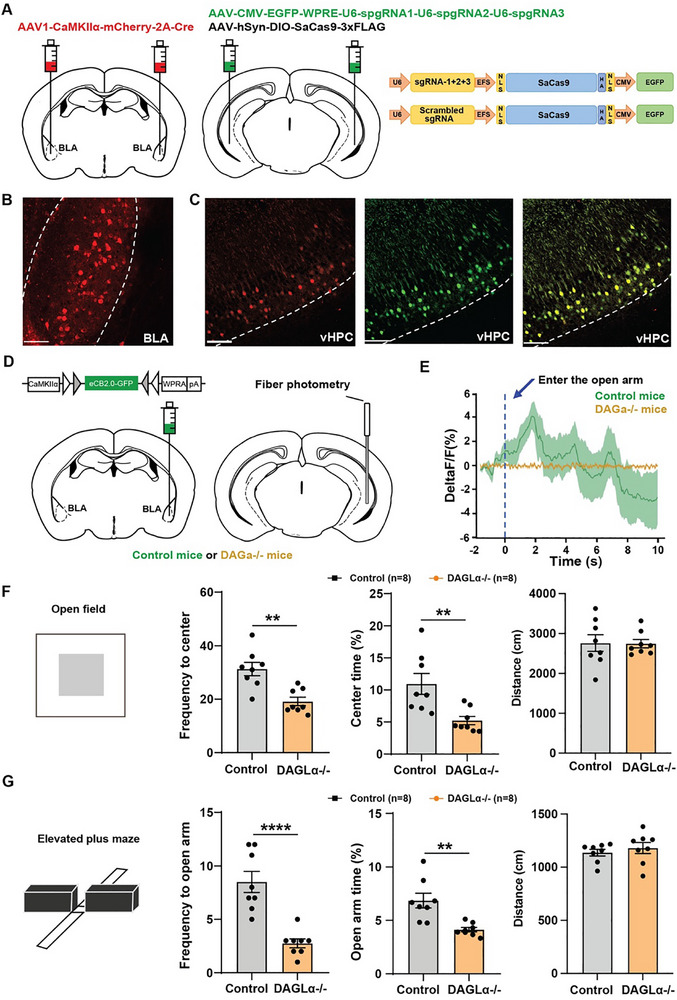
At entry into an open arm, calcium signals rise in aBLA excitatory cells and their vHPC axon terminals, with a more sustained terminal response. Turning from neural activity to chemical signals near the synapse reveals a transient increase in endocannabinoids at the same moment.
Why would a pathway promoting avoidance recruit a signal that can suppress it? Endocannabinoids can generally travel from the receiving side back to the sending side and limit subsequent transmitter release. The rising signal may therefore reflect an engaged buffer rather than simply another marker of avoidance.
Source: Xue B et al. · Advanced science (Weinheim, Baden-Wurttemberg, Germany) · CC BY
Original figure and English caption ↗
Enhancing and suppressing activity shift exploration oppositely
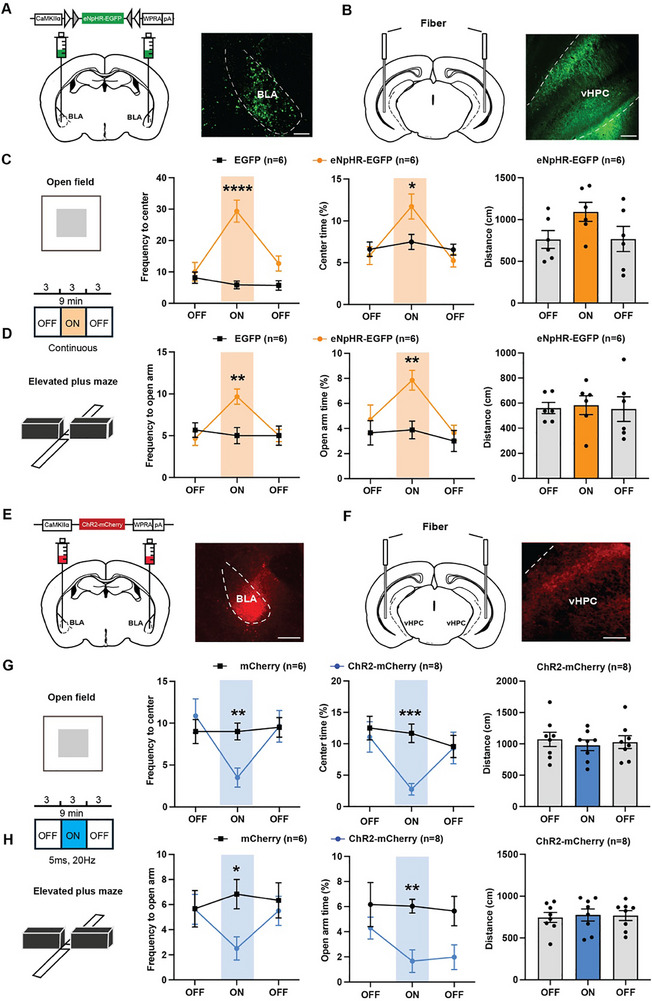
The researchers first test the pathway itself. Suppressing excitatory aBLA terminals in the ventral hippocampus increases entries into, and time in, the open-field center and open maze arms. Enhancing the same projection reduces exploration.
These changes occur during modulation and subsequently move back toward the earlier state, without a corresponding clear change in total distance traveled. The experiment links the projection to spatial choices and establishes the behavioral context for testing local feedback signaling.
Source: Xue B et al. · Advanced science (Weinheim, Baden-Wurttemberg, Germany) · CC BY
Original figure and English caption ↗
CB1 signaling reduces transmission from the sending side
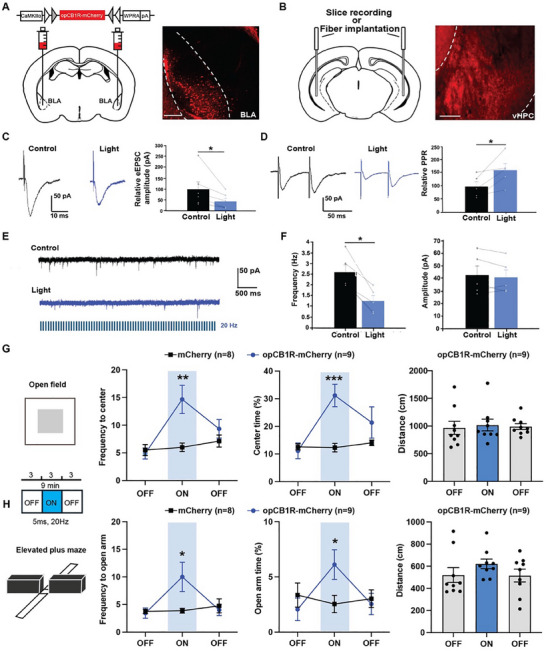
To test feedback more directly, the study uses an engineered light-regulated receptor to simulate CB1 signaling at terminals of this projection. Slice recordings show smaller evoked excitatory currents and a change in paired-pulse response ratio, supporting an effect on the transmitter-release side.
Miniature excitatory events become less frequent, while their individual amplitudes remain broadly unchanged. This combination favors reduced release from the sending terminal over reduced sensitivity to each event on the receiving side. Endogenous feedback thus gains a synaptic physiological explanation. For hippocampal cells, excitatory input from the amygdala is not fixed: signals near the connection can regulate it dynamically.
Source: Xue B et al. · Advanced science (Weinheim, Baden-Wurttemberg, Germany) · CC BY
Original figure and English caption ↗
Strengthening this buffer increases exploration
When the same CB1-signaling manipulation is applied in freely moving mice, entries into and time in the open-field center increase, as do entries into and time in open maze arms. Total distance traveled remains broadly unchanged, with the behavioral change mainly reflected in redistribution of spatial choices.
Pathway activation and stronger feedback are therefore compatible. The excitatory projection can promote avoidance, while feedback at its terminals reduces transmission and buffers avoidance. Their simultaneous rises during the natural task may reflect these counteracting influences.
Avoidance increases when the buffer weakens
The study then tests the opposite direction by reducing DAGLα in hippocampal cells receiving aBLA input. This enzyme contributes to synthesis of the endocannabinoid 2-AG. After reduction, the local endocannabinoid response normally observed at open-arm entry is strongly weakened.
Mice enter the open-field center and open arms less often and spend less time there, while distance traveled remains broadly similar. Opposing effects from enhancing receptor signaling and reducing the synthesis enzyme jointly support a role for endogenous feedback in limiting avoidance in this pathway.
Source: Xue B et al. · Advanced science (Weinheim, Baden-Wurttemberg, Germany) · CC BY
Original figure and English caption ↗
Hippocampal excitatory cells participate in the connection
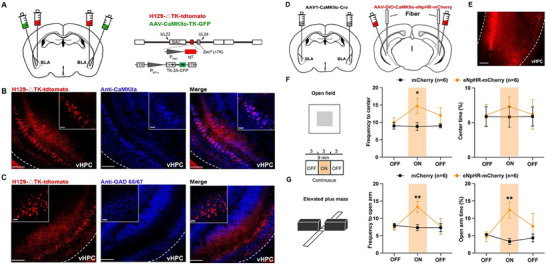
Which hippocampal cells receive the input? Tracing and cell-marker analyses indicate that most vHPC cells receiving aBLA input carry excitatory-cell markers. Suppressing this excitatory population increases open-field center entries, while center time remains broadly similar.
In the elevated maze, both open-arm entries and time increase. Findings from projection terminals to receiving cells locate avoidance regulation within an identifiable excitatory connection, while also showing that measures from different tasks do not change uniformly.
Source: Xue B et al. · Advanced science (Weinheim, Baden-Wurttemberg, Germany) · CC BY
Original figure and English caption ↗
The same signal does not act identically everywhere
The study reports a further distinction: reducing the same synthesis enzyme in the posterior basolateral-amygdala-to-hippocampus pathway decreases avoidance, opposite to the anterior pathway. The cells and connections involved are therefore central to understanding endocannabinoid effects.
These results in adult male mice connect local lipid feedback with spatial avoidance. As a circuit promotes behavior, signaling that counterbalances transmission can also be recruited. The eventual direction depends on the pathway receiving that feedback, not simply on whether the signal rises.