Approach or avoid? Accumbens Tac1 cells contribute to aversive responses
In male mice, accumbens medial-shell Tac1-associated cells and their hypothalamic output alter interaction with an aversive odor. Prefrontal input also contributes, linking distinct parts of an avoidance-related network.
An unfamiliar unpleasant odor often prompts avoidance, but time spent near it also depends on how sensation is translated into motivation and action. A male-mouse study published in International Journal of Molecular Sciences on February 22, 2023 examined Tac1-associated cells in the accumbens medial shell. Increasing their activity increased interaction with an aversive odor, whereas reducing activity strengthened avoidance. Hypothalamic outputs and prefrontal inputs provided further network links.
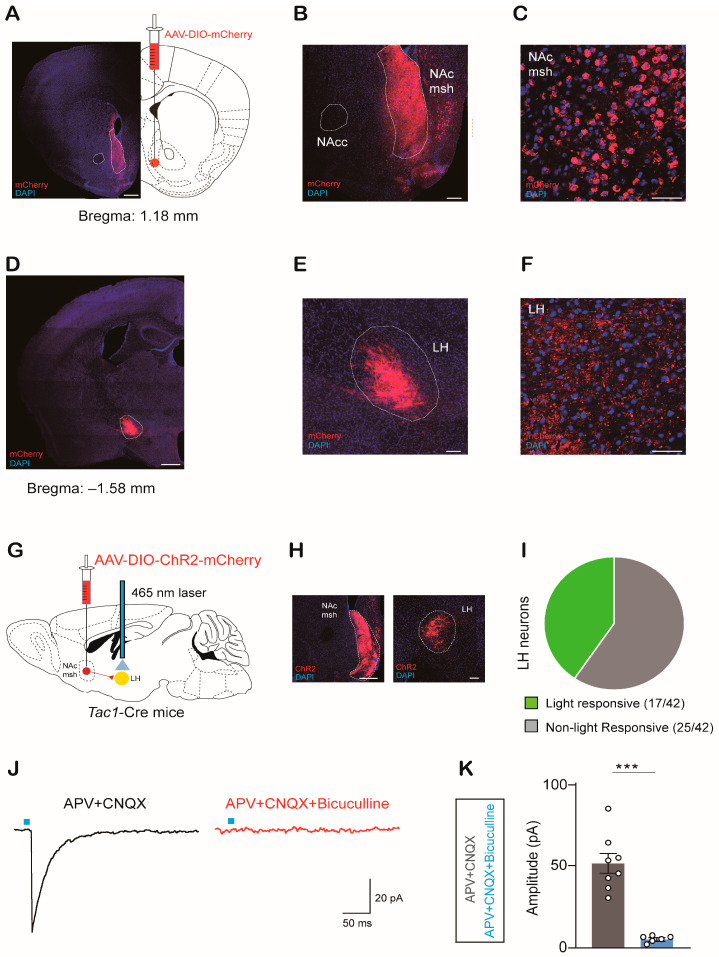
Accumbens medial-shell Tac1-associated cells provide inhibitory LH input; increasing or reducing this output respectively increases or decreases interaction with the aversive stimulus. Related mPFC input has corresponding behavioral effects, while the complete cell-specific serial mechanism remains unresolved.
Contents · 6 sections
Location within accumbens matters
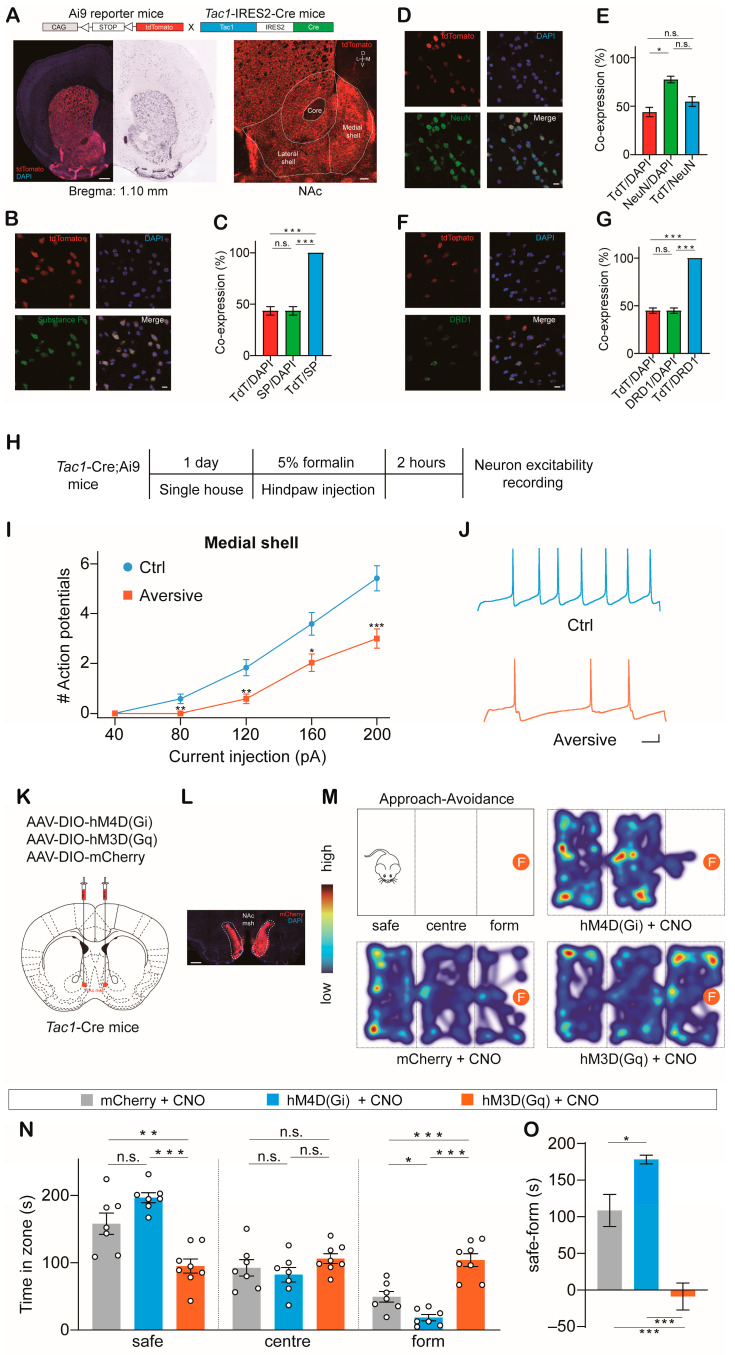
Accumbens participates in reward and motivation, yet its subdivisions can differ. Tac1-associated cells showed substantial overlap with substance P and D1 markers. Under an aversive pain-related condition, medial-shell tagged cells had weaker current-evoked firing without the corresponding lateral-shell change.
This describes a particular population and condition. Tac1 identity does not establish substance P release as the complete behavioral mediator, and current-evoked firing differs from natural spontaneous activity. The behavioral analysis then examined approach and avoidance directly.
Source: He ZX et al. · International journal of molecular sciences · CC BY
Original figure and English caption ↗
Greater activity increases interaction with the aversive stimulus
The odor assay compared time near the stimulus, in the center and in a relatively safe region. Increasing medial-shell Tac1-associated activity increased time in the aversive region, whereas reducing activity had the opposite effect. Center-region comparisons were not significant.
This links the population functionally with avoidance regulation. The behavior concerns allocation of interaction and withdrawal, without directly establishing that the stimulus becomes pleasant or its aversiveness disappears. The study involved adult male mice, leaving other populations and contexts for further testing.
An inhibitory input reaches hypothalamus
Dense Tac1-associated projection fibers were observed in lateral hypothalamus, LH. This heterogeneous region contributes to feeding, reward and aversion, providing a downstream location while leaving the recipient-cell identity unresolved.
A subset of LH cells exhibited inhibitory postsynaptic currents in response to the input, eliminated by GABAA receptor blockade. This supports GABA-associated inhibitory transmission without implying that every LH cell receives or responds identically to the projection.
Source: He ZX et al. · International journal of molecular sciences · CC BY
Original figure and English caption ↗
The output itself influences approach and avoidance
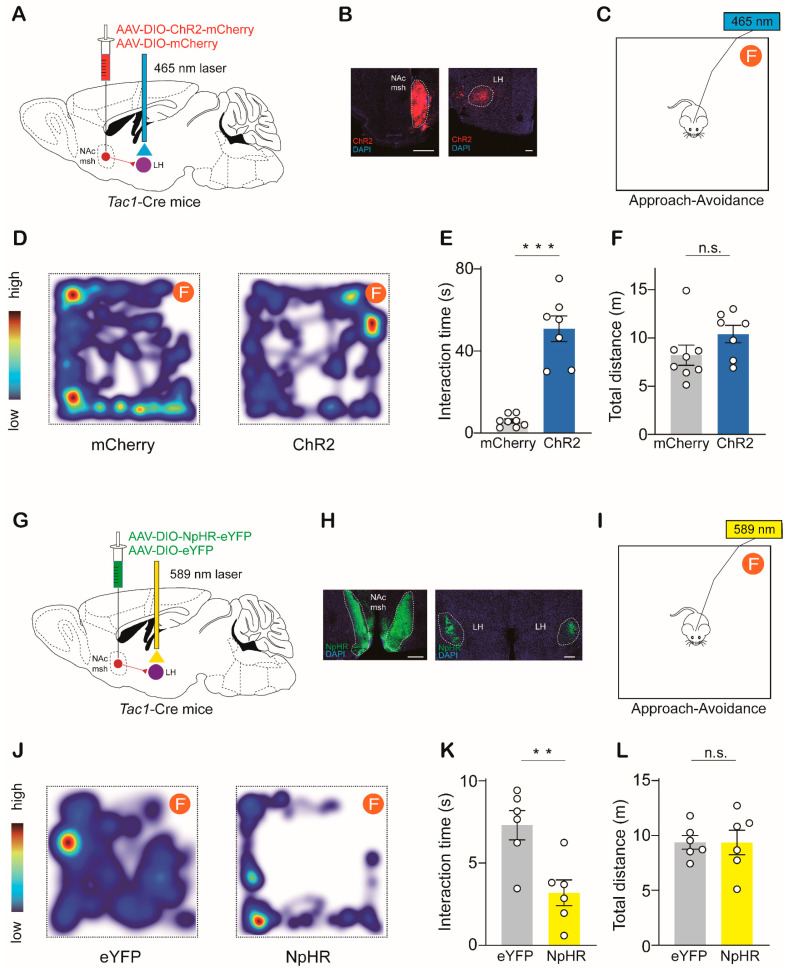
Increasing Tac1-associated terminal activity in LH increased interaction with the aversive odor without a significant total-distance change. Inhibition reduced interaction, again without a significant distance effect. Opposite manipulations thus linked output function with behavioral direction.
The distance controls reduce a simple overall-locomotion explanation without exhausting effects on olfaction, arousal or choice strategy. Identifying LH recipient populations and their downstream behavioral roles remains an important next step.
Source: He ZX et al. · International journal of molecular sciences · CC BY
Original figure and English caption ↗
Prefrontal input provides an excitatory signal
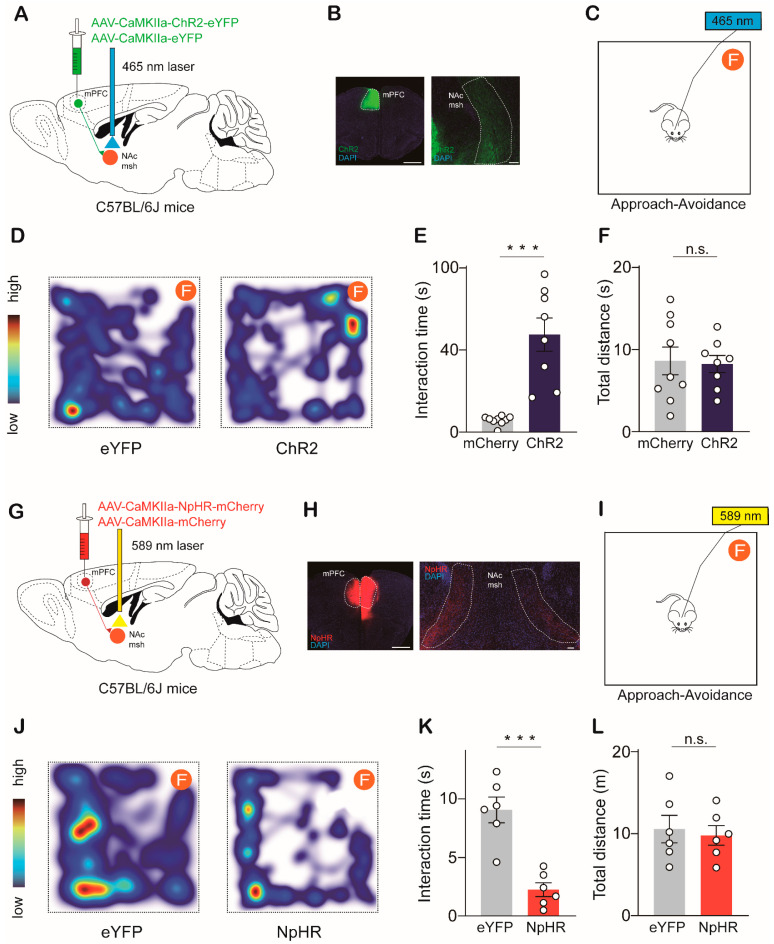
The study identified mPFC connections to NAc. Related inputs evoked excitatory currents in a subset of recipient cells that were sensitive to AMPA receptor blockade; supplementary recordings also showed such responses in Tac1-associated cells, linking prefrontal information with the population.
Increasing related mPFC terminal activity in medial-shell NAc increased odor interaction, while inhibition reduced it, without significant corresponding distance changes. These input-level manipulations may also engage NAc recipient cells beyond the Tac1 population.
Source: He ZX et al. · International journal of molecular sciences · CC BY
Original figure and English caption ↗
Avoidance reflects contributions across a network
The study provides a framework linking medial-shell Tac1-associated cells, LH output and mPFC input. These comparisons involve tagged cells, input terminals and heterogeneous recipients; the complete cell-specific serial mechanism remains to be established beyond anatomical connections alone.
The findings place accumbens motivational regulation within decisions about aversive stimuli. Different subdivisions, inputs and aversive contexts may operate differently. These male-mouse results inform avoidance mechanisms without establishing treatment efficacy for human mood disorders.