A vulnerability hidden at baseline: prefrontal peptide signaling in adult NL3 mutant mice
Mild social defeat reveals anxiety-related differences in adult mutant mice. Developmental CCK trajectories and stress-evoked release in prefrontal cortex help explain this latent vulnerability.
Two mice behaving similarly in a calm environment may respond differently to the same brief challenge. How does genotype conceal a difference until adulthood and expose it under stress? A 2026 Molecular Autism study follows NL3 R451C knock-in mice and finds an altered developmental trajectory of cholecystokinin (CCK) in medial prefrontal cortex. Signals rise earlier during social defeat, and bidirectional expression changes affect post-challenge anxiety-related behavior. Genotype, age and stress converge at a particular moment.
Excitatory prefrontal CCK expression fails to show its usual adult decline in mutants, which are more vulnerable to mild defeat. Local Cck reduction alleviates selected effects, while wild-type overexpression increases post-challenge vulnerability.
Contents · 6 sections
CCK does not decline as usual in adulthood
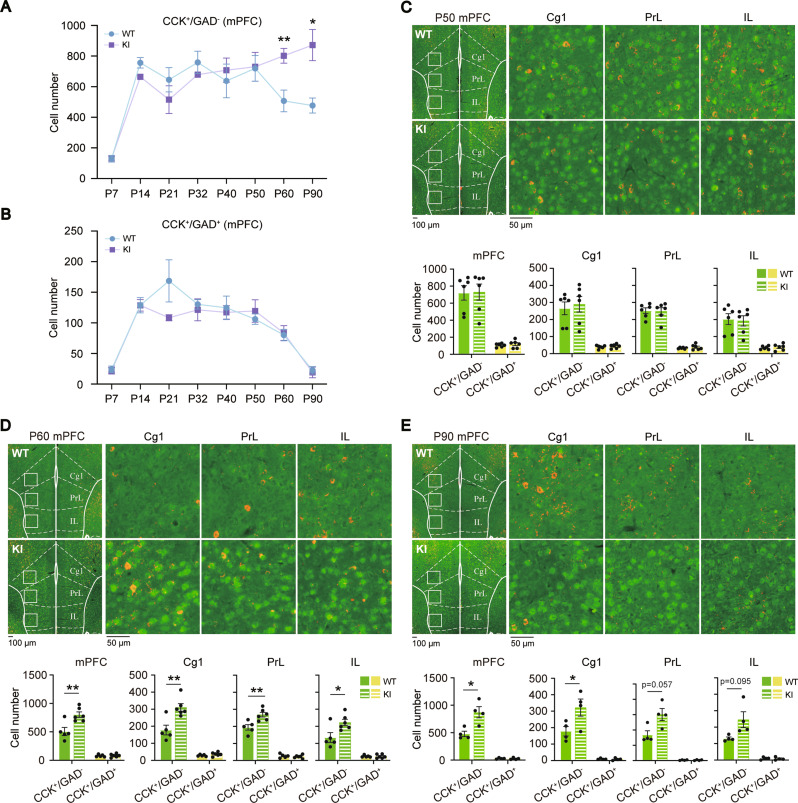
Wild-type prefrontal CCK-positive cells increased early, peaked in juveniles, stabilized in adolescence and declined in adulthood. Mutant excitatory CCK cells did not show the same adult decline: earlier comparisons were unclear, while overall differences appeared in adulthood. Inhibitory CCK populations did not show a corresponding increase.
The change was not shared by every region. Somatosensory cortex and basolateral amygdala lacked the same genotype-dependent trajectory, and prefrontal subregions differed across ages. This region- and age-dependent expression history set the context for adult stress responses.
Source: Fu Y et al. · Molecular autism · CC BY-NC-ND
Original figure and English caption ↗
Stress reveals differences hidden at baseline
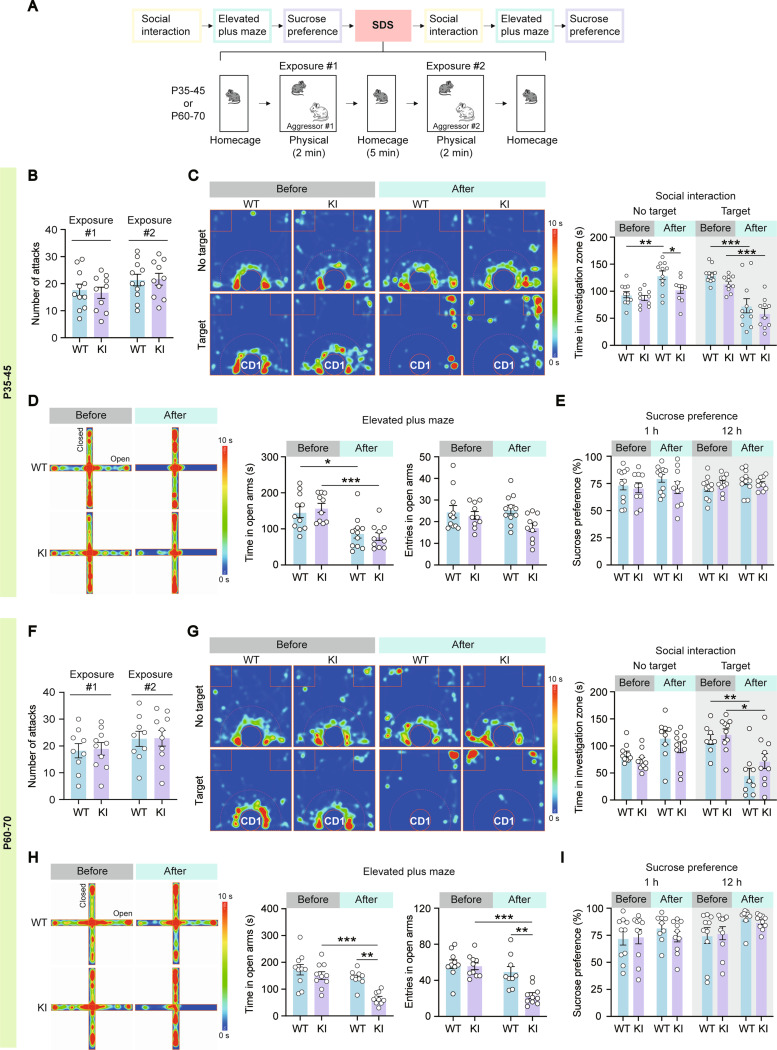
Adult wild-type and mutant mice had comparable baseline anxiety-related behavior. Two brief defeats produced clearer elevated-plus-maze changes in mutants, without equivalent changes in wild types. Attack counts were comparable, so the difference followed similar challenges rather than simply greater attack exposure.
Age added another layer. Adolescents of both genotypes showed social avoidance and similar anxiety-related changes; the additional mutant vulnerability became clearer in adulthood. Sucrose preference and distance remained largely unchanged. Most anxiety-related differences weakened at later follow-up while social avoidance persisted, revealing distinct time courses.
Source: Fu Y et al. · Molecular autism · CC BY-NC-ND
Original figure and English caption ↗
The timing of peptide signals changes too
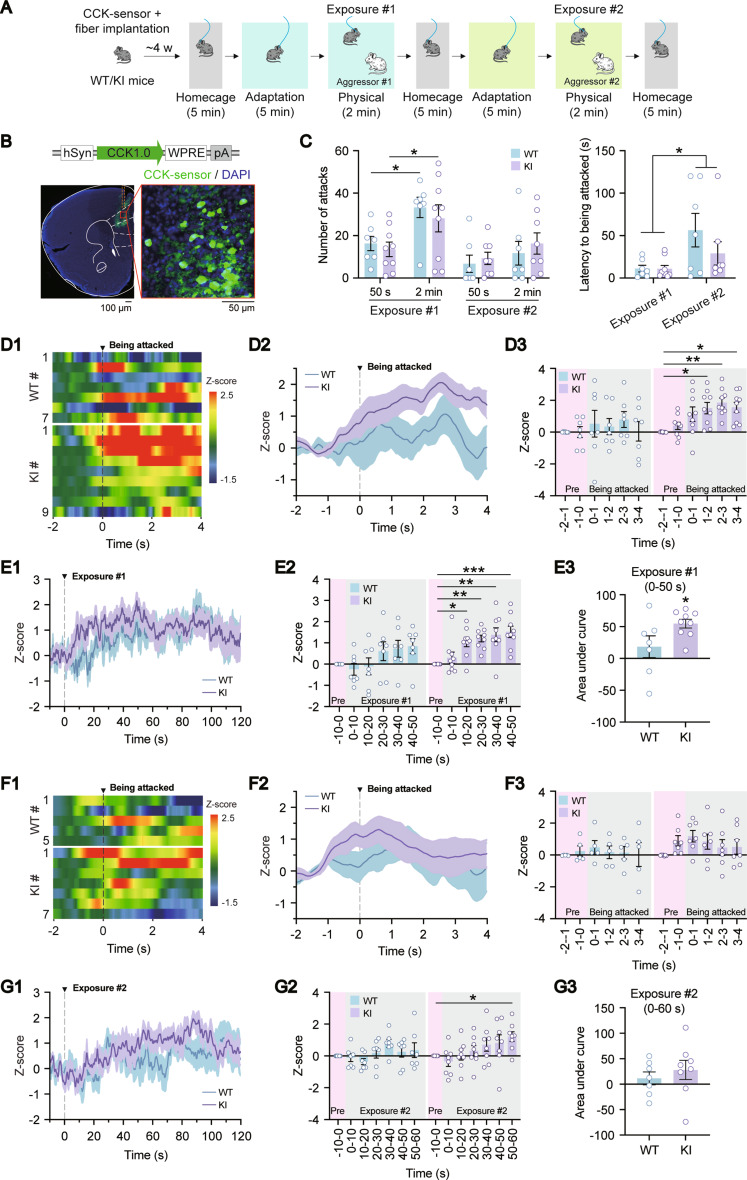
During the first attack, mutant prefrontal CCK signals rose rapidly, with a larger early first-exposure response than wild types. Speed and attack frequency lacked corresponding genotype differences. The stress event thus connected altered expression history with peptide dynamics during behavior.
The second exposure did not replay the first. Initial attack-related changes and early overall responses were comparable, with sustained increases appearing later. Repeated encounters altered the temporal pattern. CCK dynamics combined a developmental background with challenge-dependent timing rather than one fixed high-signal state.
Source: Fu Y et al. · Molecular autism · CC BY-NC-ND
Original figure and English caption ↗
Anxiety-related effects ease while avoidance remains
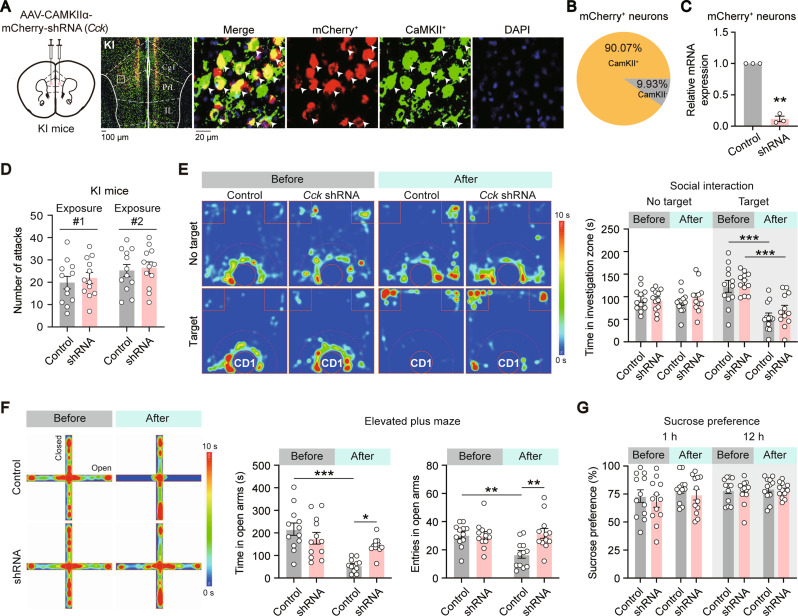
Reducing Cck in adult mutant prefrontal excitatory cells increased open-arm time and entries after defeat. The stronger anxiety-related response eased without changing attack exposure, establishing local peptide expression as a functional contributor to the stress response.
Social avoidance persisted despite improved open-arm behavior, and sucrose preference remained comparable. Post-stress responses have several components, some more sensitive to prefrontal CCK. Lowering peptide expression did not erase the encounter; it changed how that encounter influenced later exploration and avoidance choices.
Source: Fu Y et al. · Molecular autism · CC BY-NC-ND
Original figure and English caption ↗
Wild types can also become more vulnerable under challenge
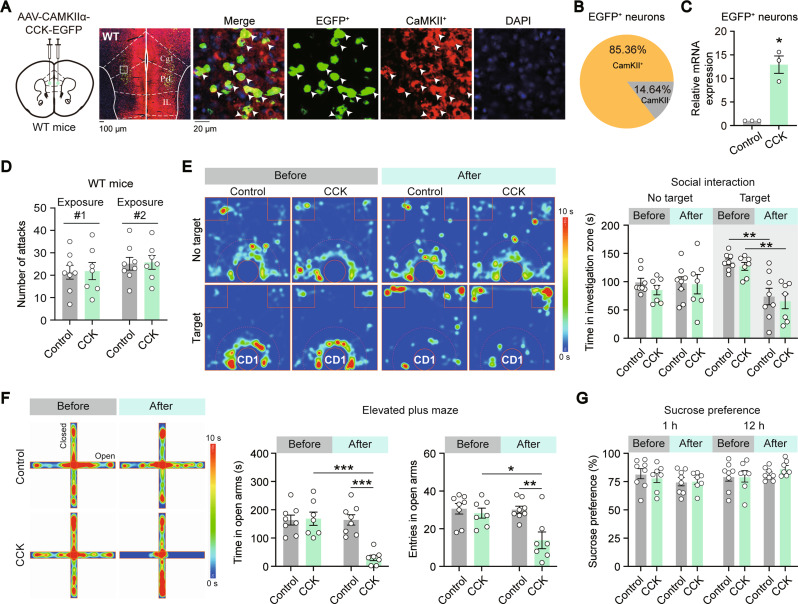
Increasing Cck in wild-type prefrontal excitatory cells produced stronger anxiety-related behavior after mild defeat, without parallel changes in attack or avoidance comparisons. Opposite expression adjustments jointly support a contribution of local CCK to selected post-stress behaviors beyond the mutation itself.
The enhancement was artificial and larger than subtle developmental regulation, with effects observed under challenge. Stronger defeat also affected adult wild types and more strongly affected mutants. Vulnerability means a greater response under particular stress loads rather than permanent fragility in one group and immunity in the other.
Source: Fu Y et al. · Molecular autism · CC BY-NC-ND
Original figure and English caption ↗
Development changes the starting point for stress
The study connects similar baselines with divergent challenge responses: an altered adult expression decline, changed release dynamics and functional effects of local expression. A baseline snapshot may miss how a system responds under pressure. A molecular history of development can become behaviorally visible only in a particular context.
The findings concern male NL3 R451C mice in social-defeat tasks. The receptors and downstream circuitry receiving CCK remain to be identified. The evidence highlights how age, genotype and experience jointly shape responses within this model, without assigning all social or autism-related differences to a single peptide.