A peripheral block influences brain circuits while fear memory is taking shape
In male mice, stellate ganglion block shortly after learning reduces later cue-evoked freezing, alongside changes in locus-coeruleus–amygdala activity and local norepinephrine signals.
A previously ordinary sound can make a mouse freeze after it has been paired with danger. How does a recent experience become a defensive response that persists into the next day? A Translational Psychiatry study blocks the peripheral stellate ganglion at different times after learning and finds timing-dependent changes in later cue-evoked freezing. Brain responses also change: locus-coeruleus and amygdala activity decrease, along with local norepinephrine signals. A peripheral intervention thus connects with the network involved in forming a fear memory.
A block immediately or half an hour after learning reduces later freezing; later intervention lacks the same effect. Increasing locus-coeruleus–amygdala activity or modulating amygdala norepinephrine can strengthen the related response.
Contents · 7 sections
An ordinary sound gains new significance
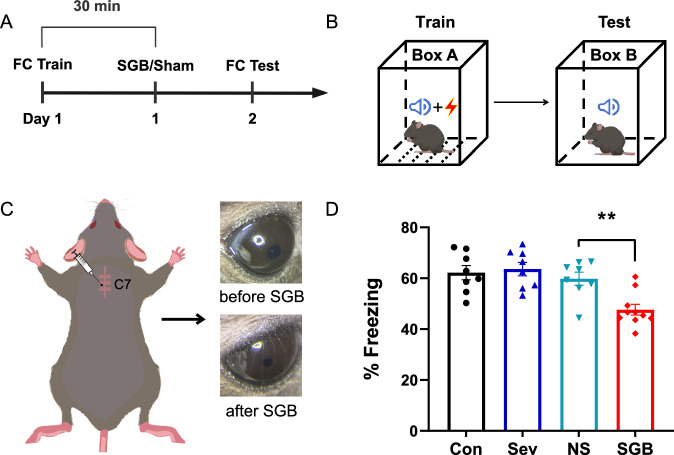
Male mice experience tone–footshock pairings. On the next day in a different environment, tones alone evoke freezing: temporary immobility apart from breathing. Prior experience gives the sound new significance, with freezing duration providing a behavioral window on that association.
The stellate ganglion belongs to the peripheral sympathetic network associated with regions including the head, neck and upper limbs. Applying a local block after learning lets the study examine subsequent tone responses and the associated brain activity, following a peripheral question into a memory network.
The early postlearning window stands out
A block half an hour after training reduces freezing on the next day. Anesthesia alone or anesthesia with saline does not produce the same effect, and open-field distance remains comparable. Reduced cue responding occurs against similar measured spontaneous locomotion.
Immediate posttraining intervention also has an effect, whereas blocks six or twenty-four hours later show no significant difference. This time dependence is consistent with an early period of memory stabilization, when a newly formed association remains more sensitive to intervention.
Source: Wang Z et al. · Translational psychiatry · CC BY-NC-ND
Original figure and English caption ↗
Following the peripheral network toward locus coeruleus
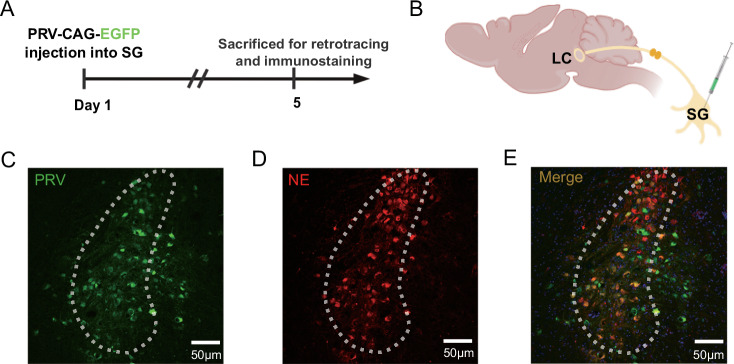
Transsynaptic retrograde tracing from the stellate ganglion labels cells in locus coeruleus (LC), some bearing noradrenergic markers. It links the peripheral sympathetic node with a brainstem network, indicating a connection through neural pathways.
LC sends noradrenergic signals to many brain regions and participates in arousal, stress and behavioral-state regulation. The study next asks how this brain signal source responds to learned tones after the peripheral block, extending the anatomical link into dynamic activity.
Source: Wang Z et al. · Translational psychiatry · CC BY-NC-ND
Original figure and English caption ↗
LC and amygdala responses weaken when the tone returns
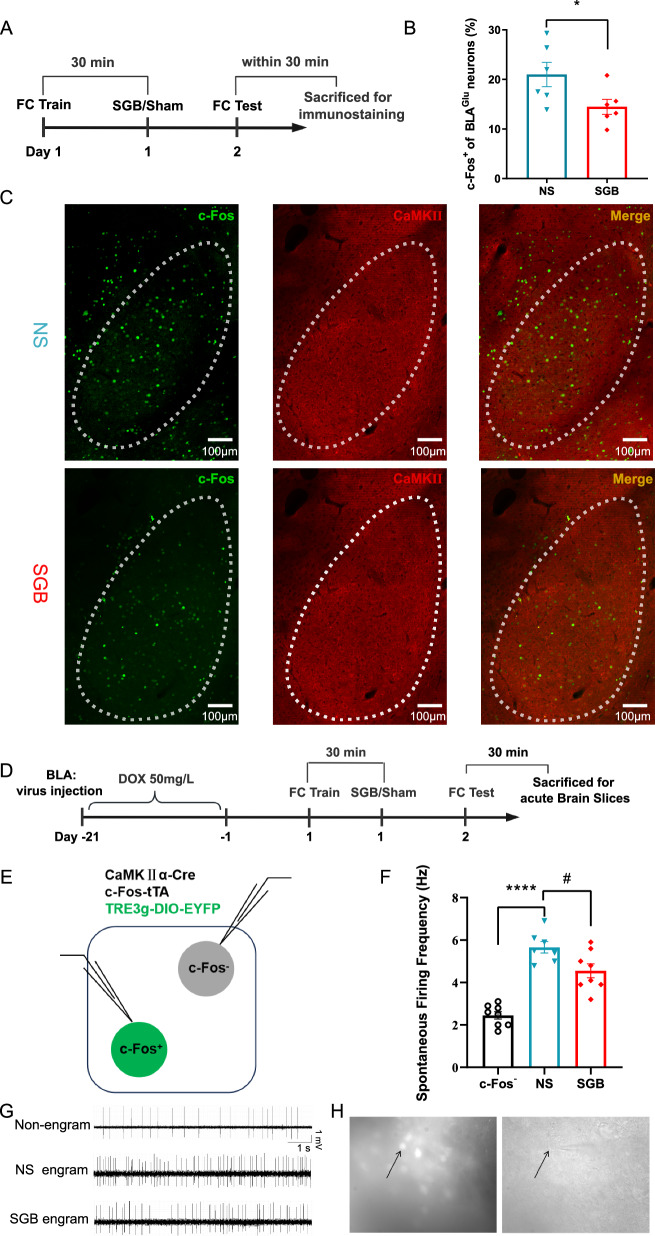
After the block, LC noradrenergic cells show less c-Fos labeling and lower population calcium responses to test tones. The same learned cue meets a different response strength, with two observations on different timescales pointing in a similar direction.
Basolateral amygdala (BLA) receives LC input and participates in processing emotional cues and memory. Following the block, excitatory BLA cells show less activity-related labeling. Cells tagged in association with the learning experience also have lower spontaneous firing rates in slices, extending the change into a memory-related region.
Source: Wang Z et al. · Translational psychiatry · CC BY-NC-ND
Original figure and English caption ↗
Norepinephrine signals weaken around the amygdala
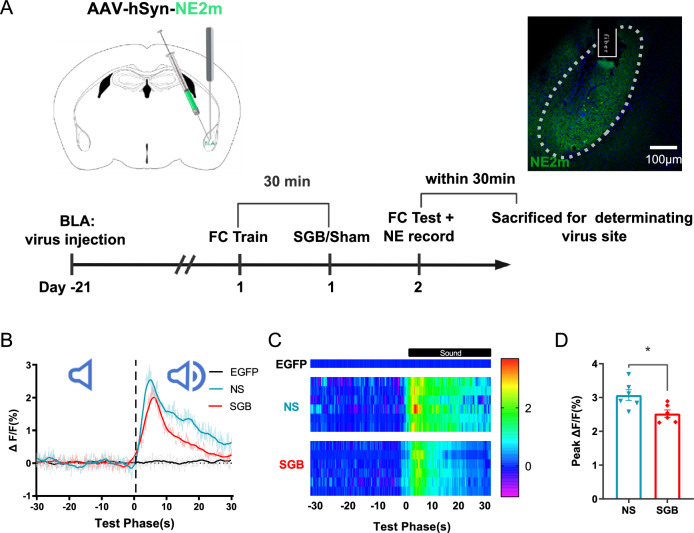
A norepinephrine-sensitive fluorescent signal in BLA responds to the test tone in both groups, but its mean change is smaller after the block. Transmitter dynamics align with the cellular findings: weaker LC responses accompany a reduced signal in the downstream region.
Norepinephrine can modulate local neuronal and synaptic responses. The observed dynamics add a chemical lead linking peripheral block, brain activity and freezing, motivating tests of whether increasing the related signal changes behavior.
Source: Wang Z et al. · Translational psychiatry · CC BY-NC-ND
Original figure and English caption ↗
Increasing activity during recall strengthens the response
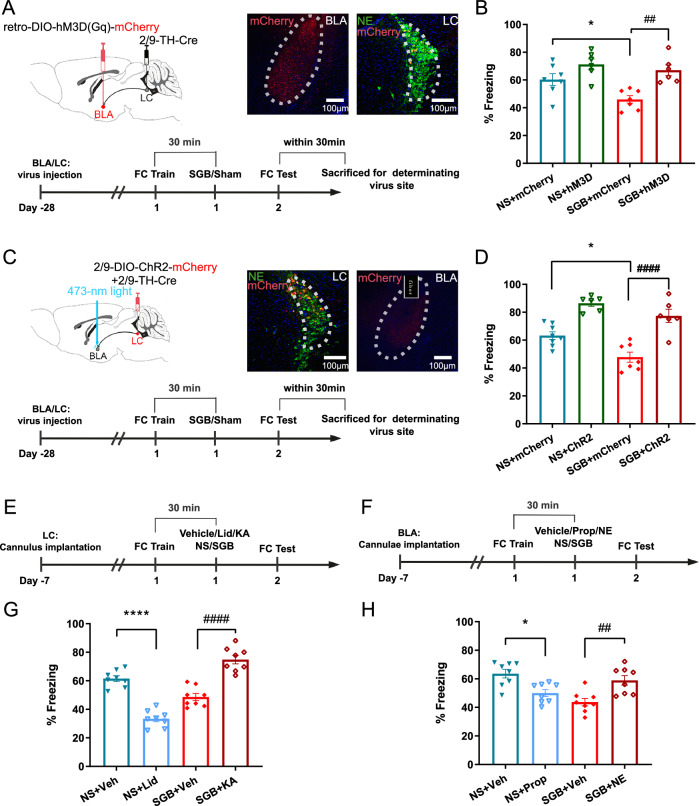
During recall testing after the block, activating LC-related cells projecting to BLA increases freezing. Activating LC terminals directly within BLA produces a change in the same direction. The connection’s state during testing can still influence cue-evoked defensive responding.
Separate postlearning pharmacological manipulations converge: suppressing LC or blocking BLA β-adrenergic receptors reduces later freezing, while raising LC activity or supplying BLA norepinephrine strengthens the response after the block. Cellular, terminal and transmitter findings align across different intervention windows.
Source: Wang Z et al. · Translational psychiatry · CC BY-NC-ND
Original figure and English caption ↗
A peripheral intervention reveals timing in the memory network
The male-mouse study links a postlearning peripheral block with LC–BLA activity, norepinephrine dynamics and cue freezing. The block’s early timing points to an influence on stabilization, while recall-period activation shows that current network state can change behavioral expression.
An experience becomes a later response through activity at several stages. The new perspective is that peripheral sympathetic modulation can enter that process. The work provides circuit leads for conditioned fear; more complex memory and affective changes in clinical trauma-related symptoms remain questions for their respective studies.