A midbrain population becomes active as male mice fight
Tac2-marked midbrain cells respond during attacks. Reducing their activity diminishes fighting, and local serotonin signaling can also change this behavior.
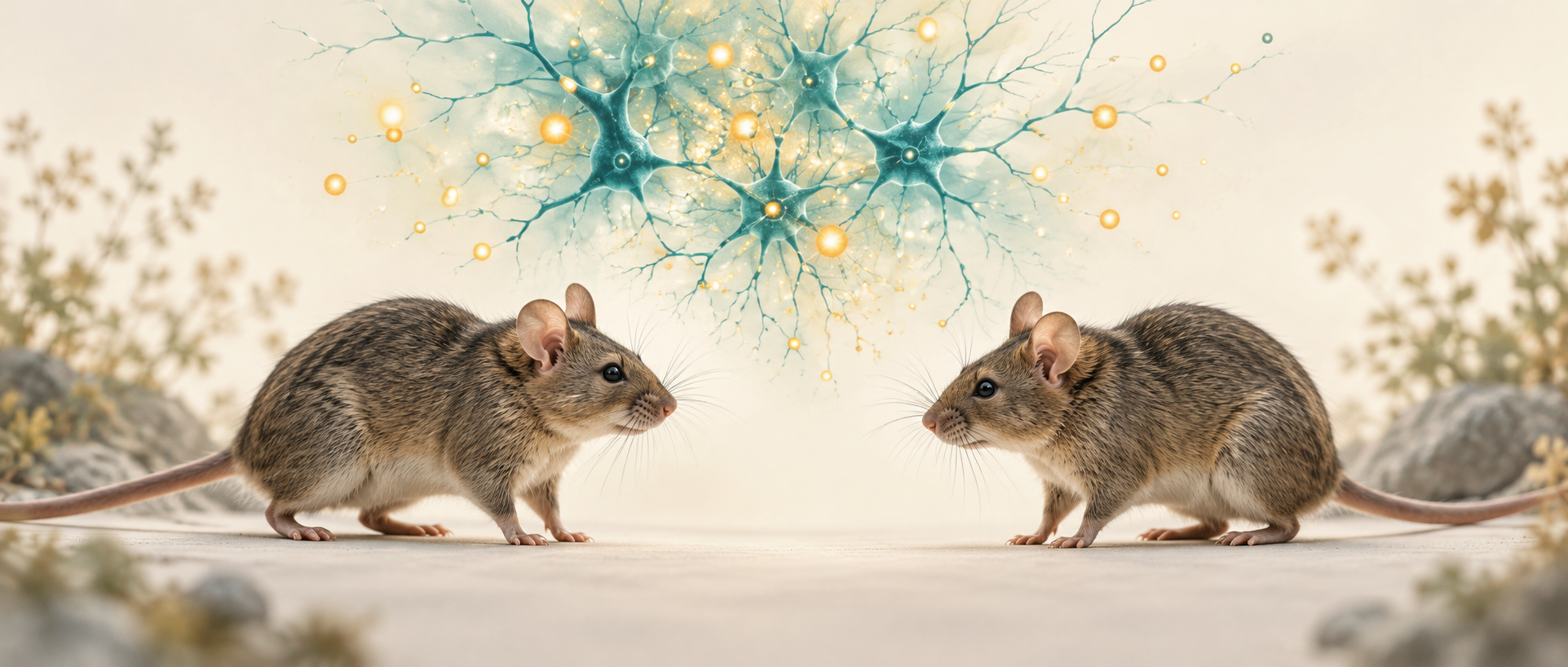
When two male mice meet, sniffing, tail rattling, chasing and attacks may unfold in sequence. Does a population in the brain follow the attacks particularly closely? A study in Theranostics identifies Tac2-marked cells in the midbrain periaqueductal gray. Their activity accompanies attacks, and manipulating them changes fighting. Molecular changes in these cells then lead the researchers to investigate local serotonin signaling.
Tac2-marked dorsomedial periaqueductal-gray cells contribute to the tested intermale aggression: activation increases it, while inhibition or cell depletion reduces it. Local serotonin-related interventions modify these behavioral effects.
Contents · 7 sections
Finding a defined population within a larger region
The periaqueductal gray (PAG) participates in defense, sensation and movement, with distinct subregions and cell populations. Earlier regional studies linked it with aggression. This study asks whether a molecular marker can identify the cells more closely associated with the behavior.
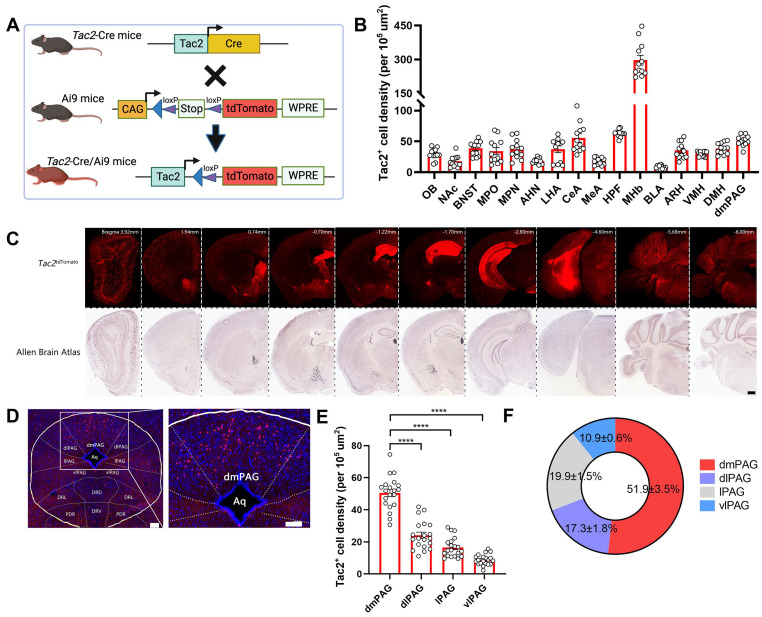
Tac2-marked cells occur in several brain regions and across PAG subregions. About half of the labeled PAG population is concentrated in dorsomedial PAG, or dmPAG, giving the team a defined population to examine. Cellular location matters alongside the shared marker.
Source: Li C et al. · Theranostics · CC BY
Original figure and English caption ↗
Calcium follows attacks rather than every encounter
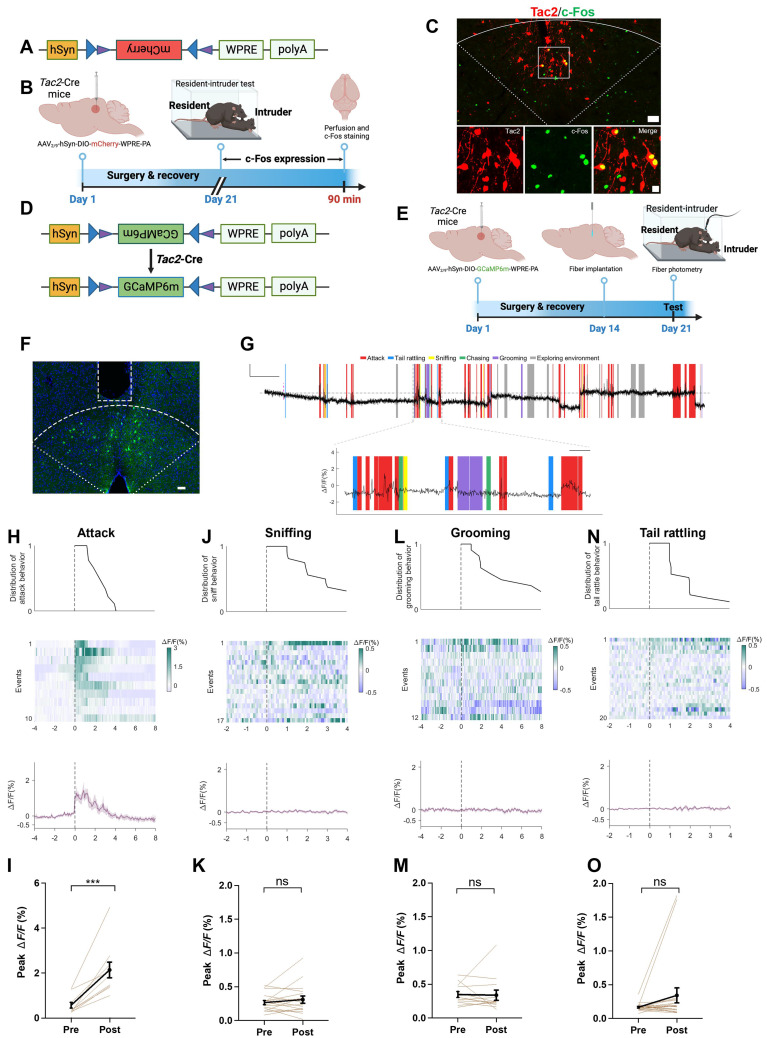
During resident–intruder encounters, dmPAG population calcium rises rapidly with attacks and falls afterward. Restricting recordings to Tac2-marked cells retains a clear attack-related response. Aligning activity with behavior identifies a more specific participant within the broader region.
Sniffing, grooming and tail rattling lack the same significant calcium response. Additional tests of ordinary social encounters, object exploration and the tested nociceptive stimulus also show no significant response. Tac2-negative cells still show a smaller attack-related increase, indicating contributions across populations with different response magnitudes.
Source: Li C et al. · Theranostics · CC BY
Original figure and English caption ↗
Fighting decreases while ordinary investigation persists
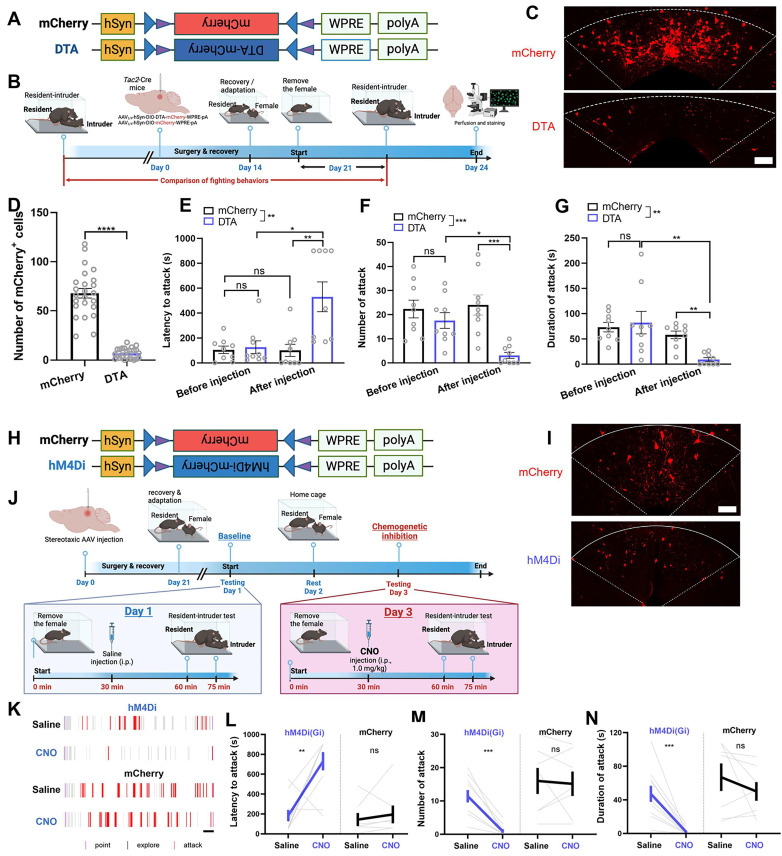
Depleting these dmPAG cells delays attack onset and reduces attack number and duration, without a corresponding decline in investigation of another male. Temporarily inhibiting the population likewise diminishes attacks and reduces the proportion of animals that fight.
Locomotor measures do not significantly change after inhibition. Open-arm time increases in the elevated maze, while other tested anxiety-like measures remain similar. Reduced attacks therefore do not accompany a uniform reduction in activity or exploration.
Source: Li C et al. · Theranostics · CC BY
Original figure and English caption ↗
More biting and wrestling, with a different chasing response
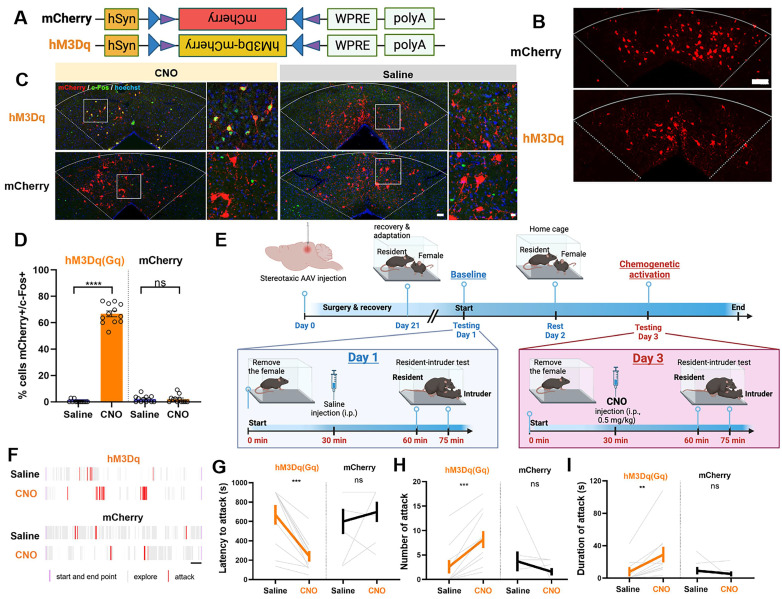
Increasing activity makes resident males attack sooner and increases attack number and duration, without significant changes in the tested locomotor or anxiety-like measures. The opposite directions of activation and inhibition support a role in regulating aggression during these encounters.
Detailed analysis shows that inhibition reduces biting, wrestling and chasing. Activation clearly increases biting and wrestling without the same clear increase in chasing. A single encounter contains several actions, each with a different relationship to population activity.
Source: Li C et al. · Theranostics · CC BY
Original figure and English caption ↗
The expression changes that follow an encounter
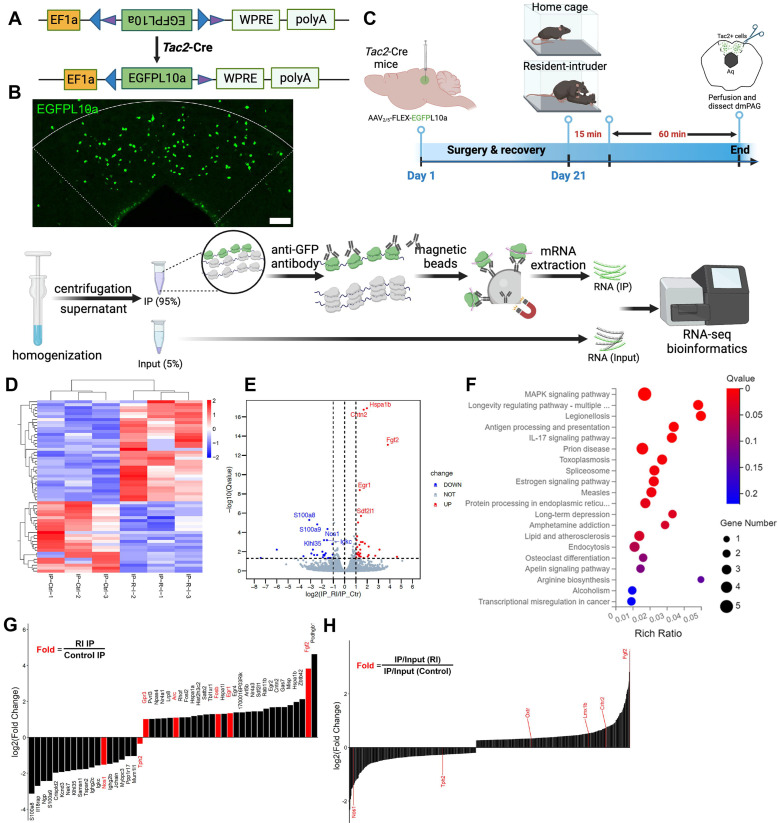
The team next compares translation-associated RNA in the population after fighting with home-cage controls. Activity-related genes change alongside immune, inflammatory and hormonal expression signatures, revealing a different molecular state in the behavioral participants.
Some changes point toward the serotonin system, including reduced Tph2 transcripts associated with synthesis and changes in receptor-related genes. These expression findings motivate tests of how local serotonin-related interventions affect the behavior.
Source: Li C et al. · Theranostics · CC BY
Original figure and English caption ↗
Serotonin-related signaling modifies aggression
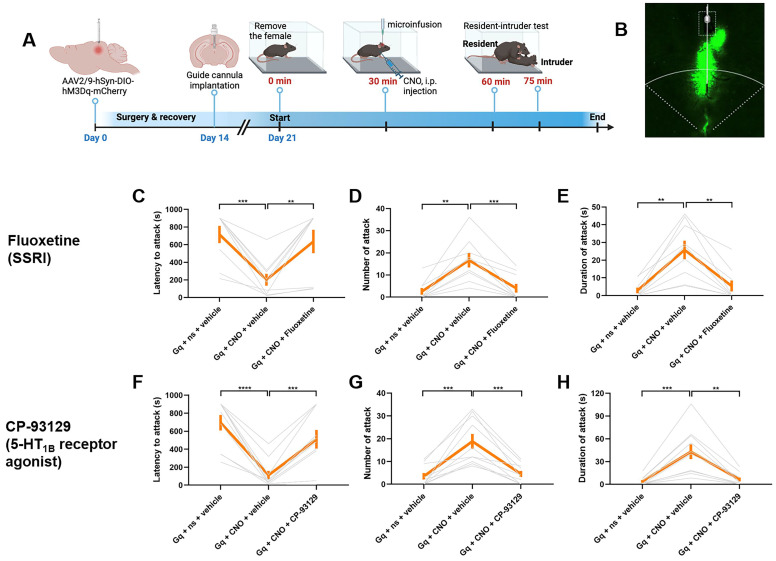
Enhancing serotonin-related signaling locally in dmPAG attenuates the increase in aggression caused by cell activation: attacks begin later and become fewer and shorter. A local 5-HT1B-receptor agonist produces a similar direction, while receptor blockade counteracts the reduction associated with population inhibition.
Serotonin modulates neural activity through several receptor types. Even when the Tac2 population is activated, enhancing local 5-HT1B signaling reduces fighting. Aggression is thus linked both to recruited cells and their local signaling environment. These pharmacological effects occur at a defined midbrain site, bringing the expression findings and behavioral tests together.
Source: Li C et al. · Theranostics · CC BY
Original figure and English caption ↗
Cellular identity sharpens the picture of aggression
This adult intermale-encounter study narrows aggression-related activity from a brain region to a molecularly identified population and shows that local modulation changes its behavioral effects. Tac2 first provides a cellular identity, while serotonin-related pharmacology and expression findings reveal a modulatory setting. Distinct changes in biting, wrestling and chasing give aggression a more detailed cellular and behavioral picture.