Two brain pathways work together to defend mice against cold
Cold signals from the brainstem can reach the hypothalamus through parallel routes. One branch helps mice keep warm chiefly by recruiting heat production in brown fat.
Cold can make the body shiver while also increasing less visible sources of heat. These responses are coordinated through more than a single command line. A study published in Nature Communications on August 15, 2023 finds that cold-related signals from the mouse lateral parabrachial nucleus, LPB, can travel to the preoptic area, POA, or directly to the dorsomedial hypothalamus, DMH. The routes jointly support core temperature, while finer cellular divisions separate brown-fat heating from other cold-defense responses.
LPB routes to POA and DMH make comparable, additive contributions to cold defense. An SST-associated LPB-to-DMH branch preferentially recruits brown-fat thermogenesis without significant increases in shivering, heart rate or locomotion.
Contents · 7 sections
A direct route complements the familiar preoptic pathway
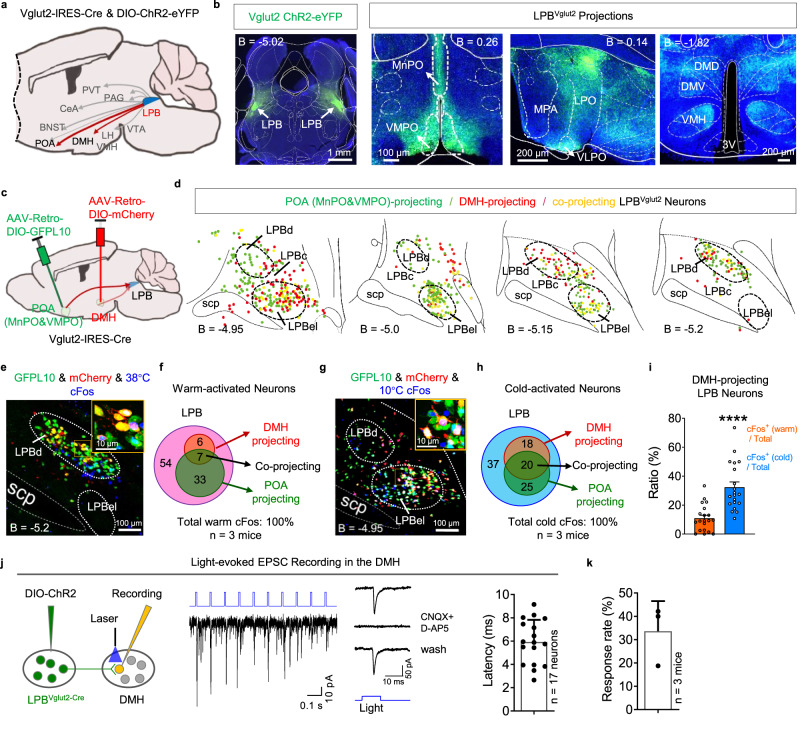
The POA is a well-established thermoregulatory hub, with DMH often placed downstream. The study finds that LPB also directly contacts DMH. Among cold-responsive LPB cells, similar proportions project to POA and DMH, and some reach both.
Cold signals therefore need not all pass through POA before reaching DMH. Anatomy and slice findings support excitatory LPB input to DMH, raising a functional question: does this direct connection actually help animals resist cold?
Source: Yang WZ et al. · Nature communications · CC BY
Original figure and English caption ↗
Cooling and sustained cold carry different signals
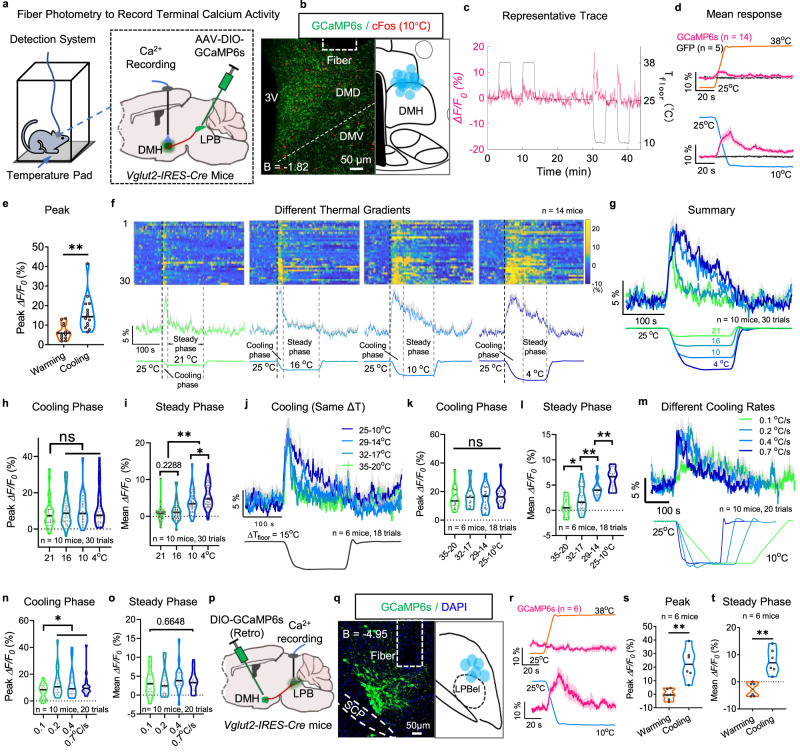
Population calcium along the LPB-to-DMH connection responds more strongly to cooling than warming. Signals rise during cooling and then adapt as temperature stabilizes, while retaining information about the sustained cold.
Initial peaks are similar across different temperature drops, whereas sustained responses become stronger at colder endpoints. Peaks also do not scale progressively with every cooling rate. The pathway distinguishes aspects of temperature change from the resulting cold state.
Source: Yang WZ et al. · Nature communications · CC BY
Original figure and English caption ↗
Disrupting both routes worsens cold defense
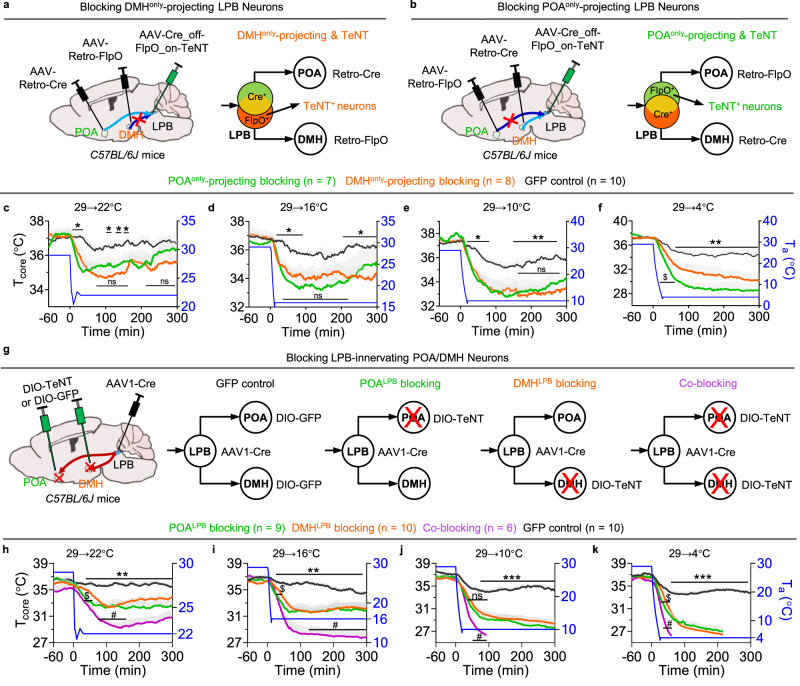
Functional findings support cooperation. Disrupting LPB cells projecting only to DMH or only to POA produces similar core-temperature deficits across most tested cold conditions, with a somewhat greater POA-related deficit in the harshest cold. Baseline temperature in thermoneutral conditions is not significantly altered.
A separate comparison targets downstream populations receiving LPB input. Disrupting either POA or DMH populations impairs cold defense, and disrupting both produces a larger deficit. Tested cold-pain responses and temperature preferences do not significantly change, separating thermoregulatory impairment from those behavioral outcomes.
Source: Yang WZ et al. · Nature communications · CC BY
Original figure and English caption ↗
One connection recruits several defenses
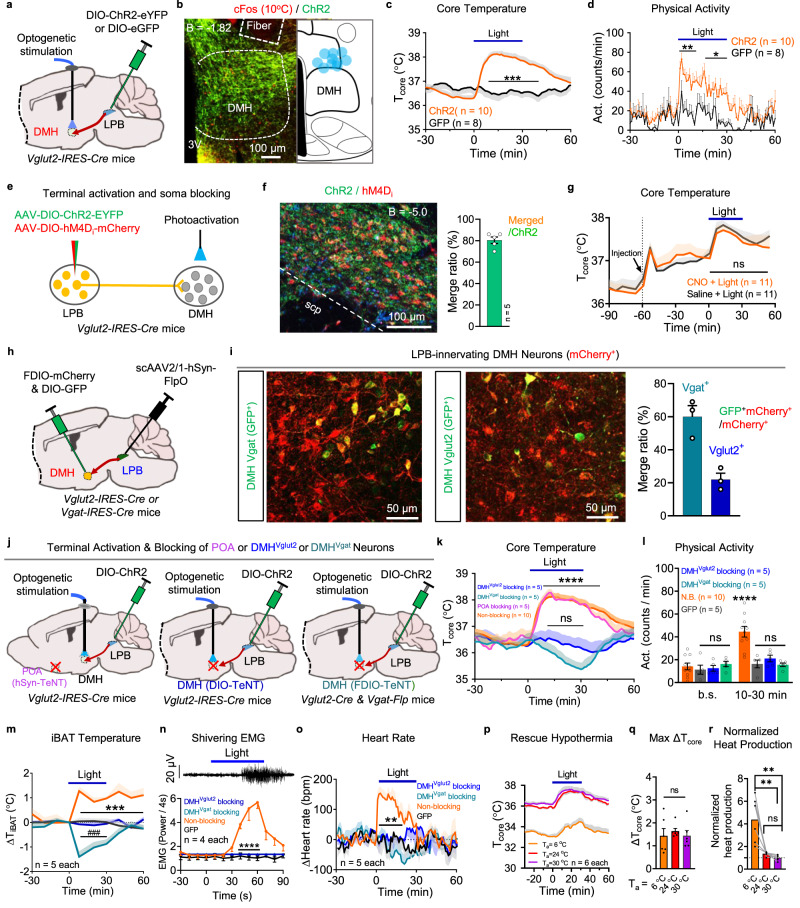
Enhancing LPB-to-DMH signaling raises core temperature alongside brown-fat temperature, shivering-related muscle activity, heart rate and locomotion. It also attenuates hypothermia during cold exposure, linking the pathway to a coordinated set of responses.
The induced warming persists when POA activity is disrupted, but is impaired by disruption of either glutamatergic or GABAergic DMH populations. Excitatory LPB input thus recruits a local network involving different cell classes.
Source: Yang WZ et al. · Nature communications · CC BY
Original figure and English caption ↗
Brown fat warms before the core
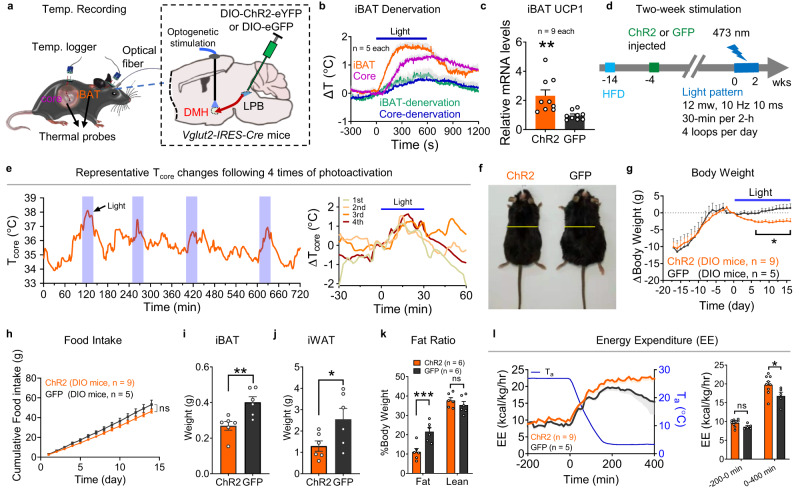
Brown-fat warming precedes the core-temperature rise and reaches a higher level, suggesting an active contribution to heat production. Disruption of its sympathetic connection weakens pathway-induced warming, while expression of the thermogenic protein UCP1 rises after enhanced signaling.
In mice with diet-induced obesity, repeated enhancement produces lower weight and fat proportion than controls without a significant change in cumulative food intake; weight gain also slows in controls. These findings connect cold defense with energy balance while remaining findings about a mouse circuit.
Source: Yang WZ et al. · Nature communications · CC BY
Original figure and English caption ↗
An SST-associated branch favors brown-fat thermogenesis
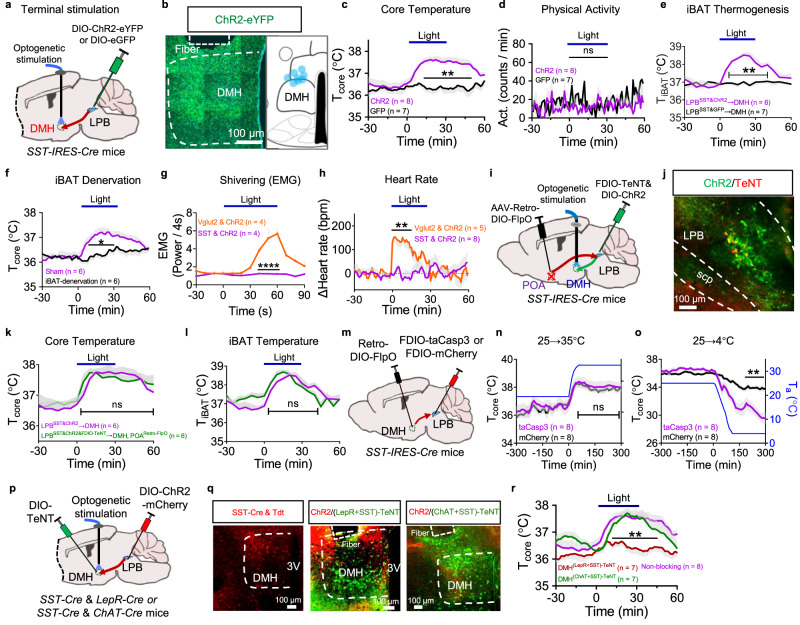
The study identifies somatostatin-marked, SST, cells in LPB as part of the cold-responsive network reaching DMH. Enhancing this branch raises brown-fat and core temperature without significant increases in locomotion, shivering or heart rate, unlike the broader population.
Loss of these DMH-projecting LPB cells impairs temperature maintenance in cold but does not significantly alter the tested warm-exposure response. SST identifies the population; these findings do not establish that the peptide itself mediates the full effect.
Source: Yang WZ et al. · Nature communications · CC BY
Original figure and English caption ↗
Parallel signaling divides work across cell populations
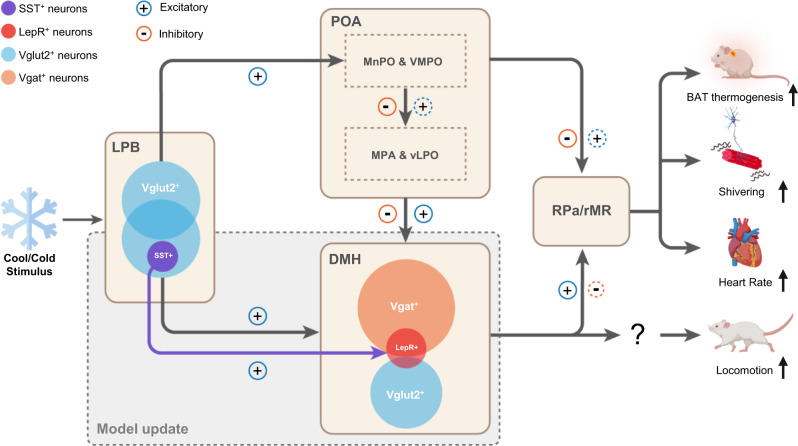
This mouse study refines the organization linking cold sensing to heat production. Parallel routes reach the hypothalamus and recruit multiple responses, with one branch favoring brown fat. Parallel routes can still share projecting cells, and their physiological outputs need not always rise together.
The central insight is that cold defense combines cooperation with specialization. Several connections jointly support temperature, while more specific populations recruit particular heat sources. This offers a richer account of physiological coordination than a single temperature switch.
Source: Yang WZ et al. · Nature communications · CC BY
Original figure and English caption ↗