Sustained food odors make mice eat less
Stronger, sustained food odors reduce feeding in male mice. An excitatory connection from olfactory bulb through ventral subiculum to hypothalamus contributes to this change.
Food smells often heighten anticipation of a meal, but olfaction can influence feeding in more than one direction. A study in Nature Communications finds that male mice eat less in a particular environment with sustained food odors. Tracing the neural signals reveals connections between olfactory bulb, ventral subiculum and ventromedial hypothalamus, linking odors with feeding regulation at the circuit level.
Sustained food odors reduce feeding through associated olfactory inputs and a ventral subiculum–hypothalamic connection. Increasing activity in the identified circuit also reduces feeding, with effects shaped by odor strength, duration and circuit state.
Contents · 6 sections
Strength and duration matter
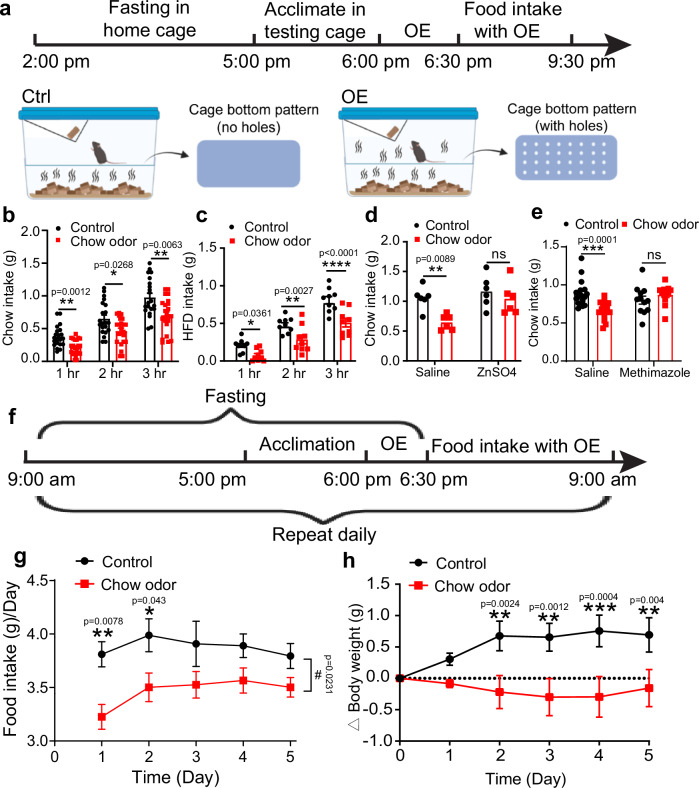
In the study’s feeding context following fasting, mice exposed to stronger, sustained chow odors eat less over the subsequent hours than controls. Two non-food odors do not produce the same reduction, nor do weaker or brief food odors. This is not a general response to detecting any trace of food.
The effect crosses food types: chow odors reduce high-fat food intake, and high-fat food odors affect intake of both diets. During observations across several days, odor-exposed mice eat less and gain less weight. The finding therefore extends beyond the first moment of odor exposure.
Source: Liu Y et al. · Nature communications · CC BY-NC-ND
Original figure and English caption ↗
The odor is not an extra meal
The team examines several possible confounds. Mice do not spend clearly more time investigating the floor near the odor source, and the environmental difference itself does not cause the same reduction in intake. Impairing olfaction removes the food-odor effect, while baseline intake without the added odor remains comparable.
The odor adds no nutrients directly, yet changes how much food is subsequently consumed. Feeding therefore reflects more than internal energy signals: environmental food cues can also participate. The next question is which cells carry olfactory information into feeding-related networks.
Ventral subiculum responds more to food odors
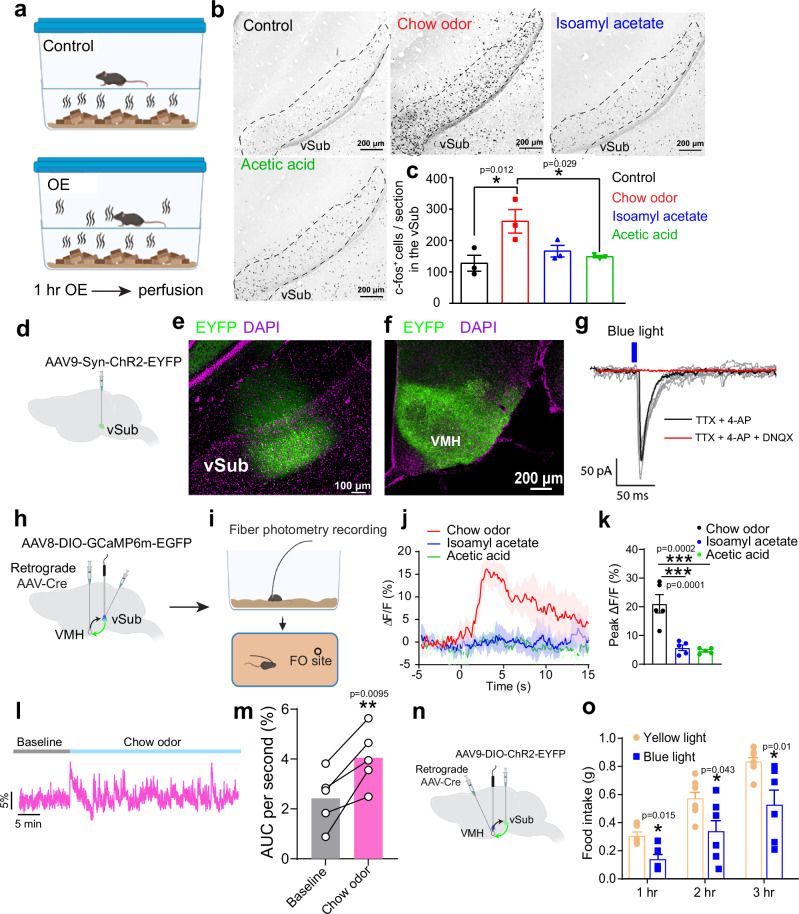
The ventral subiculum is part of the hippocampal formation and connects widely with sensory, contextual and motivational regions. Sustained food odors increase activity markers there, unlike the non-food odors compared. Subicular cells projecting to ventromedial hypothalamus also show stronger calcium responses during sniffing of chow and high-fat food odors.
During sustained odor exposure, overall calcium activity in this population remains elevated; during active consumption, it decreases. Detecting food cues and consuming food thus accompany different cellular states. This dynamic difference suggests a node involved across behavioral phases rather than one operating identically throughout feeding.
The odors all engage a familiar olfactory-processing region, but ventral subiculum responds more to food. The brain therefore does more than detect that an odor is present: later networks can link sensory cues with behavioral significance and process them differently.
Source: Liu Y et al. · Nature communications · CC BY-NC-ND
Original figure and English caption ↗
The hypothalamic output matters for feeding
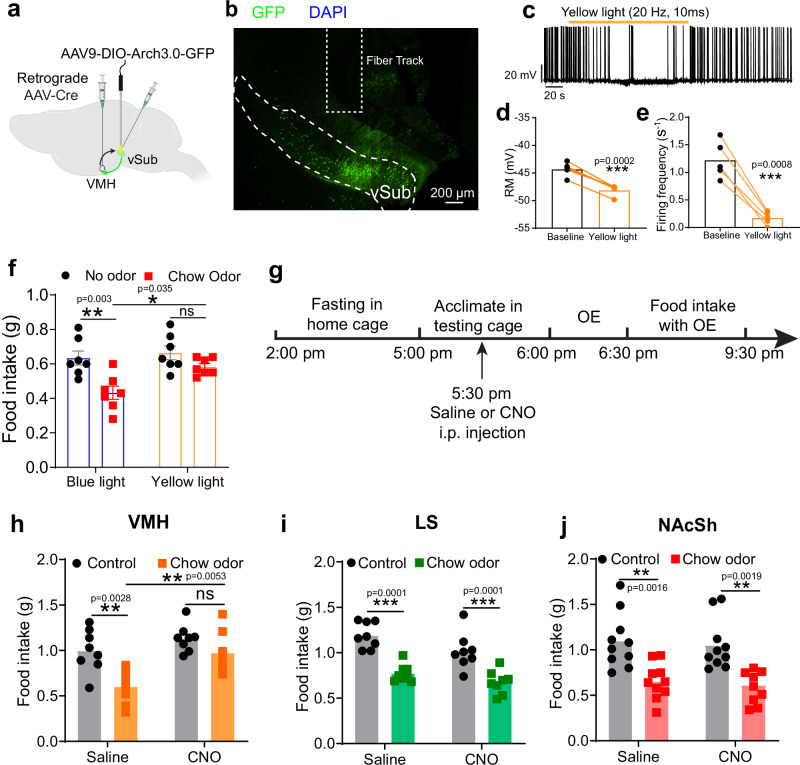
Ventral subicular output reaches several destinations. Cells projecting to hypothalamus also send branches to lateral septum and nucleus accumbens shell. Increasing these subicular cells’ activity reduces intake. Reducing the activity of their hypothalamic recipient cells attenuates this reduction, whereas the two other branches do not show the same effect.
Reducing subicular–hypothalamic activity also weakens the feeding reduction caused by sustained food odors. Increasing projection activity, in turn, is sufficient to reduce intake. Place-preference and movement observations show no clear change, distinguishing the feeding result from avoidance or movement effects measured here.
Source: Liu Y et al. · Nature communications · CC BY-NC-ND
Original figure and English caption ↗
Olfactory signals enter the subiculum
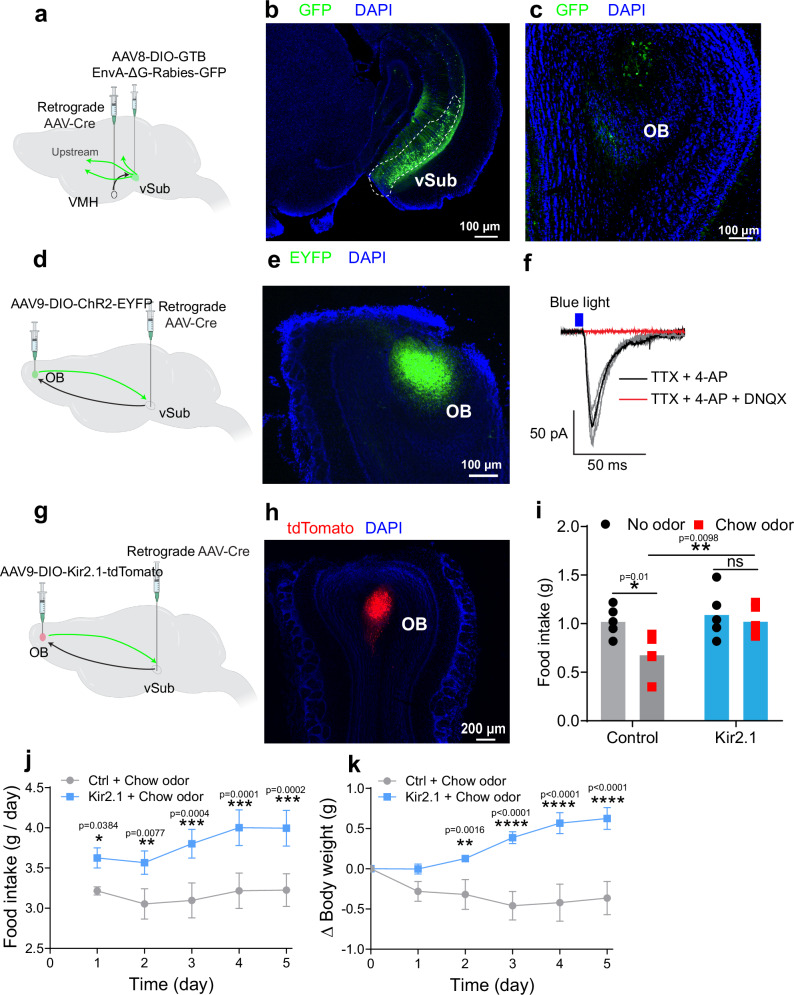
Tracing upstream reveals a population in the olfactory bulb connected to ventral subiculum. Electrical responses support a direct excitatory input, while the subiculum sends excitatory signals onward to hypothalamus. Connected nodes therefore link odor information with a feeding-regulation network.
Reducing activity in these olfactory-bulb cells removes the clear feeding reduction during a single sustained odor exposure. Intake and weight gain during repeated exposure are also higher than in odor-exposed controls, despite comparable baseline intake and weight. Changing the upstream signal changes the behavioral effect of the odor.
Source: Liu Y et al. · Nature communications · CC BY-NC-ND
Original figure and English caption ↗
The same sensory cue can have different outcomes
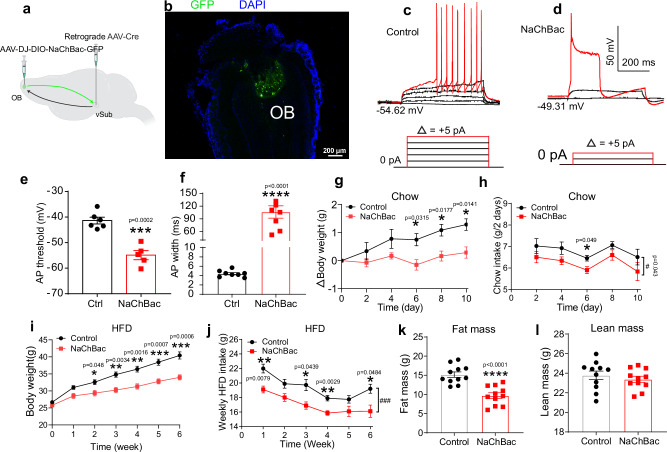
Sustained increases in the identified olfactory-bulb population’s activity reduce intake and weight gain on chow and high-fat diets. Fat mass is lower in the high-fat group, while lean mass does not change clearly. This direct neural manipulation complements the odor-environment observations.
The study uses adult male mice and does not measure a full range of odor concentrations. It shows that the relationship between food cues and feeding changes with how the signal persists and which circuits it engages. Olfaction helps animals find food and can also participate in determining how much they eat.
Source: Liu Y et al. · Nature communications · CC BY-NC-ND
Original figure and English caption ↗