How exploration and prefrontal responses differ after microbiota transfer
A male-mouse study links donor microbial differences with recipient open-area exploration and prefrontal activity, implicating gut–brain interactions in anxiety-like behavior.
Some mice explore elevated open spaces more readily than others. Could gut microbes contribute to these differences? A Frontiers in Neuroscience study compares communities from adult male donors with different exploration profiles and transfers them to antibiotic-pretreated recipients. Behavioral outcomes are then examined alongside regional activity markers, gene expression and prefrontal calcium signals.
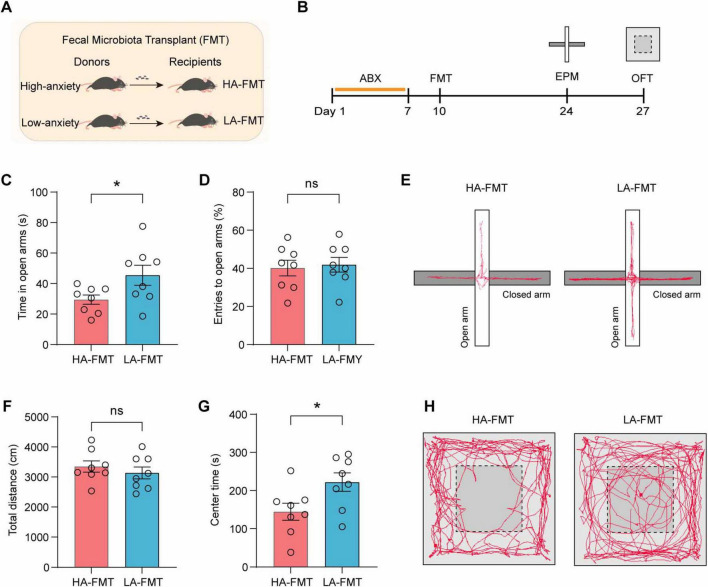
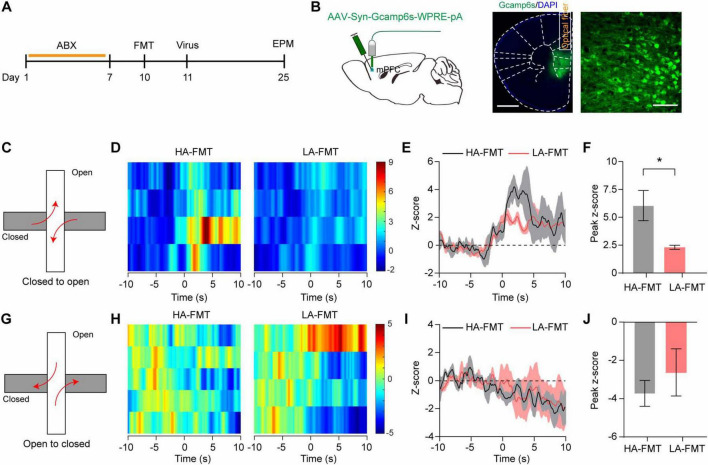
Recipients of higher-anxiety donors explore open arms and centers less, without significant total-distance or entry-ratio changes. Their mPFC calcium peaks are higher during open-arm entry; return-to-closed-arm differences are nonsignificant.
Contents · 7 sections
Starting with time in open arms
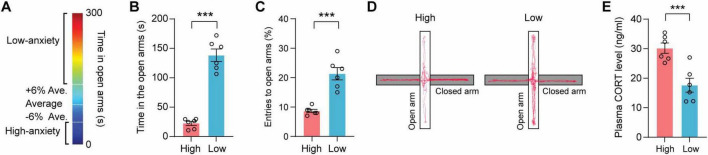
Mice choose between open and enclosed arms of an elevated plus maze. Donors are selected for higher- or lower-anxiety-like profiles based on open-arm time, with less versus more open-area exploration.
Open arms lack surrounding walls, while enclosed arms provide cover. Exploration therefore includes both movement and how long an animal stays in each location. Time, entry ratios and total distance reveal different aspects of that choice.
Open-arm entry ratios and plasma corticosterone also differ, with higher corticosterone in the higher-anxiety-like group. Variation within one strain under similar housing motivates comparison of gut communities.
Source: Ren J et al. · Frontiers in neuroscience · CC BY
Original figure and English caption ↗
Community composition differs despite similar diversity indices
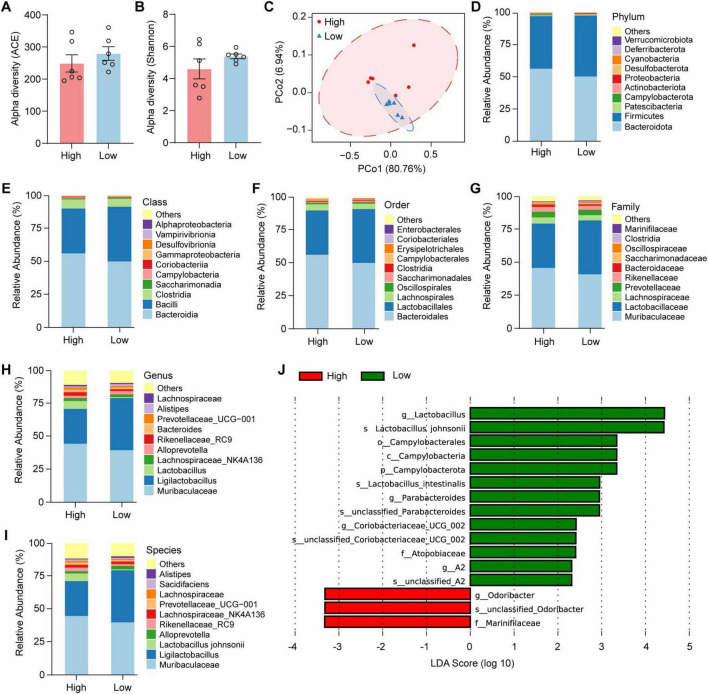
Fecal 16S profiling reveals compositional differences and altered relative abundance of several taxa. Lactobacillus and Parabacteroides-associated taxa are more abundant in lower-anxiety-like donors.
ACE and Shannon diversity indices do not significantly differ. The contrast concerns relative community composition rather than a uniform diversity shift, providing the comparison for subsequent transfers.
Source: Ren J et al. · Frontiers in neuroscience · CC BY
Original figure and English caption ↗
Open-area exploration increases after antibiotic treatment
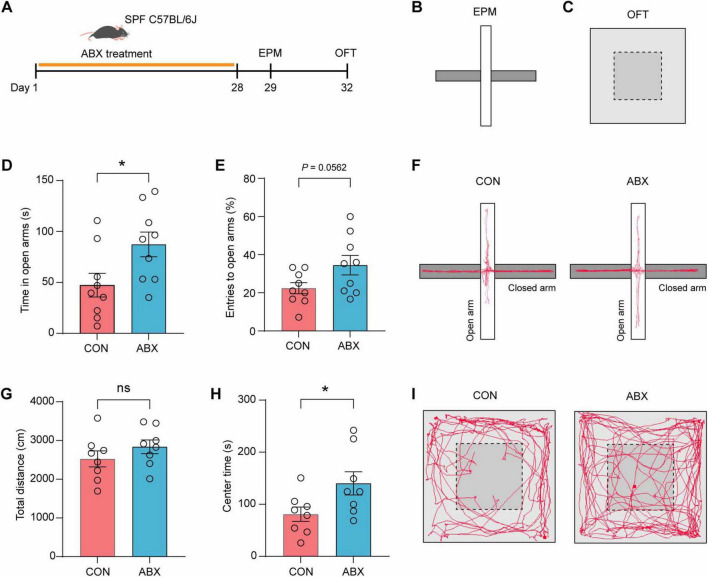
Antibiotic treatment increases open-arm time and open-field center time, without a significant total-distance change. Spatial exploration choices shift without a detected general locomotor increase.
Open-arm entry ratio shows a nonsignificant upward trend. Measures within a task need not change together: animals can remain in open regions longer without an equally clear change in relative entry frequency.
Source: Ren J et al. · Frontiers in neuroscience · CC BY
Original figure and English caption ↗
Different donor communities accompany different exploration
After the same pretreatment, recipients receive communities from higher- or lower-anxiety-like donors. Higher-anxiety-donor recipients spend less time in open arms and the open-field center, without significant differences in total distance or open-arm entry ratio.
Recipients show a direction of difference corresponding to donor profiles. Matched preparation links the gut intervention more directly to exploration, with donor origin as the comparison.
Source: Ren J et al. · Frontiers in neuroscience · CC BY
Original figure and English caption ↗
Prefrontal and amygdala activity markers differ
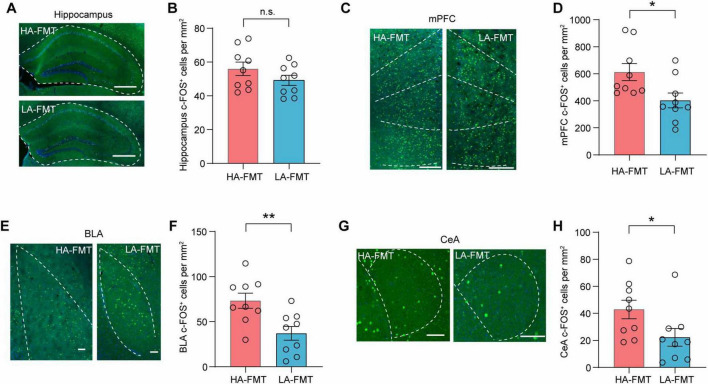
After maze testing, higher-anxiety-donor recipients have more c-FOS markers in medial prefrontal cortex, or mPFC, basolateral amygdala and central amygdala. Hippocampal differences are nonsignificant.
These regions participate in environmental evaluation and choice. Behavioral contrasts accompany a regionally patterned activity-marker distribution, motivating closer examination of mPFC.
Source: Ren J et al. · Frontiers in neuroscience · CC BY
Original figure and English caption ↗
Prefrontal gene expression also differs after transfer
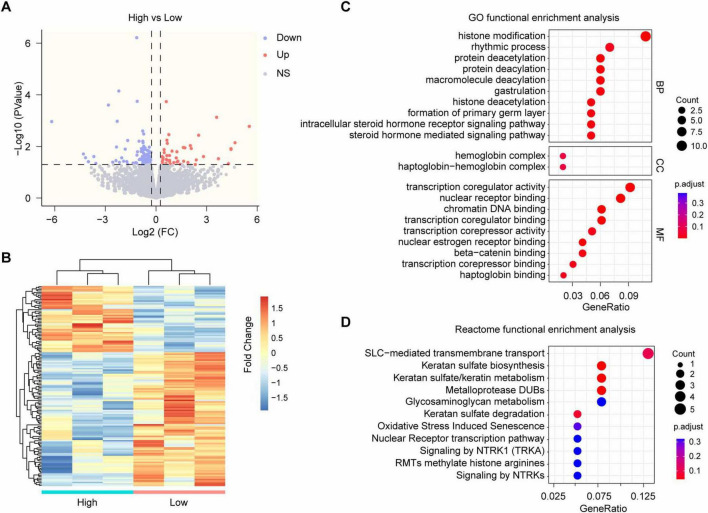
mPFC analysis identifies 139 differentially expressed genes: 46 higher and 93 lower in higher-anxiety-donor recipients. Enriched functions include histone modification, protein acetylation, receptor-associated regulation and transmembrane transport.
The results add molecular differences alongside regional activity. They provide candidate clues to the post-transfer neural environment before the study returns to population responses at the moment of exploration.
Source: Ren J et al. · Frontiers in neuroscience · CC BY
Original figure and English caption ↗
Prefrontal responses stand out during open-arm entry
During closed-to-open transitions, higher-anxiety-donor recipients have larger mPFC calcium peaks. Differences during open-to-closed transitions are nonsignificant, linking neural responses to the direction of environmental transition.
This adult male-mouse study connects community origin, exploratory choice and prefrontal responses. Community contrasts accompany behavioral differences and neural responses at an exploratory transition, specifying donor source, brain region and behavioral timing.
Source: Ren J et al. · Frontiers in neuroscience · CC BY
Original figure and English caption ↗