Approaching and consuming palatable food involve different septal rhythms
Mouse lateral septal Nts-associated cells contain populations with different activity patterns. Seeking versus consuming, and regular versus palatable food, involve different timing and output-related effects.
Approaching food and continuing to eat appear to form one action, but the brain can regulate them differently. A mouse study published in Molecular Psychiatry on August 26, 2022 finds that neurotensin-associated lateral septal cells limit palatable intake while also increasing activity during approach. Single-cell recordings reveal that the population’s rise and fall combines different cellular responses. Downstream connections extend this division to food type and longer-term weight gain.
Approach- and consumption-period activity in septal Nts populations has different effects. TU-associated output preferentially limits palatable intake, GABA and neurotensin contribute conditionally, and chronic activation slows weight gain during high-fat feeding.
Contents · 8 sections
Palatable food recruits activity beyond ordinary feeding
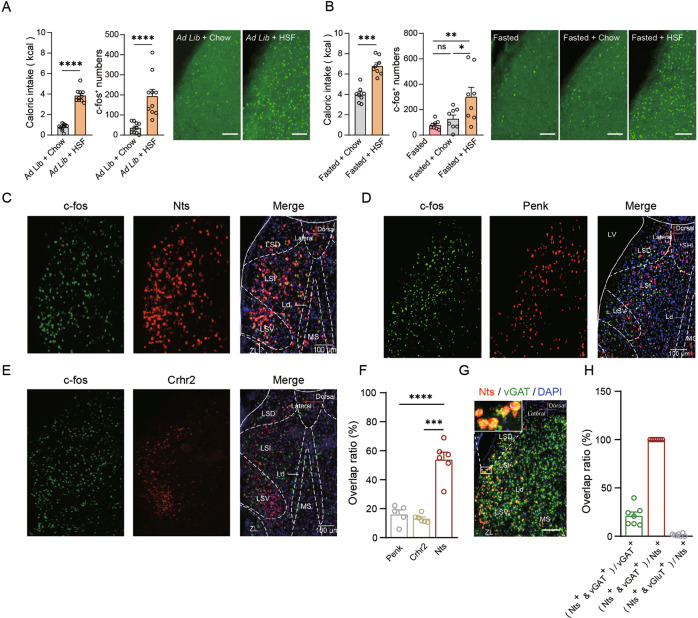
When regular chow is freely available, mice still consume palatable food, accompanied by increased lateral septal activity labeling. Comparing foods reveals stronger LS labeling for high-sucrose food, unlike another sampled thalamic region.
More than half of the activated cells carry an Nts-associated marker, and Nts cells predominantly carry GABA-associated labeling. The study therefore focuses on an inhibitory-transmission-associated population and its contribution to food intake.
Source: Chen Z et al. · Molecular psychiatry · CC BY
Original figure and English caption ↗
Reducing output primarily increases palatable intake
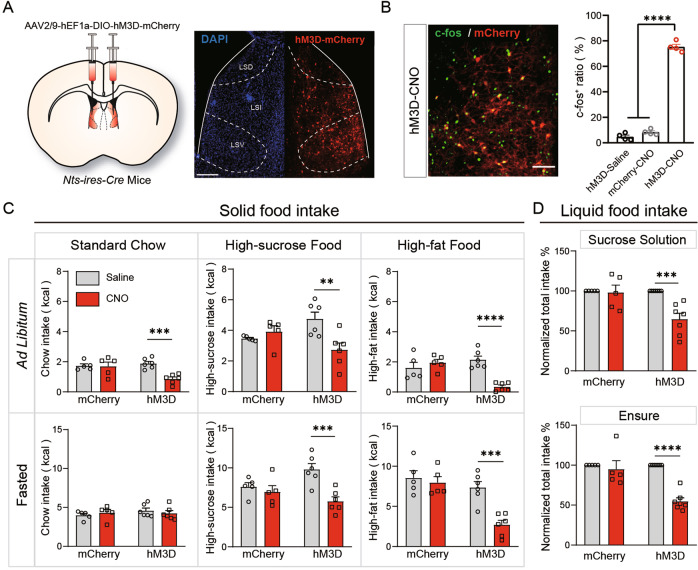
Reducing synaptic output increases high-sucrose, high-fat and palatable-liquid intake in freely fed mice, without significant increases in chow or water. Acute suppression likewise promotes palatable-liquid consumption, supporting an ongoing constraint on intake.
During fasting, output reduction has no significant effect on the tested foods. It increases weight gain with high-fat feeding but not significantly with chow, without significant locomotor or energy-expenditure changes. The effect depends on food and physiological state.
Activation broadens suppression of intake
Activating the Nts-associated population reduces chow, high-sucrose, high-fat and palatable-liquid intake under freely fed conditions. The effect is broader than the food-selective increase produced by output reduction.
During fasting, chow intake does not decline significantly, while palatable intake still falls. Context changes the effect and raises a molecular question: do GABA and neurotensin carried by the population perform the same job?
Source: Chen Z et al. · Molecular psychiatry · CC BY
Original figure and English caption ↗
GABA and the peptide contribute under different conditions
Weakening GABA transmission increases baseline palatable intake without a significant chow effect. Reducing Nts itself does not significantly alter baseline intake, distinguishing the two signals.
During population activation, weakening GABA transmission still permits suppression of both foods. Reducing Nts removes chow suppression while palatable intake still decreases. These results support conditional contributions, while endogenous peptide-release timing remains to be observed directly.
Population activity rises during approach and falls during consumption
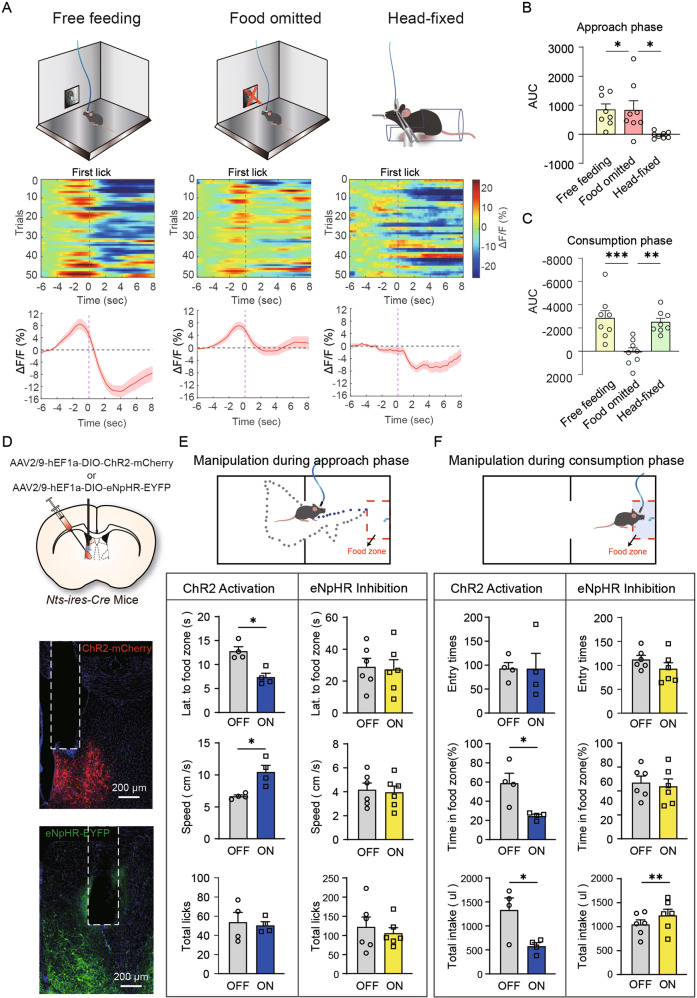
Population calcium rises during approach and falls after consumption begins. Food omission preserves the approach increase but weakens the consumption-related decrease. Feeding without seeking removes the increase while retaining the decrease, separating the phases.
Approach-period activation speeds arrival without significantly increasing intake. Consumption-period activation reduces intake without changing food-zone entries, while suppression during consumption increases intake. Seeking and consuming can therefore be modulated separately.
Source: Chen Z et al. · Molecular psychiatry · CC BY
Original figure and English caption ↗
Single cells reveal distinct response populations
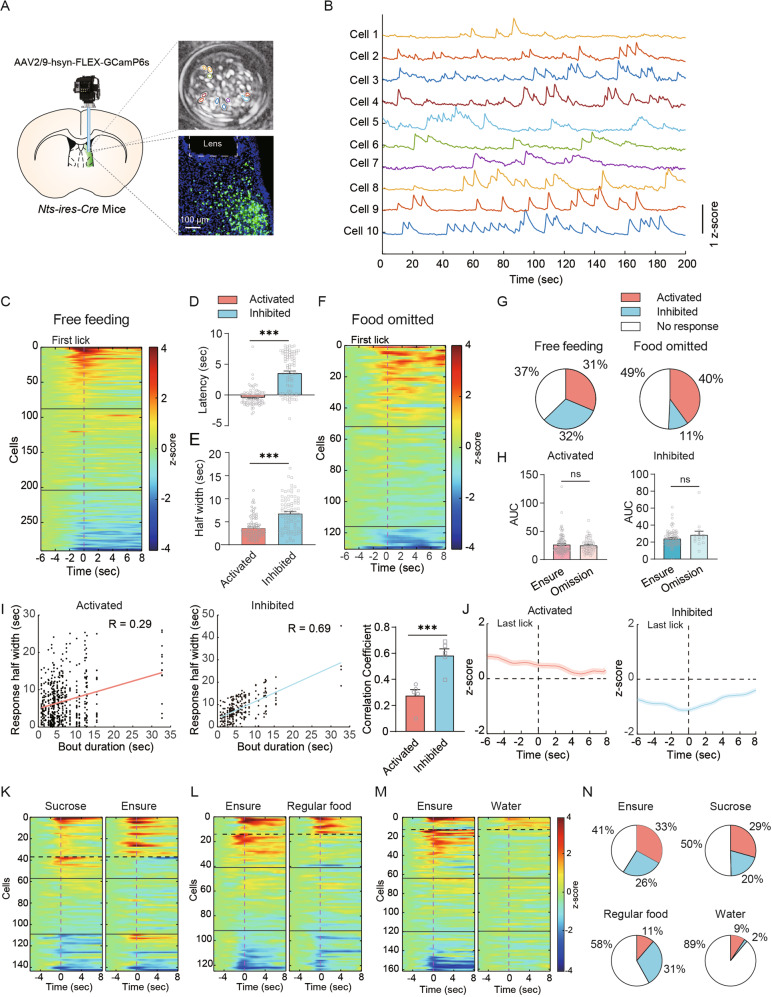
Single-cell recordings show roughly three in ten cells increasing activity around approach and feeding onset, and another three in ten decreasing. Increases are earlier and narrower; decreases are later and broader. Their combination can reproduce the population’s biphasic signal.
Decreasing-response duration tracks consumption bouts more closely and returns toward baseline after the last lick. Food type changes response proportions, with fewer increasing cells for regular food or water. These are activity-defined groups, not established molecular subtypes.
Source: Chen Z et al. · Molecular psychiatry · CC BY
Original figure and English caption ↗
Downstream populations distinguish selective and broader effects
Activating TU-projecting LS cells primarily reduces high-sucrose and high-fat intake without a significant chow effect. Suppressing TU terminals increases palatable-liquid but not regular-food intake. Other projection-associated populations produce broader suppression.
LS input evokes GABA-related inhibitory currents in TU. Another target, SUM, expresses an Nts receptor, and local Nts is sufficient to reduce chow and high-fat intake. These findings link signal and target, while recipient identities and endogenous peptide necessity remain unresolved.
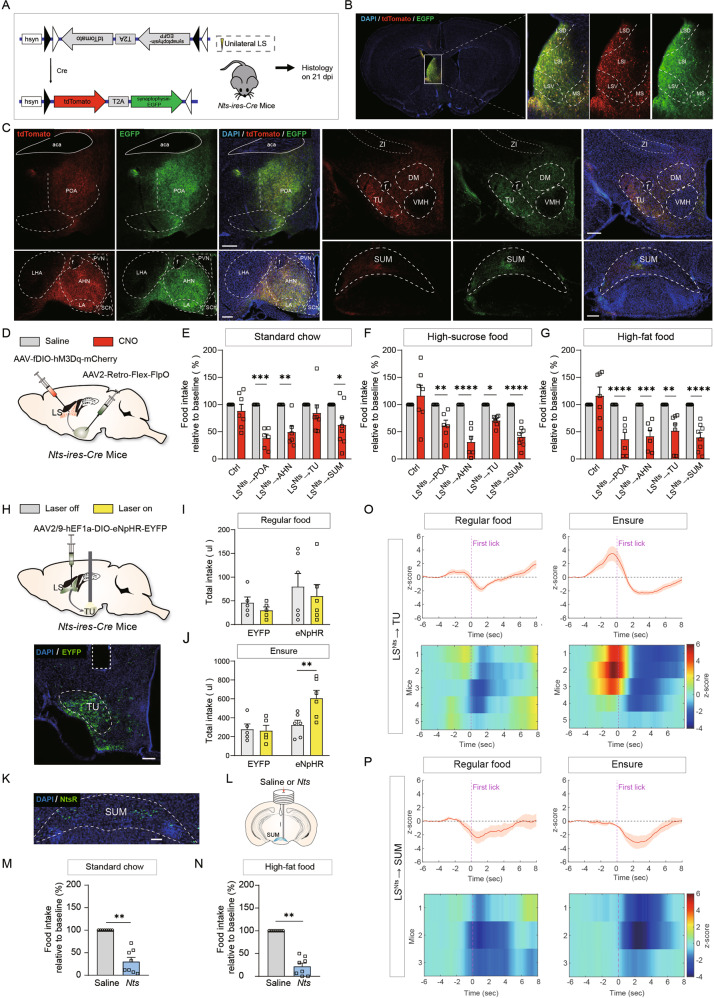
Source: Chen Z et al. · Molecular psychiatry · CC BY
Original figure and English caption ↗
Longer-term observation shows slower weight gain
During high-fat feeding, chronic activation of LS Nts or TU-projecting populations reduces six-week weight gain, while body weight still increases. TU-associated chronic modulation does not significantly change open-field locomotion or center time.
The mouse study separates feeding by phase, food and output. One population can participate in approach while limiting later intake, with different signals and targets refining the division. It provides a circuit account of palatable feeding while leaving the connection between subpopulations and long-term body regulation open.
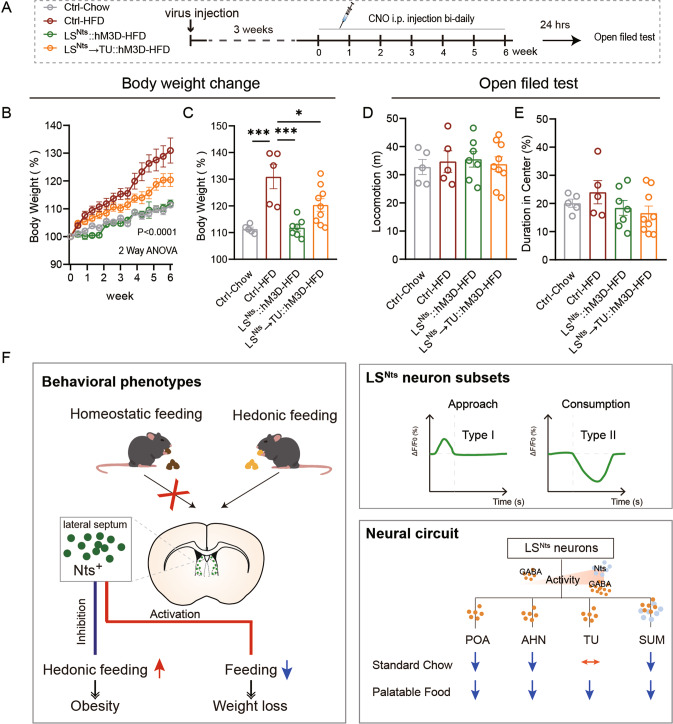
Source: Chen Z et al. · Molecular psychiatry · CC BY
Original figure and English caption ↗