Another role for lateral habenula: contributing to body-temperature regulation
Increasing lateral habenula excitatory-neuron activity raises mouse body temperature, while reducing activity lowers it. Inhibitory input from the preoptic area contributes to the temperature changes.

In the cold, mice recruit heat production to maintain internal temperature. How does the brain contribute? A study in iScience looks beyond familiar hypothalamic temperature-regulating regions to the lateral habenula. This region, associated with affect and motivation among other functions, can alter body temperature through neuronal activity and interacts with inhibitory preoptic input.
Lateral habenula excitatory-neuron activity contributes to temperature increases and maintenance in cold environments. Increasing GABA input from lateral preoptic area lowers temperature, while local receptor blockade weakens this effect.
Contents · 6 sections
Both cold and warmth engage lateral habenula
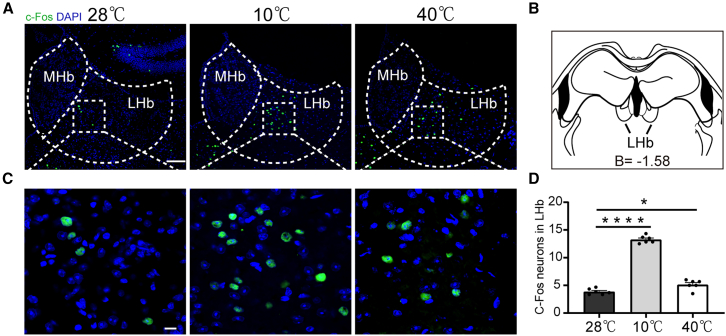
The lateral habenula, or LHb, lies outside the hypothalamus but connects with regions regulating behavior and bodily state. Activity markers increase in both cooler and warmer environments relative to the thermoneutral condition. The cold response is larger, while warmth also produces a significant increase, indicating engagement across temperature states.
Activity markers reveal regional engagement. To examine its contribution to temperature change, the team alters LHb excitatory-neuron activity and observes whether body temperature changes with it.
Source: Wang X et al. · iScience · CC BY-NC-ND
Original figure and English caption ↗
More activity raises temperature, less lowers it
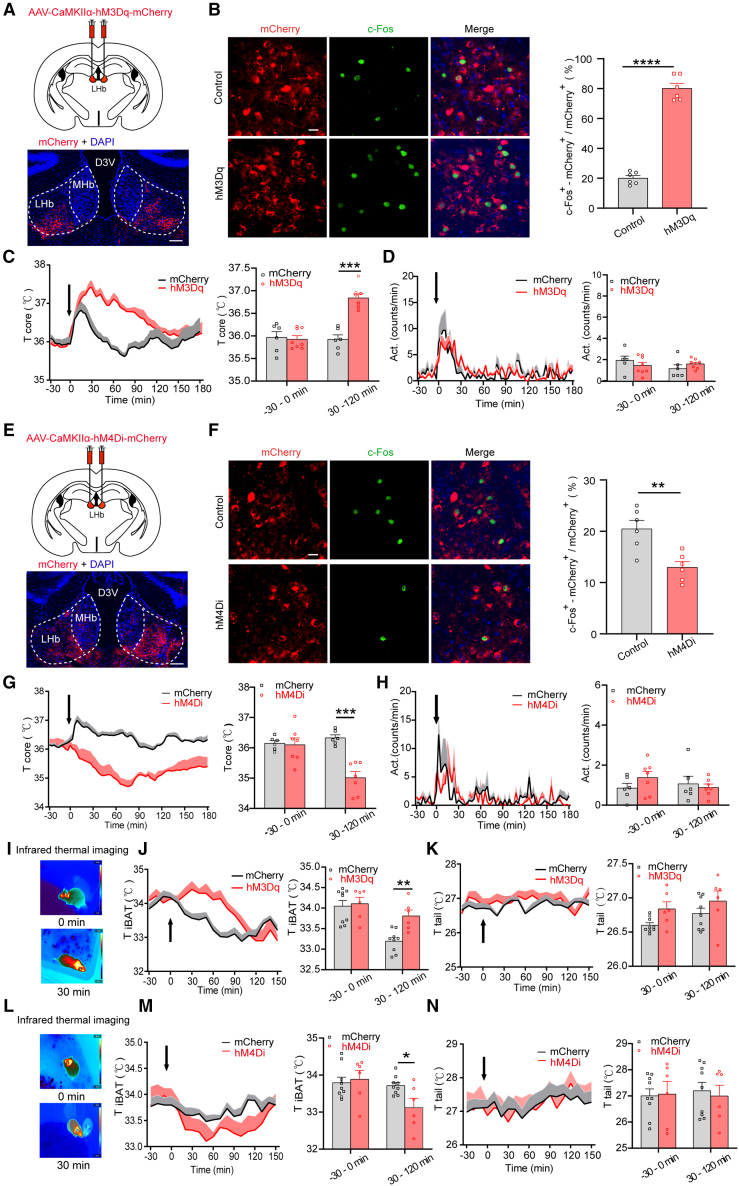
Maintaining temperature involves coordinating heat production and loss. Mouse brown adipose tissue contributes to heat production, while the tail participates in heat loss. The team therefore observes core temperature alongside temperatures over brown adipose tissue and the tail to examine bodily responses to changed neural activity.
Increasing this neuronal population’s activity raises core temperature, whereas reducing activity lowers it. Two different intervention approaches produce the same directions of change. Measured movement activity does not change clearly, so the temperature differences do not accompany a broad change in movement.
Temperature over the brown-adipose region rises and falls in infrared images, while tail temperature does not change significantly. Brown adipose tissue contributes to heat production, linking the neural intervention with a heat-related bodily region. Temperature regulation appears in responses across the body as well as neural activity.
Source: Wang X et al. · iScience · CC BY-NC-ND
Original figure and English caption ↗
Temperature is harder to maintain with reduced function
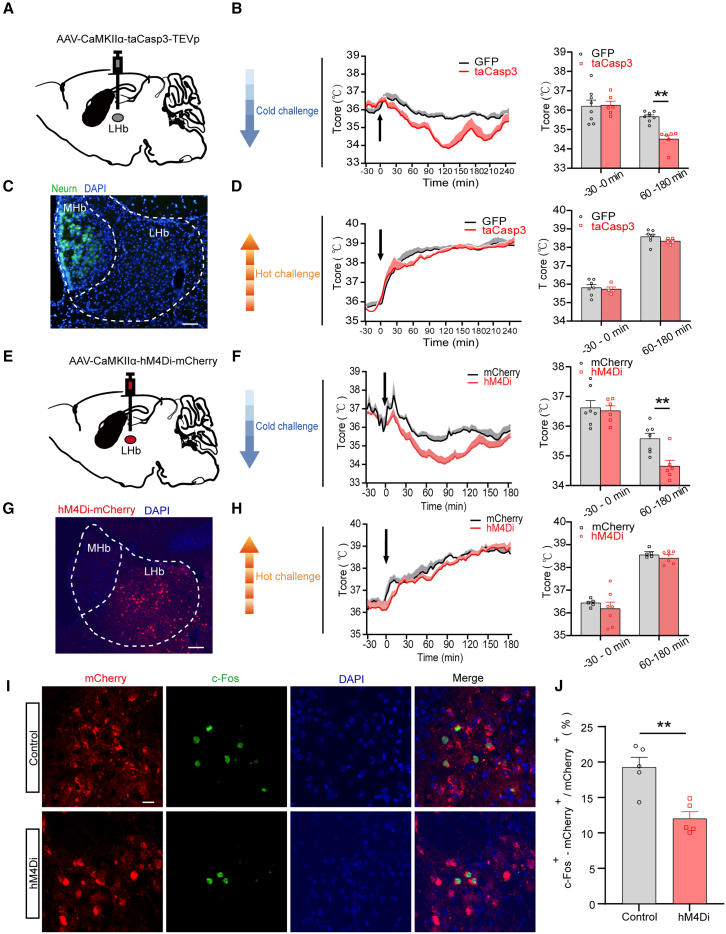
Cold exposure provides a more specific context for this contribution. Removing targeted LHb neurons or reducing their activity produces a greater temperature fall in the cold. The two findings indicate that normal LHb function contributes to maintaining temperature during cold defense.
The warm condition differs: temperature rises in both groups without a significant between-group difference. Although warmth increases LHb activity markers, reduced function does not produce the same temperature separation in this observation. Its contribution depends on the environmental condition.
Source: Wang X et al. · iScience · CC BY-NC-ND
Original figure and English caption ↗
Another temperature-responsive region connects with LHb
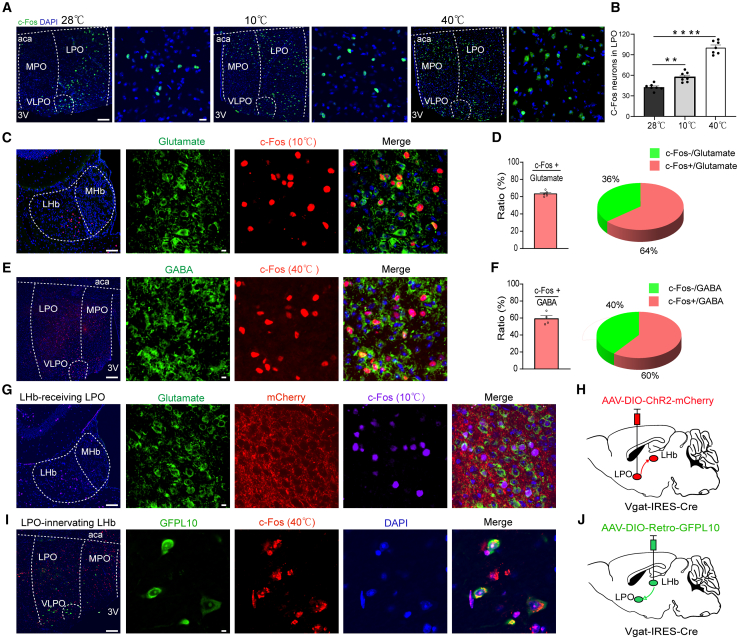
Lateral preoptic area, or LPO, is part of the temperature-regulating network and sends GABA-associated input to LHb. Its activity markers are strongest in warmth and also increase in the cold. Both regions respond to temperature, with different response magnitudes across conditions.
Tissue and tracing observations identify the input more closely. Heat-responsive LPO GABA cells project toward LHb, and LPO fibers are found near cold-responsive LHb excitatory cells. These connections lead to a test of whether the input can change downstream activity.
Source: Wang X et al. · iScience · CC BY-NC-ND
Original figure and English caption ↗
Increasing the input lowers temperature
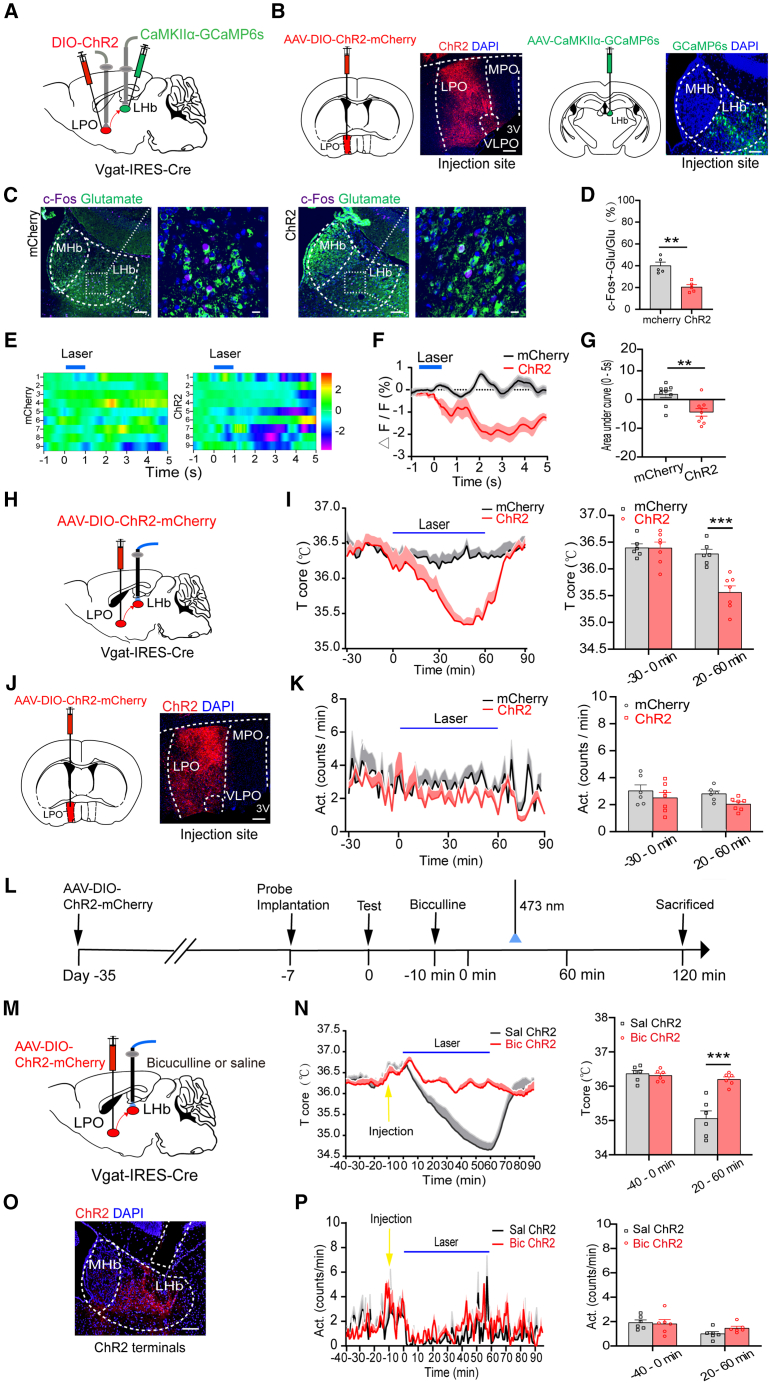
Increasing LPO GABA-neuron activity reduces downstream LHb population calcium responses and activity markers. Increasing their terminal activity in LHb lowers body temperature, while movement remains comparable. Upstream input, downstream response and bodily change are thereby connected.
After reducing local GABA receptor action in LHb, increasing the input no longer produces clear cooling. The result supports an inhibitory contribution to the temperature effect: preoptic input reduces LHb activity and changes body-temperature responses under the studied physiological conditions.
Source: Wang X et al. · iScience · CC BY-NC-ND
Original figure and English caption ↗
Thermoregulation includes a node beyond the hypothalamus
LHb is often studied for affective and motivational functions; this work reveals another contribution to bodily temperature. Its activity can alter core temperature, reduced function compromises cold defense, and inhibitory preoptic input modulates it. Multiple regions participate in a network regulating bodily state.
The study uses young adult mice and examines physiological temperature changes without testing a model of emotional hyperthermia. Its direct finding links a node outside conventional thermoregulatory regions with heat-related bodily responses. Regions within behavioral and affective networks also participate in maintaining the body’s internal environment.