Approach or retreat? Prefrontal β2 receptors influence choices in mice
Enhancing β2-receptor-related signaling in prefrontal excitatory neurons reduces exposed-space exploration and social time in mice; reducing receptor expression shifts behavior in the opposite direction.
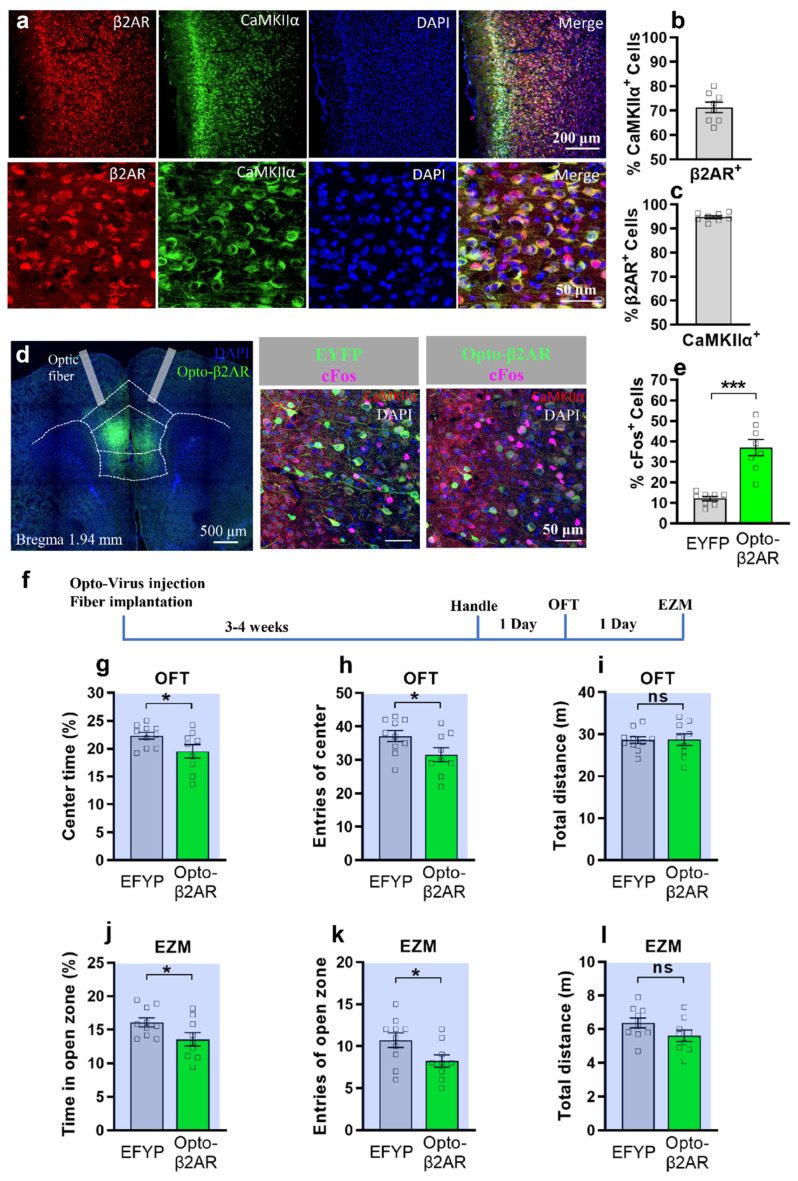
In an unfamiliar environment, will a mouse remain near the edge or enter the center? How long will it stay near a new companion? Such choices depend both on communication between brain regions and on receptors receiving signals at the cell surface. A study published in the International Journal of Molecular Sciences on May 17, 2022 focuses on β2-adrenoceptors in excitatory neurons of the medial prefrontal cortex (mPFC). Enhancing related signaling or reducing receptor expression shifts exploration, feeding latency and social time, adding a cellular perspective on noradrenergic influences on emotion-related behavior.
Optical enhancement of β2-receptor-related signaling reduces center and open-zone exploration; local receptor knockdown produces opposite changes. Total distance is unchanged under both interventions, and social effects prominently involve time spent near another mouse.
Contents · 7 sections
First locate the receptor, then ask what its signal does
Noradrenaline modulates arousal and stress responses, yet a single transmitter acts through multiple receptors and cell types. Increasing or decreasing an entire prefrontal region cannot isolate the receptor signal involved in avoidance. The study therefore focuses on β2 receptors within mPFC excitatory neurons.
Staining shows that most β2-receptor-positive cells also bear CaMKIIα, while nearly all CaMKIIα-positive cells show β2-receptor labeling. A light-sensitive chimeric receptor then permits brief activation of related signaling. Increased c-Fos in labeled cells after illumination indicates a cellular activity response.
Source: Lei Z et al. · International journal of molecular sciences · CC BY
Original figure and English caption ↗
Movement persists, but exposed spaces become less inviting
During optical activation, mice spend less time in the open-field center and enter it less often. In the elevated zero maze, they also spend less time in and make fewer entries into exposed zones. Total distance does not differ significantly in either task, concentrating the change on where the animals go rather than on overall movement.
The avoidance does not automatically persist after illumination. Supplementary tests find no significant group differences in center or open-arm exploration after activation ends. The evidence therefore captures a brief state linking enhanced receptor-related signaling to ongoing avoidance; longer-lasting consequences remain untested.
Food is available, but feeding begins later
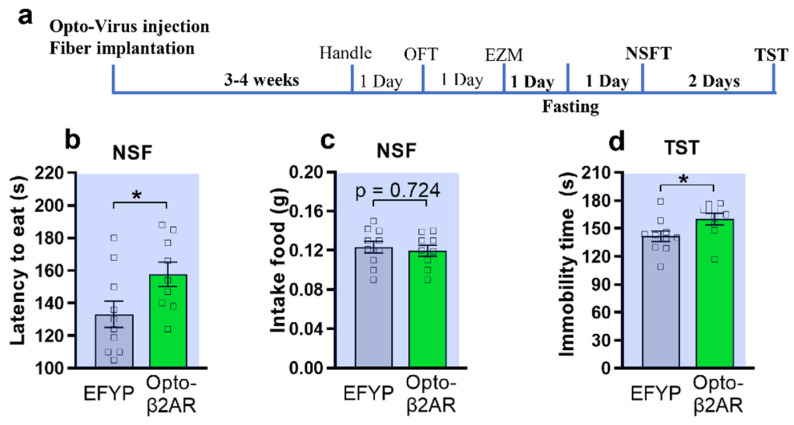
Food in an unfamiliar setting presents a conflict between approaching a resource and avoiding exposure. Enhancing β2-receptor-related signaling prolongs the latency to begin eating, while subsequent food intake in the familiar home cage remains unchanged. The effect is consistent with increased hesitation in the novel context rather than reduced food consumption across settings.
Activation also increases immobility during tail suspension. This extends the behavioral effects to another form of responding, complementing the changes in exploration and avoidance.
Source: Lei Z et al. · International journal of molecular sciences · CC BY
Original figure and English caption ↗
After approaching a companion, does the mouse stay?
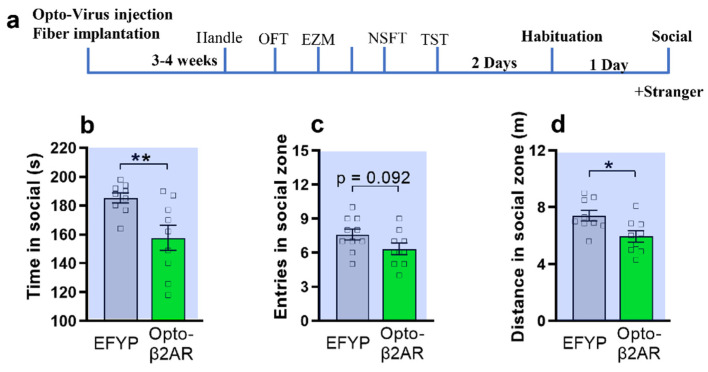
Social testing reveals a finer distinction. Activated mice spend less time near an unfamiliar conspecific and travel less within the social zone, while entry counts do not differ significantly. They still approach but remain for less time. Without a companion present, time spent in the corresponding zone is similar between groups.
This gives reduced social interaction a more specific form: the affected choice includes how long to remain after approaching, rather than simply whether to cross a boundary.
Source: Lei Z et al. · International journal of molecular sciences · CC BY
Original figure and English caption ↗
Reducing receptor expression shifts exploration the other way
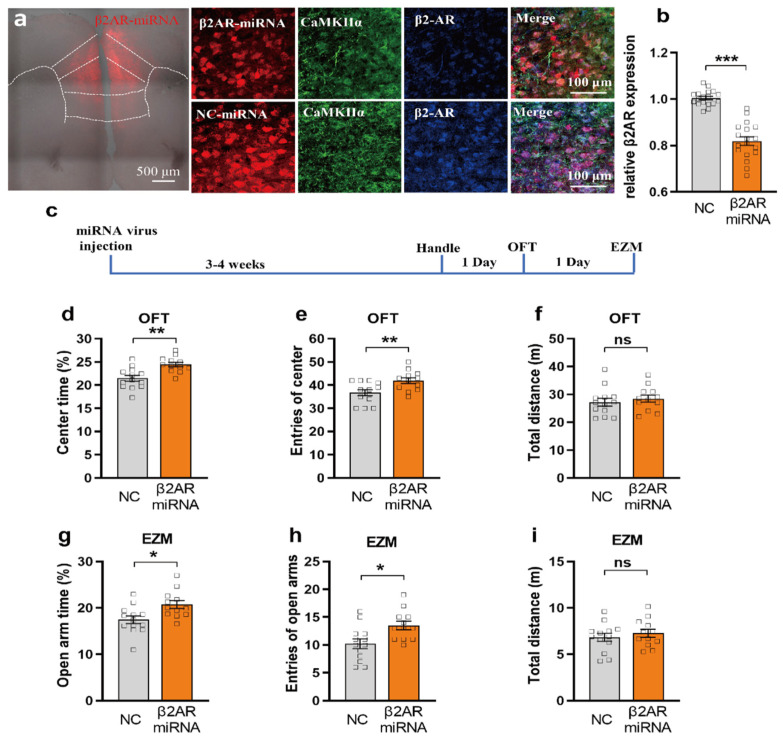
A separate experiment reduces β2-receptor expression in mPFC excitatory neurons. Unlike brief optical activation, this produces a sustained local expression change. Knockdown mice enter the open-field center more often and remain longer; entries and time in exposed zero-maze zones also increase, with total distance unchanged in both tasks.
Source: Lei Z et al. · International journal of molecular sciences · CC BY
Original figure and English caption ↗
Feeding and social time also shift in the opposite direction
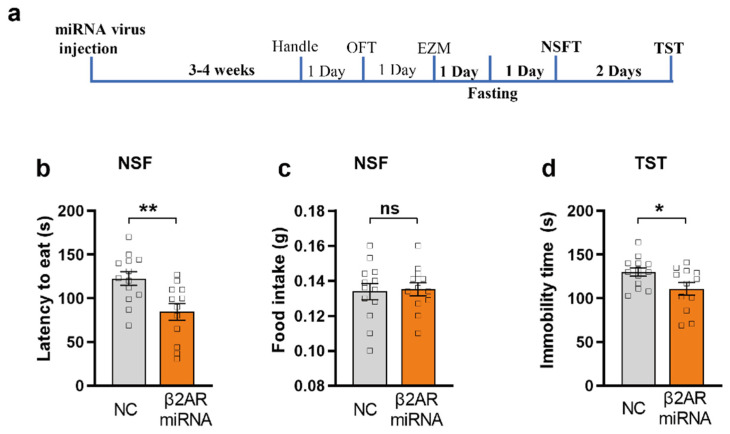
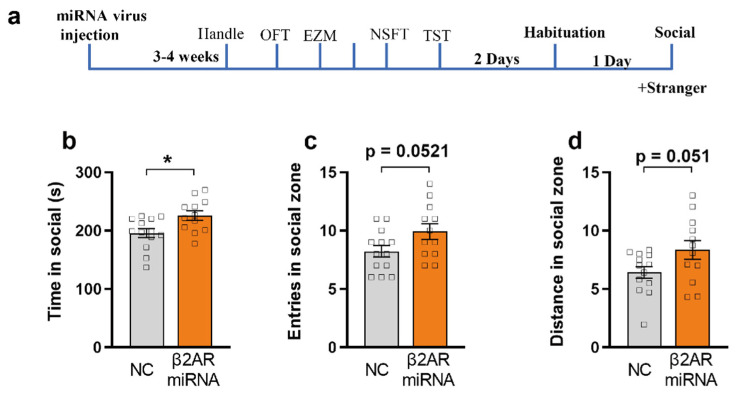
Receptor-knockdown mice begin feeding sooner in the unfamiliar setting, with home-cage intake still unchanged, and show less tail-suspension immobility. They also remain longer near a new companion, without significant changes in entry counts or distance within the social zone. The social effect again prominently concerns time spent near another mouse rather than more entries or movement.
Source: Lei Z et al. · International journal of molecular sciences · CC BY
Original figure and English caption ↗
A receptor’s effects depend on the cells carrying it
These findings in adult male mice link β2 receptors in prefrontal excitatory neurons to behavior and distinguish a local, cell-focused intervention from changes throughout the body. The work covers mPFC territory including PL and IL, without resolving their individual contributions or downstream projections. The light-sensitive chimera also does not reproduce every aspect of native receptor signaling. Prefrontal inhibitory cells also express β2 receptors and were not individually manipulated here; the consequences of signaling through a receptor can depend on its cellular and circuit setting.
Across exposed environments and unfamiliar companions, the recurring theme is the balance between approaching and remaining. The downstream molecular processes and circuits remain to be connected to this cellular contribution.
Source: Lei Z et al. · International journal of molecular sciences · CC BY
Original figure and English caption ↗